UrOops3D, danger-zone atlas

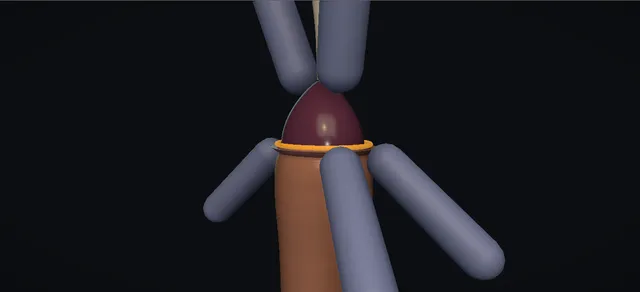
Schematic model.

Operative animation, Acute paraphimosis

Acute paraphimosis: reduction and constriction release

A retracted prepuce that cannot be returned forms a tight band behind the corona; the glans and the inner prepuce in front of it swell, and the swelling tightens the band further.

The band is taken off by compression and manual reduction under a penile block, then by punctures of the swollen collar, and if it still will not pass, by a dorsal slit of the band. The same urgency applies to a ring or a hair strangling the shaft.

Core tier FRCS emergency urology, penile and genital emergencies Interactive 3D

Operative visualisation

Schematic scene preview: Acute paraphimosis
Preparing the 3D anatomy…

UrOops3D · UroRef · © Nity G

How to use this module. Play through the eight steps, or use Back and Next. Watch the amber band behind the corona, the collar shrink under the swab, the thumbs and fingers carry the band over the glans, then punctures and the slit on the branch. The triggers show a ring, a dark glans, a ventral slit and recurrence.

Click me next Section 2 of 8 Anatomy The structures this operation works between, and the one it must not cross.

The structures in the scene

Acute paraphimosis: how the structures relateThe retracted preputial ring behind the corona, and what lies round it. Preputial ring: the constricting band: swells in front of it; punctured if it will not pass Oedematous inner prepuce. Preputial ring: the constricting band: behind the corona; venous return lost first Glans and corona (danger). Preputial ring: the constricting band: under it at 12 o'clock, beneath Buck's fascia Dorsal neurovascular bundle (danger). Preputial ring: the constricting band: ventral; a slit carried round reaches it Urethra at 6 o'clock (danger). Preputial ring: the constricting band: released after a block placed at the base Base of the penis: the block.Preputial ring: theconstricting bandOedematous innerprepuce!Glans and corona!Dorsal neurovascularbundle!Urethra at 6 o'clockBase of the penis:the blockswells in front ofit; punctured if itwill not passbehind the corona;venous return lostfirstunder it at 12o'clock, beneathBuck's fasciaventral; a slitcarried roundreaches itreleased after ablock placed at thebaseTargetDangerLandmarkContext
The retracted preputial ring behind the corona, and what lies round it. Schematic, not to scale; relationships only.
  • With the patient supine and the penis held up, 12 o'clock is the dorsum.
  • From the tip back: the swollen glans, the coronal sulcus, the collar of everted inner prepuce, then the band, and behind it the outer prepuce running on as shaft skin to the base.
  • Under the skin lies Buck's fascia with the dorsal neurovascular bundle at 12 o'clock; the urethra runs ventrally at 6 o'clock.
  • ›Preputial ring - the narrow orifice of the prepuce; retracted behind the corona it becomes the constricting band.
  • ›Inner prepuce - everted in front of the band and swollen into a collar; the site of the punctures.
  • ›Glans - swells and turns dusky while the band is on; its colour and capillary return are the test of viability.
  • ›Coronal sulcus and corona - the band sits on the sulcus; the corona is the widest point it must pass on reduction.
  • ›Frenulum and ventral urethra - ventral, under the swelling; kept out of every puncture and every cut.
  • ›Buck's fascia - the layer under the shaft skin and dartos; the dorsal slit stays superficial to it.
  • ›Dorsal neurovascular bundle - the deep dorsal vein, the paired dorsal arteries and nerves under Buck's fascia at 12 o'clock.
  • ›Base of the penis - where the penile block is placed, at 2 and at 10 o'clock and round the base.
  • ›Urethral meatus - where the catheter that so often causes this lies; voiding is checked after release.
Click me next Section 3 of 8 Steps The operation in order, with the landmark that guards each move.

Operative steps

  1. Assess the constriction The prepuce has been retracted and its narrow ring is stuck behind the corona as a tight band. In front of it the everted inner prepuce forms a swollen collar and the glans is swollen and dusky. The colour, warmth and sensation of the glans are checked, whether he can pass urine, and how long it has been. A catheter left in with the foreskin retracted is a common cause and is noted.
    where it bites: the band itself; the glans and urethra lie beneath swollen tissue that hides how tight it is.
  2. Penile block A penile block is given at the base of the penis: the needle goes in at 2 and at 10 o'clock, beside the dorsal neurovascular bundle, with a ring of infiltration round the base, and the block is given time to work. A child may need sedation or a general anaesthetic instead. Reduction is painful and an attempt without analgesia often fails.
    where it bites: the dorsal vessels and nerves at the base; the needle stays out of the corpora.
  3. Sustained compression The glans and the swollen collar are wrapped in a swab and squeezed steadily in the hand, for several minutes rather than seconds. The pressure drives the oedema fluid back past the band and the collar visibly shrinks. A cold pack over the swab, or an elastic wrap, are alternatives to the hand.
    where it bites: the swollen glans: steady pressure, not a twisting grip that tears the inner prepuce.
  4. Manual reduction Both thumbs are placed on the glans and push it back through the band, while the index and middle fingers of each hand sit behind the band and draw it forward over the corona. The movement is slow and continuous. Once the band has passed, the prepuce lies forward over the glans and the colour of the glans returns.
    where it bites: the corona is the widest point; forcing the band there tears the inner prepuce.
  5. When it will not pass: punctures If the band will not pass, the swollen collar in front of it is punctured many times with a fine needle under clean conditions, away from the dorsal midline and the frenulum. Gentle pressure then expresses the oedema fluid through the punctures, the collar shrinks, and manual reduction is tried again.
    where it bites: the glans and the urethra beneath: the needle goes into the swollen prepuce only.
  6. Dorsal slit of the band If reduction still fails, the band is divided. Under local anaesthetic infiltrated into the band at 12 o'clock, a straight clamp crushes it for a short time and it is incised longitudinally along the crush, through skin and band only. The band springs open into a diamond and the prepuce can then be brought forward over the glans.
    where it bites: the dorsal neurovascular bundle under Buck's fascia; the incision stays at 12 o'clock and never turns ventrally toward the urethra.
  7. Reassess viability With the band off, the glans pinks up and its capillary return is checked by pressing it and watching the colour come back. Voiding, the shaft skin and any bleeding from the slit edges are reassessed. A glans that stays dark or cold after decompression needs a senior opinion at once.
    where it bites: a dark glans after release; viability is judged only once the constriction is off.
  8. Dressing and the plan A light dressing is placed on the slit edges, which may be closed with a few absorbable sutures. He is shown how to return the foreskin after washing and after any catheter care. A circumcision is offered as a planned operation once the swelling and the slit have settled, because the narrow ring that caused this remains.
    where it bites: a catheterised patient: the foreskin is returned over the glans after every catheter care.
Click me next Section 4 of 8 Danger zones Where this operation bites, and why it bites there.
Critical relationship

Danger zones

The spatial relationships the animation is built to make automatic. Before you read each one, ask yourself: at this point in the operation, what is about to go wrong, and what is my first move? The save for each sits in the Complications tab.

  • RiskGlans and urethra beneath oedematous tissue - the swelling hides how deep the band sits and where the urethra is; punctures and cuts go into the prepuce only.
  • RiskDorsal neurovascular structures - under Buck's fascia at 12 o'clock, beneath the dorsal slit and beside the block needle at the base.
  • RiskThe urethra at 6 o'clock - a slit carried off the dorsal midline toward the ventral side enters it.
  • RiskSkin exposed to heat or cutting equipment - a ring cutter heats metal and can cut skin; a guard goes under the ring and the metal is cooled with saline.
  • RiskThe glans that has waited too long - delay turns oedema into ischaemia; release comes before every other consideration.
Practise it Take me into the scene Opens the animation at a danger moment and asks you to predict the mechanism and your first move before it reveals.
Click me next Section 5 of 8 Complications The save for each one: the first move, the escalation trigger, the op-note line.

Complications and immediate saves

Trigger each of these live in the Animation tab, then read the save: the first move, the escalation trigger, and the line that goes in the op note.

Ring or hair tourniquet

  • a metal or other ring at the base, or in a child a hair or thread buried in the sulcus, strangles the shaft in the same way; the swelling can hide a hair entirely.
The save
  1. Find the constriction: examine the base and, in a child with a swollen penis, look closely in the sulcus for a hair or thread. first move
  2. A ring: lubricate and try the string method, or cut it with a ring cutter over a guard, cooling the metal with saline; a hardened ring needs a heavier cutter.
  3. A hair or thread: divide it completely under magnification, often under anaesthetic in a child, and make sure no strand remains.
  4. A ring that cannot be removed with the tools to hand, a hair cut into the skin, or any sign of urethral injury: senior urology help now. escalation trigger
  5. Check the urethra: urine passes from the meatus and not from the groove; a catheter or a urethrogram if in doubt.
  6. Note the object, how long it was on, the method of removal, the state of the skin, glans and urethra afterwards, and any safeguarding concern in a child. document

Glans ischaemia

  • the band has been left too long: the glans is dark and cold and its capillary return is absent.
  • Swelling has turned into ischaemia.
The save
  1. Release the band now, by reduction or by a dorsal slit, without waiting for a theatre slot. first move
  2. Reassess the colour and capillary return of the glans once the constriction is off.
  3. A glans that stays dark after release: senior urology review the same day. escalation trigger
  4. Keep the area clean and dry and review it daily; demarcation is allowed to declare itself before anything is debrided.
  5. Note the duration, the colour before and after release and the plan for review. document

Urethral injury from the slit

  • the incision has wandered off 12 o'clock round onto the ventral side, or been carried deep, and opened the urethra; urine leaks from the wound.
The save
  1. Stop cutting and look: urine or a catheter visible in the wound confirms it. first move
  2. Pass a urethral catheter gently, if it goes, to divert the urine and to splint the urethra.
  3. Senior urology help now: the injury is repaired formally in theatre, not closed blindly in the emergency department. escalation trigger
  4. Note where the incision ran, the size of the opening and what was done; the patient is told. document

Recurrence

  • the prepuce is retracted and stuck again, weeks or months later, because the narrow ring that caused it is still there; after a dorsal slit, the healed notch shows in its dorsum.
The save
  1. Treat the episode as before: analgesia, compression and manual reduction. first move
  2. Teach the patient, or the carers, to return the foreskin after washing, after intercourse and after any catheter care.
  3. Recurrent episodes, or a ring that will not reduce: refer for circumcision. escalation trigger
  4. Note the number of episodes and the advice given. document
Click me next Section 6 of 8 Troubleshooting When the case turns: the problem, then the next move.

Intra-operative troubleshooting

When the case turns: the problem, then the next move.

  • ActionThe child will not tolerate an attempt - sedation or a general anaesthetic; a forced attempt on a frightened child rarely succeeds and makes the next one harder.
  • ActionThe swelling is too tense to compress - punctures first, then compression; the fluid has somewhere to go.
  • ActionA catheter is in place - the catheter can stay; after reduction the foreskin is returned after every catheter care, and the nursing plan says so.
  • ActionBleeding from the slit edges - pressure first; a few absorbable sutures to the edges if it persists. A haematoma that grows needs review.
  • ActionWhether to circumcise on the day - an emergency circumcision is an option for some surgeons; in this module the slit is the emergency operation and the circumcision is planned once the swelling has settled.
Click me next Section 7 of 8 FRCS viva Say it out loud, then mark yourself against the model answer.

FRCS viva questions

The examiner stems this scene prepares you for. Try to answer out loud first, then reveal, and learn the discriminator, the detail that turns a pass into a strong pass.

QA man on the ward has a swollen, painful glans with the foreskin stuck behind it. He had a catheter placed two days ago. What is happening, and why does it get worse?reveal answer
  • This is paraphimosis.
  • The prepuce has been retracted, here most likely at catheter insertion or catheter care, and not returned.
  • Its narrow ring now sits behind the corona as a constricting band.
  • The band obstructs venous and lymphatic return first, because those vessels are low pressure; arterial inflow continues, so the glans and the everted inner prepuce in front of the band swell.
  • That swelling tightens the band further, which is why it is self-perpetuating and an emergency.
  • If it is left, the venous congestion progresses to arterial compromise and ischaemia of the prepuce and then of the glans.
  • The EAU paediatric guideline describes it the same way and calls it a medical emergency requiring urgent treatment.
  • I would treat it as preventable: the commonest avoidable cause in adults is a foreskin left retracted after catheterisation or examination, and the prevention is simply to return it.
Strong pass

Say all three

  • Explaining that low-pressure venous and lymphatic return is lost first
  • So the oedema is what makes it worse
  • Naming the retained retraction after catheterisation as the avoidable cause
Examiner note
Explaining that low-pressure venous and lymphatic return is lost first, so the oedema is what makes it worse, and naming the retained retraction after catheterisation as the avoidable cause.
QHow would you reduce it?reveal answer
  • I would explain to him what I am going to do and give analgesia, a penile block at the base, waiting for it to work.
  • I would then compress the glans and the swollen collar steadily, wrapped in a swab, for several minutes, to drive the oedema back past the band.
  • For the reduction itself I place both thumbs on the glans and push it back while the index and middle fingers of both hands, behind the band, draw it forward over the corona, slowly and continuously.
  • If it will not pass, I would puncture the swollen collar many times with a fine needle, which is the Dundee technique described by Reynard and Barua, express the fluid and try again.
  • If that fails, the EAU guideline says a dorsal incision of the constrictive ring is required: under local anaesthetic I crush the band at 12 o'clock and divide it, skin and band only, and then bring the prepuce forward.
  • The evidence is a narrative one: these are described techniques and case series, not trials.
  • Afterwards I check the colour and capillary return of the glans and that he can void.
Strong pass

Say both

  • A stepwise escalation from compression to punctures to a dorsal slit
  • With analgesia first and reassessment of the glans last
Examiner note
A stepwise escalation from compression to punctures to a dorsal slit, with analgesia first and reassessment of the glans last.
QYou have reduced it. What do you tell him, and when would you circumcise?reveal answer
  • I would tell him that the narrow ring that caused this is still there, so it may happen again, and show him how to return the foreskin after washing and after intercourse.
  • While the catheter is in, the nursing plan must say that the foreskin is returned after every catheter care.
  • If I needed a dorsal slit, the edges are dressed, and the result is a split prepuce that some men accept and many do not.
  • The EAU guideline recommends additional treatment after the acute episode to correct whatever anomaly increases the chance of recurrence.
  • In practice I would offer a circumcision as a planned operation once the swelling and any slit have settled, usually some weeks later, rather than through oedematous tissue on the night.
  • Some surgeons do circumcise as the emergency operation; I would choose the slit for the emergency and plan the circumcision.
Strong pass

Say both

  • Planning definitive treatment of the cause after the swelling has settled
  • Making the prevention part of the catheter care plan
Examiner note
Planning definitive treatment of the cause after the swelling has settled, and making the prevention part of the catheter care plan.
QA man presents with a swollen penis and a metal ring at its base. A mother brings a toddler with a red, swollen penis and no obvious cause. How do these differ from paraphimosis?reveal answer
  • Both are strangulation by an external band, and the physiology is the same: venous and lymphatic return go first, then the arterial supply.
  • The difference is that the band is not the prepuce, so reduction of the foreskin will not help.
  • In the man the ring is obvious.
  • I would lubricate and try the string method, and if that fails cut the ring with a ring cutter over a guard, cooling the metal with saline, calling for heavier equipment if needed.
  • Silberstein and colleagues found that metal rings are the commonest reported devices, that non-metallic ones caused the higher-grade injuries, and that patients who present after 72 hours sustain higher-grade injuries.
  • In the toddler I would look hard in the coronal sulcus for a hair or a thread, which the swelling can bury.
  • In the series of Badawy and colleagues, 25 boys were operated on and 18 had complete transection of the urethra at the coronal sulcus.
  • So after any removal I check the urethra, and in a child I think about safeguarding.
Strong pass

Say both

  • Looking for a hair in the sulcus of a swollen child's penis
  • Checking the urethra after every constriction is removed
Examiner note
Looking for a hair in the sulcus of a swollen child's penis, and checking the urethra after every constriction is removed.
Click me next Section 8 of 8 Evidence The guidance each of these answers is built on.

Evidence and guidance

Operative Dictations in Urologic Surgery
Armenakas NA, Fracchia JA, Golan R. Circumcision. Chapter 23. Wiley, 2019
The book has no chapter on paraphimosis or penile constriction. From the circumcision chapter: the dorsal slit variation, a straight clamp placed beneath the foreskin and the foreskin incised taking care not to injure the glans, and a penile block injected circumferentially in the proximal shaft. Everything else on this page comes from the sources below or is general UK emergency practice: the puncture step, the danger lines, the first, escalate and document lines, the timing of the circumcision, and every save for the ring, the ischaemic glans, the urethral injury and recurrence. The scene is schematic: the swab, the clamp and the hands are drawn at the scale of the field, and the ring complication is a still state.
Open guideline
European Association of Urology
EAU Guidelines on Paediatric Urology 2026: Phimosis and other abnormalities of the penile skin, read 18 October 2026
The foreskin has been retracted and cannot be brought back; the narrow ring may constrict the shaft at the sulcus, causing oedema of the glans and retracted foreskin; impaired perfusion may lead to necrosis of the prepuce and then the glans; a medical emergency requiring urgent treatment. Treatment is manual compression of the oedematous tissue then an attempt to bring the foreskin forward; if this fails, a dorsal incision of the constrictive ring is required. Additional treatment afterwards to correct anomalies that increase recurrence. Recommendation (strong): treat by manual reposition and, if this fails, proceed to surgery. The guideline does not set a time for circumcision.
Open guideline
NHS
Phimosis and paraphimosis (nhs.uk), read 18 October 2026
The patient-facing page: a foreskin stuck after being pulled back, a very swollen and painful end of the penis, a medical emergency; call 999 or go to A&E; immediate treatment to avoid restricted blood flow; the foreskin may be returned by a doctor and a circumcision may be recommended.
Open guideline
American Family Physician
Choe JM. Paraphimosis: current treatment options. Am Fam Physician 2000;62:2623-2628
Abstract read 18 October 2026. A urologic emergency in uncircumcised males in which the foreskin is trapped behind the corona as a tight band; often iatrogenic, and prevented by returning the prepuce after penile manipulation; treatment begins with reduction of oedema, then mechanical compression, pharmacological methods, the puncture technique and the dorsal slit. The page leaves out the pharmacological methods.
Open guideline
BJU International
Reynard JM, Barua JM. Reduction of paraphimosis the simple way: the Dundee technique. BJU Int 1999;83:859-860
Cited for the name and the method of multiple punctures of the oedematous prepuce. No abstract is indexed and the full text was not available on 18 October 2026; the description of the method on this page is taken from the Choe review and general practice, not from this paper.
Open guideline
Journal of Sexual Medicine
Silberstein J, Grabowski J, Lakin C, Goldstein I. Penile constriction devices: case report, review of the literature, and recommendations for extrication. J Sex Med 2008;5:1747-1757
Abstract read 18 October 2026. A review of the English literature since 1970: metal rings are the most commonly reported devices; non-metallic objects more often cause higher-grade injuries; patients presenting after 72 hours are more likely to sustain higher-grade injuries; the method of removal depends on the device, the time on and the tools available, and often needs a multidisciplinary approach.
Open guideline
Journal of Pediatric Surgery
Badawy H, Soliman A, Ouf A, Hammad A, Orabi S, Hanno A. Progressive hair coil penile tourniquet syndrome: multicenter experience with 25 cases. J Pediatr Surg 2010;45:1514-1518
Abstract read 18 October 2026. Twenty-five boys, 2 to 5 years, operated on in two centres in Alexandria: 18 with complete and 7 with partial transection of the urethra at the coronal sulcus; single-stage repair; 2 fistulas and 2 strictures at a mean follow-up of 20.7 months.
Open guideline

Curriculum. Supports learning relevant to the ISCP Urology Curriculum syllabus topics Urological emergencies and Genitourinary trauma. Not a workplace-based assessment and not evidence of competence.

Two minutes

Close the lap: recall it before you leave.

Say it aloud, then reveal. Reading is not remembering.

  1. 01 The relationship Say the critical spatial relationship out loud, then reveal. reveal
    Memory frame

    With the patient supine and the penis held up, 12 o'clock is the dorsum.

    Why?
    From the tip back: the swollen glans, the coronal sulcus, the collar of everted inner prepuce, then the band, and behind it the outer prepuce running on as shaft skin to the base. Under the skin lies Buck's fascia with the dorsal neurovascular bundle at 12 o'clock; the urethra runs ventrally at 6 o'clock.
  2. 02 The first move Ring or hair tourniquet. Your first move? reveal
    First move

    Find the constriction: examine the base and, in a child with a swollen penis, look closely in the sulcus for a hair or thread.

  3. 03 The escalation trigger Ring or hair tourniquet. What makes you call for help? reveal
    Escalate when

    A ring that cannot be removed with the tools to hand, a hair cut into the skin, or any sign of urethral injury: senior urology help now.

  4. 04 The discriminator What turns a pass into a strong pass? reveal
    Strong pass

    Say all three

    • Explaining that low-pressure venous and lymphatic return is lost first
    • So the oedema is what makes it worse
    • Naming the retained retraction after catheterisation as the avoidable cause
    Examiner note
    Explaining that low-pressure venous and lymphatic return is lost first, so the oedema is what makes it worse, and naming the retained retraction after catheterisation as the avoidable cause.
  5. 05 The pitfall Where does this operation bite first? reveal
    Pitfall

    Glans and urethra beneath oedematous tissue

    Why?
    the swelling hides how deep the band sits and where the urethra is; punctures and cuts go into the prepuce only.

Revision practice with self-marked answers, not an assessment of clinical competence. Kept in this browser only; it does not sync between devices.