Operative Dictations in Urologic Surgery
Armenakas NA, Fracchia JA, Golan R. Male urethral sling. Chapter 62. Wiley, 2019
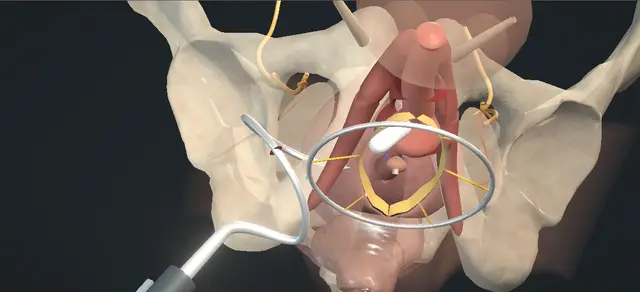
The indication (mild to moderate stress incontinence), the eight essential steps and their order, the template dictation followed step by step here, the variations (the distal ends tunnelled back into the perineal incision and sutured together; bone-anchored and quadratic fixation devices) and the complication list: bleeding, urinary retention, infection, perineal pain, neuropraxia, persistent or worsening incontinence, erosion. The chapter names the layer perforated before the tip emerges the endopelvic fascia; the text here says the fascia, and the model shows the obturator membrane across the foramen. The chapter lists complications without their management: the first, escalate and document steps, the troubleshooting lines on a tip that does not appear and on an obstructed urethra, and the danger lines not traceable to the dictation are general surgical practice. The model is schematic. The device is generic and the passer is a helix fitted to this pelvis; the stab lies further below the adductor tendon than in life; the bulb is drawn a short way; each tail is shown trimmed at the skin because the chapter does not say how the arms end; and the cystoscopy is drawn from outside, with the near half of the urethra taken away.
Open guideline
EAU Guidelines
Management of Non-neurogenic Male Lower Urinary Tract Symptoms, 2026: Disease management, section 5.6.5 Surgical treatment for stress urinary incontinence (5.6.5.b male slings, 5.6.5.c.1 artificial urinary sphincter), read 13 October 2026
Synthetic slings restore continence by urethral compression, by repositioning the bulb of the urethra, or both. Offer non-adjustable transobturator slings to men with mild to moderate post-prostatectomy stress incontinence (weak); the terms mild and moderate are not defined. Inform men that severe incontinence, earlier pelvic radiotherapy or transurethral surgery may worsen outcomes (weak). A systematic review and meta-analysis of 1,170 men found prior radiation, severity of incontinence and previous surgery to predict failure. The most common complications are pain and superficial wound infection; transient voiding dysfunction in 4.3 to 10.3%, mostly de novo urgency or retention; erosion and chronic pain uncommon (0 to 0.4%). The artificial urinary sphincter is the standard treatment for moderate to severe male stress incontinence (strong). No evidence that adjustability offers additional benefit over other slings.
Open guideline
European Urology
Rehder P, Gozzi C. Transobturator sling suspension for male urinary incontinence including post-radical prostatectomy. Eur Urol 2007;52:860-866
Abstract read 13 October 2026. A cadaver study and a pilot series of 20 men, 15 of them after radical prostatectomy. In the five men measured before and after, membranous urethral length rose from a mean of 3 mm (range 0 to 7) to 17.2 mm (10 to 22) once the tape was tensioned, and urethral closure pressure rose; maximum flow rate did not change significantly; 40% used no pads afterwards and 30% one or two a day. Used here for the mechanism only.
Open guideline
European Urology
Rehder P, Haab F, Cornu JN, Gozzi C, Bauer RM. Treatment of postprostatectomy male urinary incontinence with the transobturator retroluminal repositioning sling suspension: 3-year follow-up. Eur Urol 2012;62:140-145
Abstract read 13 October 2026. A prospective series from three European centres: 156 men, a single sling design, no comparator group. Cured or improved: 76.9% at 12 months and 76.8% at three years. Cure in 58.6% with mild or moderate against 42.3% with severe incontinence; pad use before treatment was the independent predictor of success. No perioperative or severe postoperative complications; seven men needed a second procedure for stress incontinence.
Open guideline