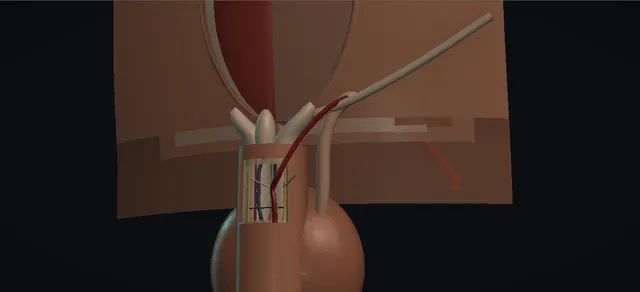
Book, chapter 27
Armenakas NA, Fracchia JA, Golan R. Operative Dictations in Urologic Surgery, first edition. Wiley, 2019. Chapter 27, Penile Arterial Revascularization, printed pages 109 to 111
Indication (erectile dysfunction from isolated occlusion of the internal pudendal artery, for example after pelvic trauma), the six essential steps, the variations (Michel, Virag, Crespo, Hauri and Goldstein procedures; paramedian or transverse abdominal incision; penoscrotal approach; end-to-end anastomosis; Doppler confirmation), the complication list, and the template dictation: a 16 Fr urethral catheter, the left or right rectus retracted with padded Richardson retractors, branches clipped with titanium clips or 4-0 silk ties, 3000 units of intravenous heparin, a 5 cm dorsal incision at the base of the penis, the dorsal artery mobilised for about 3 cm, a 3 mm anterior arteriotomy between two microvascular clamps, topical papaverine, interrupted or two running 10-0 polypropylene or nylon sutures, dartos closed with 3-0 polyglactin and skin with subcuticular 4-0 poliglecaprone, rectus with 2-0 chromic and aponeurosis with 1-0 polydioxanone. These figures are book figures and appear nowhere else on this page.
Open guideline
EAU Guidelines
Sexual and Reproductive Health: management of erectile dysfunction, sections 5.6.11.a (surgery for post-traumatic arteriogenic erectile dysfunction in young men), 5.5.4 (pudendal arteriography only in revascularisation candidates) and 5.6.11.b (venous ligation no longer recommended)
Surgery for arteriogenic erectile dysfunction is reserved for young men with pelvic or perineal trauma and a stenosis confirmed on pharmaco-arteriography; veno-occlusive dysfunction is a contraindication. Read 8 October 2026; the fetched text was truncated and the selection wording is to be confirmed against the full guideline; no graded recommendation on revascularisation was found.
Open guideline