UrOops3D, danger-zone atlas

Schematic model.

Operative animation, Vasectomy

Vasectomy: no-scalpel access, clips and fascial interposition

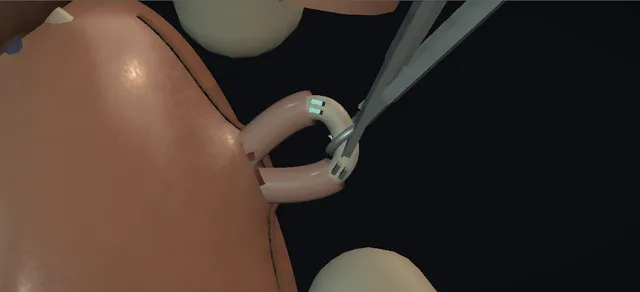
Elective male sterilisation under local anaesthetic. Each vas is found by palpation, brought under the skin of the upper median raphe and held in a ring clamp, and the scrotum is entered through one small puncture.

A loop of each vas is delivered, a segment is clipped at both ends and divided out for pathology, the ends and their lumens are cauterised, and the sheath is closed over one end.

The lesson is the identity of the structure in the clamp, and a man who is not sterile until his semen analysis says so.

Core tier FRCS andrology, male sterilisation and its counselling Interactive 3D

Operative visualisation

Schematic scene preview: Vasectomy: no-scalpel
Preparing the 3D anatomy…

UrOops3D · UroRef · © Nity G

How to use this module. Play through the eight steps, or use Back and Next. Watch each loop come through the one opening, the sheath strip back, the segment leave for the pot and the sheath close over one end. The triggers show a vein delivered instead of the vas, a vas that slips back, and a haematoma.

Click me next Section 2 of 8 Anatomy The structures this operation works between, and the one it must not cross.

The structures in the scene

Vasectomy: how the structures relateThe vas at the top of the scrotum, and what lies round it. Vas deferens: firm, white, with a lumen: beside it in the cord; never in the clamp Testicular artery (danger). Vas deferens: firm, white, with a lumen: beside it; a blue loop is a vein, not the vas Pampiniform veins (danger). Vas deferens: firm, white, with a lumen: stripped back, then closed over one end Vasal sheath. Vas deferens: firm, white, with a lumen: held under it; one opening reaches both Median raphe and its skin vessels (danger). Vas deferens: firm, white, with a lumen: begins there and ascends behind the testis Tail of the epididymis. Vas deferens: firm, white, with a lumen: taken just below its root Penis root.Vas deferens: firm,white, with a lumen!Testicular artery!Pampiniform veinsVasal sheath!Median raphe and itsskin vesselsTail of theepididymisPenis rootbeside it in thecord; never in theclampbeside it; a blueloop is a vein, notthe vasstripped back, thenclosed over one endheld under it; oneopening reachesbothbegins there andascends behind thetestistaken just belowits rootTargetDangerLandmarkContext
The vas at the top of the scrotum, and what lies round it. Schematic, not to scale; relationships only.
  • Seen from in front of a supine patient, each spermatic cord runs up from the upper pole of its testis toward the groin.
  • At the top of the scrotum, just below the penis root, the vas lies posteromedial in its cord, behind the testicular artery and the pampiniform veins.
  • The hold brings it forward and medially to lie under the median raphe, so that one opening in the midline reaches the right vas and then the left.
  • ›Vas deferens - firm, white, cord-like and about the thickness of a pencil lead; it lies posteromedial in the cord at the top of the scrotum.
  • ›Vasal sheath - the thin vascular layer round the vas; incised and stripped to isolate the vas, then closed over the abdominal end.
  • ›Testicular artery - anterior in the cord, among the veins; its injury is the one that threatens the testis.
  • ›Pampiniform plexus - thin-walled blue veins wound round the artery; the commonest wrong structure in the clamp.
  • ›External spermatic fascia - the outer covering of the cord, under the dartos.
  • ›Scrotal skin and dartos - thin, mobile and vascular; the opening is made on the median raphe.
  • ›Median raphe - the midline ridge of the scrotum; one opening there reaches both vasa.
  • ›Epididymis and testis - below; the vas begins at the tail of the epididymis and ascends behind the testis.
  • ›Penis - held up out of the field on the lower abdomen.
Click me next Section 3 of 8 Steps The operation in order, with the landmark that guards each move.

Operative steps

  1. Consent, palpation, local anaesthetic Consent and the contraceptive plan are confirmed, irreversibility, failure, chronic pain and the semen test having been discussed beforehand. Supine, prepared, draped and a time-out. Each vas is palpated at the top of the scrotum and rolled between finger and thumb, and local anaesthetic is infiltrated round each one.
    where it bites: both vasa are identified before anything is cut; the testicular artery and the pampiniform veins lie beside the vas in the cord.
  2. Three-finger hold and ring clamp The right vas is taken first. The middle finger lifts it from behind the scrotum, and the index finger and thumb fix it under the skin of the upper median raphe. The ring-tipped fixation clamp is closed round the vas through the skin and holds it there.
    where it bites: only the vas belongs in the clamp: a cord vessel taken with it is a wrong structure.
  3. Puncture The skin over the vas is pierced on the raphe with the sharp-tipped curved haemostat, one blade going through skin and vasal sheath. The blade is withdrawn, both tips are reintroduced, and they are spread to open a small hole down to the vas. No scalpel is used.
    where it bites: the scrotal skin vessels run in the edges of the opening; spreading rather than cutting spares most of them.
  4. Delivery and isolation One blade spears the wall of the vas and lifts it, and a loop of vas is delivered through the opening. The clamp lets go of the skin and takes the loop. The sheath of the vas is incised and stripped back, and a segment of bare vas, about a centimetre long, is isolated.
    where it bites: the loop must be firm, white and have a lumen; a thin-walled blue loop is a pampiniform vein.
  5. Clip, divide, cauterise A clip is placed on each end of the isolated segment, and the segment between the clips is divided out and sent to pathology. Both cut ends of the vas and their lumens are cauterised. Meticulous haemostasis is kept throughout.
    where it bites: nothing is clipped or cut until the loop is held securely; a vas that slips back is caught again, never cut blind.
  6. Sheath over one end, return The vasal sheath is closed over the abdominal end, so that the two ends lie in different tissue planes with the testicular end outside the sheath. The clamp lets go, the ends drop back into the scrotum, and the field is checked for bleeding.
    where it bites: a bleeding vessel left in the cord now becomes a haematoma tonight.
  7. The other side An identical procedure is done on the left. The left vas is held with the three-finger hold, clamped, and delivered through the same opening; its sheath is stripped, a clip goes on each end, the segment is divided out to the pot, both lumens are cauterised and the sheath is closed over its abdominal end.
    where it bites: the second vas must be a second vas: the same right vas delivered twice leaves him fertile.
  8. Haemostasis, closure, advice Haemostasis is secured at the edges of the opening, the skin is closed with an absorbable stitch, and a dressing and a scrotal support are applied. Before he leaves he is told that he is not yet sterile: other contraception continues until semen analysis shows clearance, and both specimens go to pathology.
    where it bites: the operation is not the end of the treatment; the semen result is.
Click me next Section 4 of 8 Danger zones Where this operation bites, and why it bites there.
Critical relationship

Danger zones

The spatial relationships the animation is built to make automatic. Before you read each one, ask yourself: at this point in the operation, what is about to go wrong, and what is my first move? The save for each sits in the Complications tab.

  • RiskTesticular artery and pampiniform veins - beside the vas in the cord; the clamp and the clips take the vas alone.
  • RiskScrotal skin vessels - in the edges of the opening; the source of bleeding the support and the stitch are there for.
  • RiskWrong or duplicate cord structure mistaken for vas - a vein delivered in place of the vas, or the same vas twice, leaves the man fertile.
  • RiskHaemostasis before the ends drop back - the cord is checked dry on each side before the clamp lets go.
  • RiskThe semen result - he is not sterile until semen analysis shows clearance.
Practise it Take me into the scene Opens the animation at a danger moment and asks you to predict the mechanism and your first move before it reveals.
Click me next Section 5 of 8 Complications The save for each one: the first move, the escalation trigger, the op-note line.

Complications and immediate saves

Trigger each of these live in the Animation tab, then read the save: the first move, the escalation trigger, and the line that goes in the op note.

Wrong structure delivered

  • the loop in the clamp is thin-walled, blue and collapsible: a pampiniform vein, not the vas.
  • Ligation of a vessel mistaken for the vas is a listed complication of the operation.
The save
  1. Stop. Nothing is clipped or cut. Let the vein go and check it for bleeding. first move
  2. Find the vas again by palpation, bring it under the opening with the three-finger hold and clamp it.
  3. Deliver it and confirm that it is firm, white and has a lumen before the sheath is opened.
  4. A vas that cannot be identified with certainty on either side is a reason to stop and call a senior, not to cut. escalation trigger
  5. Op note: what was delivered first, how the vas was identified, and that both segments went to pathology. document

Vas slips back

  • before it is clipped, the vas slips out of the clamp and back through the opening into the scrotum, its sheath half stripped.
The save
  1. Do not probe blindly. Keep the opening, and bring the vas up again with the three-finger hold. first move
  2. Clamp it through the skin, deliver it again and finish isolating the segment.
  3. If it cannot be found, close the opening and call a senior; a second approach is better than a cord vessel cut in the dark. escalation trigger
  4. Op note: that the vas was lost and recovered, and how it was confirmed. document

Scrotal haematoma

  • that evening the left hemiscrotum is tense, swollen and bruised; bleeding is a listed complication, from a cord vessel or the skin edge.
The save
  1. Examine him: a soft, stable swelling is managed with a support, ice and analgesia, and reviewed. first move
  2. Stop any anticoagulant or antiplatelet only on the advice of whoever prescribed it.
  3. A tense, expanding or very painful haematoma is a senior review now; it may need exploration, evacuation and haemostasis. escalation trigger
  4. Record the size and progress of the swelling and the plan, and tell him what would bring him back. document
Click me next Section 6 of 8 Troubleshooting When the case turns: the problem, then the next move.

Intra-operative troubleshooting

When the case turns: the problem, then the next move.

  • ActionThe vas cannot be felt on one side - a high, thin or mobile vas may be impossible to fix under local anaesthetic. The BAUS leaflet advises a general anaesthetic when the tubes are difficult to feel.
  • ActionTwo firm tubes are felt on one side - a duplicated vas is rare; any structure in doubt is delivered and identified before anything is cut, and both segments go to pathology.
  • ActionOozing from the skin edge - pressure and fine cautery to the point; the opening is small enough to see every edge.
  • ActionChoice of occlusion - the operative text clips, divides and cauterises, and lists the sheath closed over the remnant as a variation. The EAU guideline reports that mucosal cautery and fascial interposition reduce early failure compared with simple ligation and excision.
  • ActionPersistent sperm on semen analysis - motile sperm at the planned test is an early failure: the test is repeated, and if it persists the vasectomy is repeated.
  • ActionScrotal pain months later - examine for a sperm granuloma, epididymal congestion or other scrotal pathology; most settle with conservative measures.
Click me next Section 7 of 8 FRCS viva Say it out loud, then mark yourself against the model answer.

FRCS viva questions

The examiner stems this scene prepares you for. Try to answer out loud first, then reveal, and learn the discriminator, the detail that turns a pass into a strong pass.

QA man in his late thirties with two children asks for a vasectomy. What do you tell him?reveal answer
  • I would tell him that it should be regarded as irreversible, and I would make sure he has thought about the alternatives, including female sterilisation and reversible methods.
  • I would quote the BAUS leaflet.
  • Most men have mild bruising and swelling, and blood in the semen the first few times is common.
  • Troublesome chronic testicular pain that affects day-to-day activities occurs in about 1 to 2 in 100 men.
  • Early failure, with motile sperm on the semen test so that he is not sterile, occurs in 1 in 250.
  • Late failure, after a clear test, when the ends rejoin, occurs in 1 in 2000.
  • I would say that there is no evidence that vasectomy causes long-term health risks such as testicular or prostate cancer.
  • Most importantly, he is not sterile straight away: he must use other contraception until his semen test, at least 12 weeks and 20 ejaculations after the operation, has given him the all-clear.
  • The EAU guideline asks that counselling covers alternative methods, complication and failure rates and the need for semen analysis, and that consent is taken before the operation.
Strong pass

Say both

  • Giving the failure figures with their source
  • Making the semen test part of the operation in his mind
Examiner note
Giving the failure figures with their source, and making the semen test part of the operation in his mind.
QTalk me through a no-scalpel vasectomy.reveal answer
  • After a time-out I palpate both vasa and infiltrate local anaesthetic round each.
  • I take the right vas first: I lift it with my middle finger from behind and fix it under the median raphe with my index finger and thumb, and close the ring clamp round it through the skin.
  • I pierce the skin over it with one blade of the sharp curved haemostat, then spread both tips to open a small hole.
  • I spear the vas with one blade, deliver a loop, and transfer the clamp to the loop.
  • I open the sheath and strip it back, isolate about a centimetre of bare vas, put a clip on each end, divide out the segment and send it to pathology, and cauterise both ends and their lumens.
  • I close the sheath over the abdominal end so that the ends lie in different planes, check for bleeding and let the ends drop back.
  • I do the left through the same opening, then secure haemostasis, close the skin with an absorbable stitch and apply a support.
Strong pass

Say both

  • Confirming that each loop is the vas before anything is clipped
  • Naming the occlusion done on each end
Examiner note
Confirming that each loop is the vas before anything is clipped, and naming the occlusion done on each end.
QWhy interpose fascia? Does the technique of occlusion matter?reveal answer
  • It matters for early failure.
  • In the randomised trial of Sokal and colleagues, 841 men having ligation and excision through a no-scalpel approach, adding fascial interposition halved failures judged by semen analysis, from 12.7 to 5.9 per cent, and shortened the time to azoospermia.
  • The EAU guideline summarises that mucosal cautery and fascial interposition reduce early failure compared with simple ligation and excision, but that no robust data show any one technique to be superior in preventing late recanalisation and pregnancy.
  • So I use cautery of the lumens and fascial interposition, as the operative text allows, and I still counsel him about late failure.
  • On access, the Cochrane review found that the no-scalpel approach caused less bleeding, haematoma, infection and pain than the incisional one, with an odds ratio for haematoma of 0.23, and no difference in effectiveness.
Strong pass

Say all four

  • Separating early failure
  • Which technique changes
  • From late recanalisation
  • Which it has not been shown to change
Examiner note
Separating early failure, which technique changes, from late recanalisation, which it has not been shown to change.
QHis semen test at sixteen weeks shows a few non-motile sperm. Is he clear?reveal answer
  • The EAU guideline allows clearance when semen analysis at least three months after the operation shows azoospermia or rare non-motile sperm.
  • So a few non-motile sperm can be accepted, provided the test was done properly and at the right interval.
  • The BAUS leaflet tells the patient that if a few sperm remain he will be asked for a further sample a few weeks later, so I would follow the local laboratory protocol on whether a second sample is needed.
  • Motile sperm would be a different matter: that is early failure, which the BAUS leaflet puts at 1 in 250, and the vasectomy would need to be repeated.
  • Whichever it is, I would tell him clearly whether he can stop other contraception, and I would remind him that late failure, at 1 in 2000, can still occur after clearance.
Strong pass

Distinguishing rare non-motile sperm, which can be cleared, from motile sperm, which is failure.

QSix months later he has a tender lump at the vasectomy site and an aching testis. What is going on?reveal answer
  • I would examine him for a sperm granuloma at the cut end, a tender epididymis from congestion, infection, and any other scrotal pathology, including a testicular lesion, and arrange an ultrasound where the examination is unclear.
  • Chronic pain severe enough to affect day-to-day life is one of the things I would have warned him about: the BAUS leaflet puts it at about 1 to 2 in 100.
  • Most pain settles with simple analgesia, anti-inflammatory drugs and support.
  • For pain that persists, the options include a cord block, excision of a granuloma, and in selected men vasectomy reversal or epididymectomy, and I would refer to an andrologist for that discussion rather than operate on pain I cannot explain.
Strong pass

Say both

  • Excluding other scrotal pathology before calling it post-vasectomy pain
  • Quoting the risk he was warned about
Examiner note
Excluding other scrotal pathology before calling it post-vasectomy pain, and quoting the risk he was warned about.
Click me next Section 8 of 8 Evidence The guidance each of these answers is built on.

Evidence and guidance

Operative Dictations in Urologic Surgery
Armenakas NA, Fracchia JA, Golan R. Vasectomy. Chapter 46. Wiley, 2019
Followed for the indication, the four essential steps and the template dictation. Consent includes the contraceptive alternatives; supine, preparation and a time-out; both vasa palpated and local anaesthetic given into the scrotum. Access is by one incision on the upper median raphe or two anterolateral ones. The vas is grasped with a ring-tipped fixation clamp and brought into the wound, its fascia incised and a segment of about a centimetre isolated. A clip goes on each end, the segment is divided out and sent to pathology, and both ends and lumens are cauterised, with haemostasis throughout. The same is done on the other side, the skin closed with an absorbable suture, and a dressing and a support applied. Two variations are used: the scrotal wall pierced with a sharp-tipped curved haemostat (the no-scalpel technique) for access, and the sheath closed over the remnant for occlusion. The complication list (bleeding, infection, swelling, a vessel ligated in mistake for the vas, pain, recanalisation) supplies the three states. General practice, not from the chapter: the three-finger hold, the right side first, the sheath over the abdominal rather than the testicular end, a puncture closed with one stitch, and every first, escalate and document step.
Open guideline
BAUS
British Association of Urological Surgeons. Vasectomy: information about your procedure. Leaflet A24/049, published October 2024, read 18 October 2026
Regard as irreversible; not sterile until the all-clear from post-operative semen tests after at least 12 weeks and 20 ejaculations, with 20 to 30 ejaculations needed on average; if a few sperm remain, a further sample a few weeks later. Late failure 1 in 2000. Early failure, persistent motile sperm, 1 in 250. Troublesome chronic testicular pain affecting day-to-day activities in 1 to 2 in 100. Mild bruising and swelling in almost all; blood in the semen the first few times in between 1 in 2 and 1 in 10. No evidence of long-term health risks such as testicular or prostate cancer. A general anaesthetic is advised when the tubes are difficult to feel. Absorbable skin stitches.
Open guideline
European Urology
Dohle GR, Diemer T, Kopa Z, Krausz C, Giwercman A, Jungwirth A. European Association of Urology guidelines on vasectomy. Eur Urol 2012;61:159-163
Abstract read 18 October 2026. Counselling to include alternative methods of contraception, complication and failure rates and the need for postoperative semen analysis; informed consent before the operation. Mucosal cautery and fascial interposition reduce early failure compared with simple ligation and excision; no robust data show one technique superior in preventing late recanalisation and pregnancy. Clearance can be given for azoospermia or rare non-motile sperm at least 3 months after the procedure. The current EAU sexual and reproductive health guideline has no vasectomy chapter; this is the EAU document on the operation.
Open guideline
BMC Medicine
Sokal D, Irsula B, Hays M, Chen-Mok M, Barone MA. Vasectomy by ligation and excision, with or without fascial interposition: a randomized controlled trial. BMC Med 2004;2:6
Abstract read 18 October 2026. 841 men at eight clinics in seven countries, all by the no-scalpel approach, randomised to ligation and excision with or without fascial interposition. Fascial interposition shortened the time to azoospermia (hazard ratio 1.35) and reduced failures based on semen analysis from 12.7% to 5.9%. Slightly more adverse events with interposition, not significant.
Open guideline
Cochrane Database of Systematic Reviews
Cook LA, Pun A, Gallo MF, Lopez LM, Van Vliet HA. Scalpel versus no-scalpel incision for vasectomy. Cochrane Database Syst Rev 2014;(3):CD004112
Abstract read 18 October 2026. Two randomised trials. The larger found less perioperative bleeding, pain during surgery, scrotal pain and incisional infection with the no-scalpel approach; both found less haematoma (odds ratio 0.23). Faster operations and quicker return to sexual activity; no difference in effectiveness.
Open guideline

Curriculum. Supports learning relevant to the ISCP Urology Curriculum syllabus topic Andrology. Not a workplace-based assessment and not evidence of competence.

Two minutes

Close the lap: recall it before you leave.

Say it aloud, then reveal. Reading is not remembering.

  1. 01 The relationship Say the critical spatial relationship out loud, then reveal. reveal
    Memory frame

    Seen from in front of a supine patient, each spermatic cord runs up from the upper pole of its testis toward the groin.

    Why?
    At the top of the scrotum, just below the penis root, the vas lies posteromedial in its cord, behind the testicular artery and the pampiniform veins. The hold brings it forward and medially to lie under the median raphe, so that one opening in the midline reaches the right vas and then the left.
  2. 02 The first move Wrong structure delivered. Your first move? reveal
    First move

    Stop.

    More detail
    Nothing is clipped or cut. Let the vein go and check it for bleeding.
  3. 03 The escalation trigger Wrong structure delivered. What makes you call for help? reveal
    Escalate when

    A vas that cannot be identified with certainty on either side is a reason to stop and call a senior, not to cut.

  4. 04 The discriminator What turns a pass into a strong pass? reveal
    Strong pass

    Say both

    • Giving the failure figures with their source
    • Making the semen test part of the operation in his mind
    Examiner note
    Giving the failure figures with their source, and making the semen test part of the operation in his mind.
  5. 05 The pitfall Where does this operation bite first? reveal
    Pitfall

    Testicular artery and pampiniform veins

    Why?
    beside the vas in the cord; the clamp and the clips take the vas alone.

Revision practice with self-marked answers, not an assessment of clinical competence. Kept in this browser only; it does not sync between devices.