
Adult acquired buried penis reconstruction
Multicomponent reconstruction to expose the penile shaft, remove diseased tissue and restore durable skin coverage and fixation.
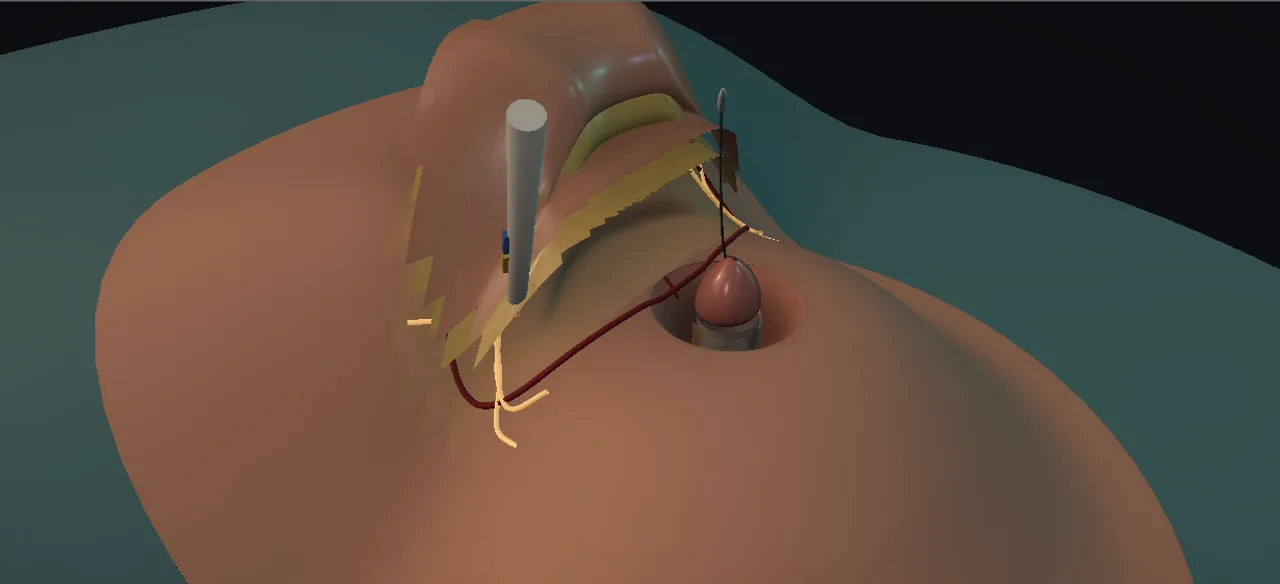 Interactive 3D Interactive buried penis reconstruction Open the 3D animation
Teaching catalogue only. This coverage record is not a patient pathway or operative instruction.
Typical place in practice
Functional concealment with hygiene, urinary, sexual or inflammatory problems after assessment of obesity, lymphoedema and skin disease.
Alternatives and neighbouring procedures
Weight optimisation, skin-disease treatment, hygiene and urinary aids, or limited local surgery in carefully selected disease.
Same procedure family, explicit technique branches
These are variations of this canonical operation. Complication modules below identify whether they apply to all branches or only to named approaches.
Release and penile fixation
Releases tethering and prevents recurrent retraction when skin remains usable.
Escutcheonectomy or panniculectomy
Reduces the overlying fat/skin apron and recreates the penopubic angle.
Penile skin excision and grafting
Removes diseased shaft skin and restores coverage with graft.
Composite genital reconstruction
Addresses extensive genital tissue disease in a staged or multidisciplinary procedure.
High-level sequence
Coverage outline only; not a step-by-step technical guide.
- Define functional goals and optimise comorbidity and skin disease
- Release the penis and excise irreversibly diseased tissue
- Recreate stable penopubic and penoscrotal fixation
- Provide viable local or graft skin coverage
- Immobilise and monitor graft, wound, urinary and sexual recovery
Every failure mode is its own module.
Timing and variation coverage are recorded for each module.
Major wound infection or dehiscence
Large moist wounds, comorbidity and lymphatic leakage can compromise healing.
Applies to: All variantsGraft loss or skin necrosis
Haematoma, shear, infection or poor bed vascularity can prevent graft take.
Applies to: Penile skin excision and grafting · Composite genital reconstructionBleeding, seroma or lymphatic leak
Broad suprapubic and genital dissection creates large raw surfaces.
Applies to: All variantsUrethral or neurovascular injury
Distorted anatomy and chronic inflammation can obscure the urethra and dorsal structures.
Applies to: All variantsRe-burying, contracture or contour problem
Scar contraction, residual tissue or failed fixation can recreate concealment.
Applies to: All variantsAltered sensation, erectile or sexual-function difficulty
Extensive skin and base reconstruction can change sensation, mechanics and sexual confidence.
Applies to: All variantsDonor-site morbidity
Graft harvest adds pain, delayed healing, infection and scarring at a second site.
Applies to: Penile skin excision and graftingSources for this module
Penile prosthesis, Peyronie disease, priapism and reproductive surgery.
Accessed 2026-08-03 · opens source British Association of Urological Surgeons Patient information leaflets by procedureUK patient-facing procedure, alternatives, recovery and complication framing.
Accessed 2026-08-03 · opens source