
Revision sheet
Bladder neck closure
9 steps, each one the authored title and caption from the interactive animation, with the frame captured from that step. Read it before the case, or print it and work through the steps in order.
Teaching only, not for diagnosis or treatment decisions. The text on this sheet is the animation's own step copy, reproduced verbatim.
UrOops3D · UroRef · © Nity G
- 01
Who
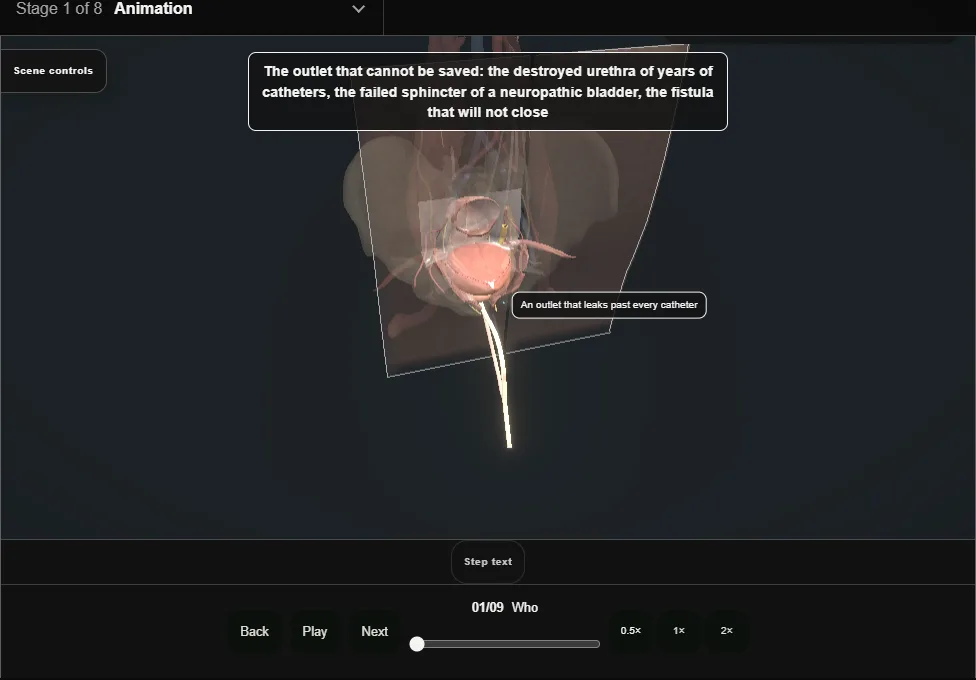
- The outlet that cannot be saved: the urethra destroyed by years of catheters, the failed sphincter of a neuropathic bladder, the fistula that will not close.
- A patient who leaks past every catheter and is never dry.
- 02
The plan: how the urine will leave
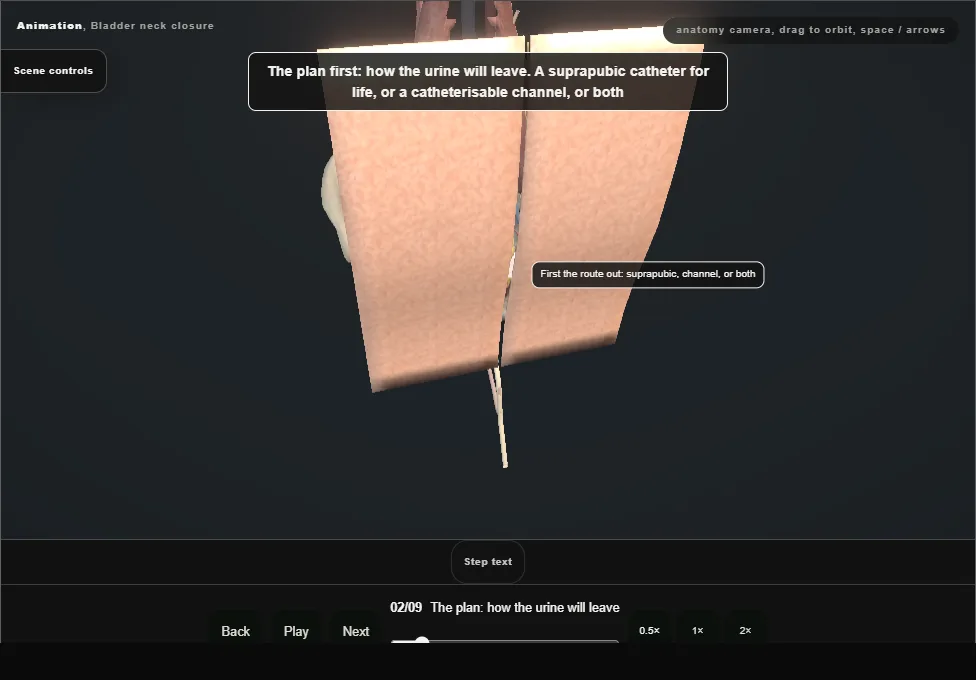
- A suprapubic catheter for life, a catheterisable channel, or both, decided before the neck is touched.
- The bladder must hold: capacity and compliance on urodynamics, and augmented at the same sitting if it does not.
- 03
Incision and the retropubic space
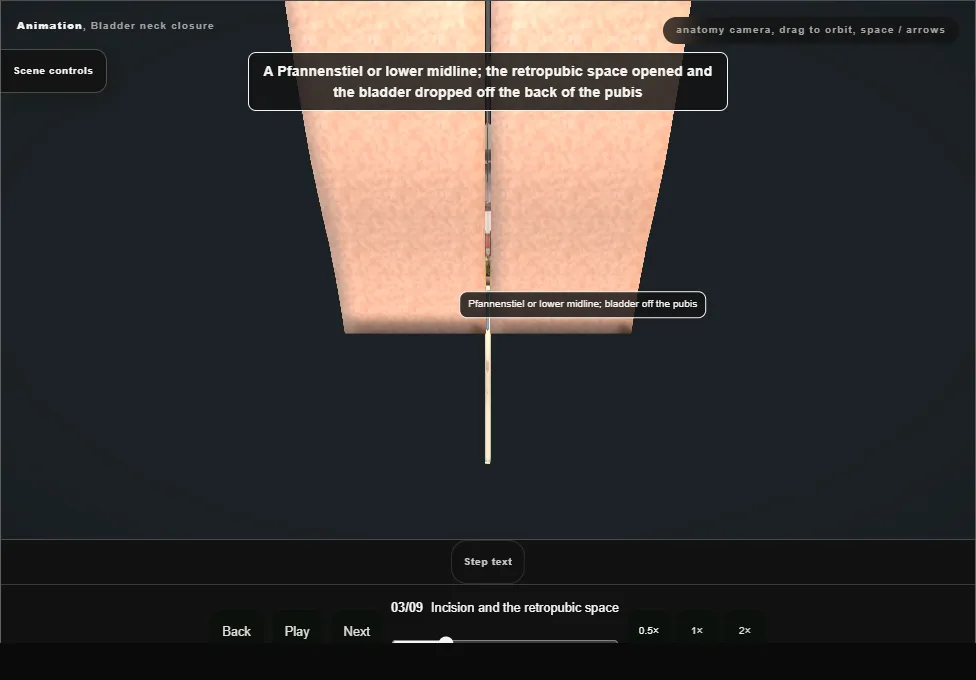
- A Pfannenstiel or lower midline; the retropubic space, scarred by every catheter and operation before, developed down to the neck and the endopelvic fascia.
- 04
Dissecting the neck and dividing the urethra
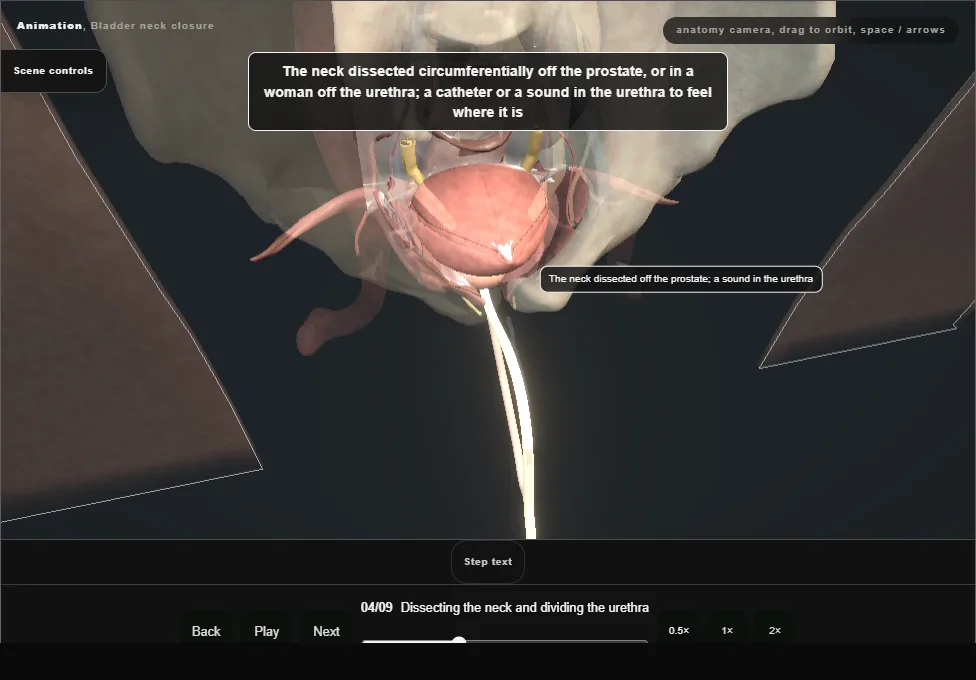
- The neck dissected circumferentially off the prostate, or in a woman off the urethra, with a sound in the urethra to feel where it is.
- A short anterior cystotomy so the orifices are seen from inside, then the urethra divided at the neck: two cut ends, drawn apart.
- 05
Closing the urethral stump
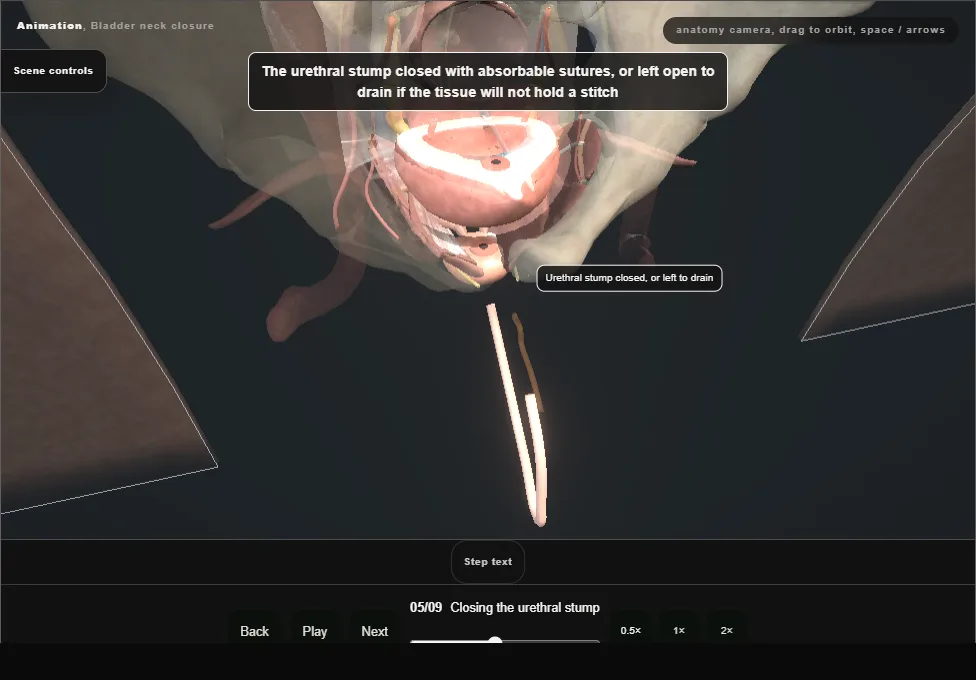
- Absorbable sutures, or the stump left open to drain if the tissue will not hold a stitch.
- The membranous urethra is not chased: the dorsal venous complex and the rectum are millimetres away.
- 06
Closing the bladder neck in two layers
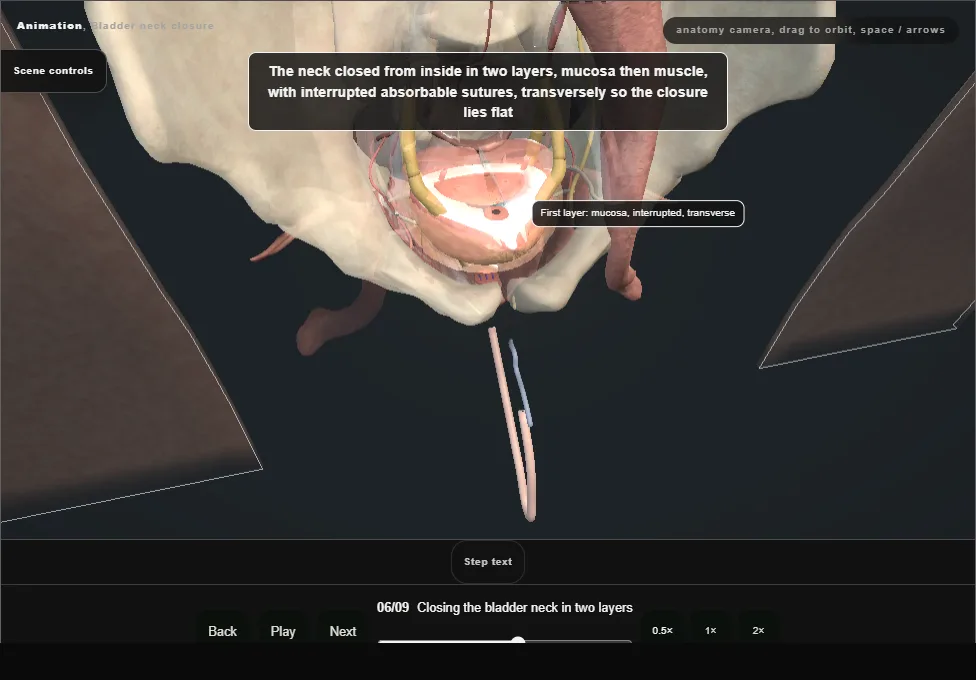
- Mucosa then muscle, interrupted absorbable sutures, transversely so the closure lies flat.
- Well-vascularised tissue at the edge, no tension, and the orifices watched at every stitch.
- 07
Omentum between the closure and the urethra
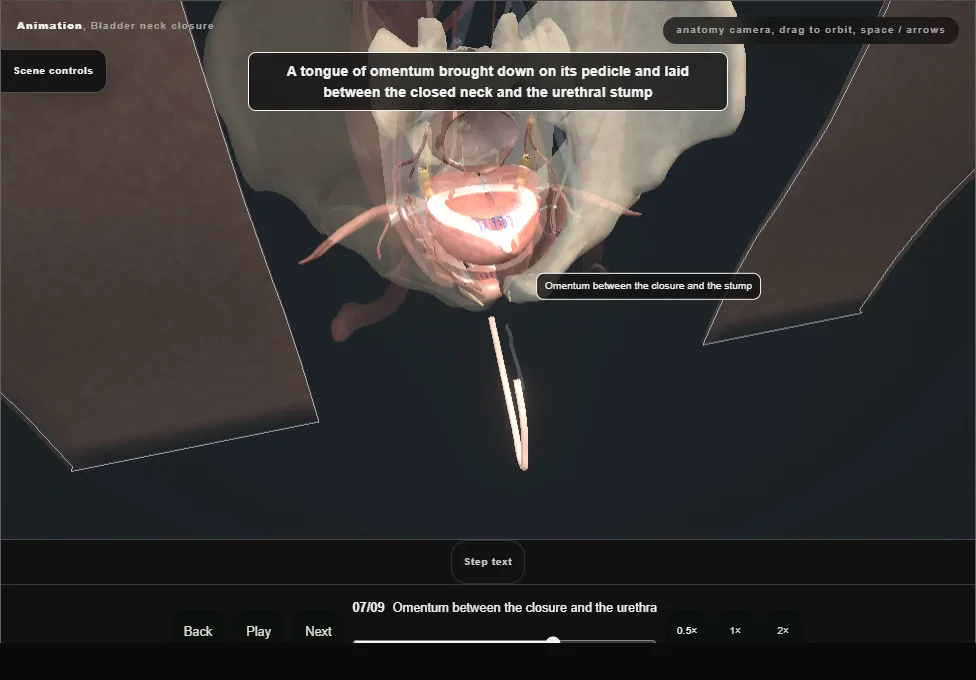
- A tongue of omentum on its pedicle laid between the closed neck and the urethral stump.
- Living tissue between two suture lines is what stops the fistula reforming.
- 08
Suprapubic catheter, drain, the test fill
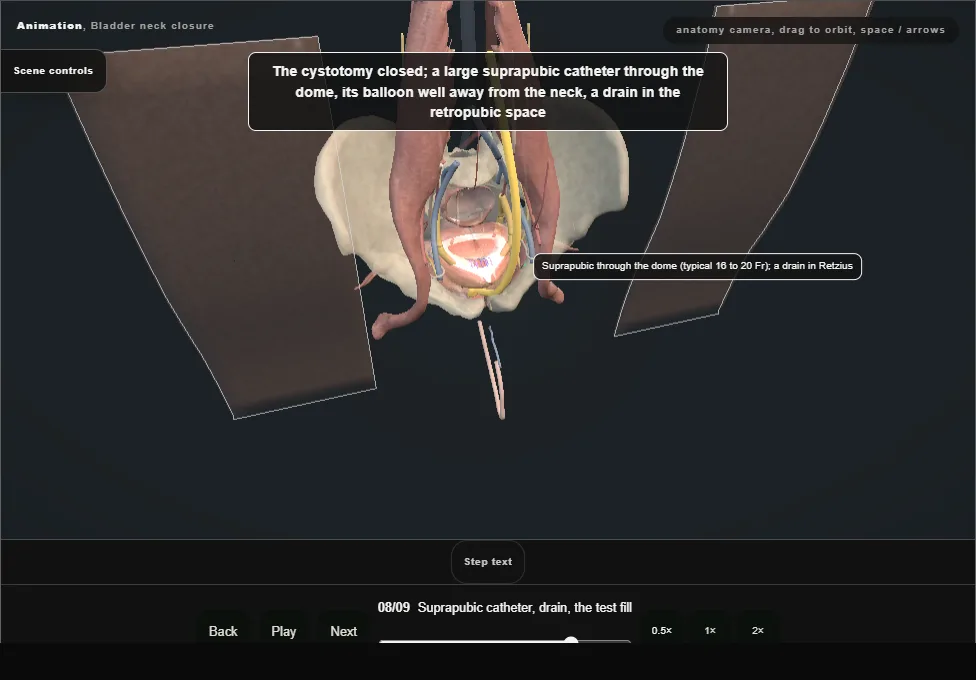
- The cystotomy closed; a large suprapubic catheter (typical 16 to 20 Fr) through the dome, its balloon away from the neck; a drain in the retropubic space; the bladder filled to 150 to 200 ml with the neck watched.
- 09
After
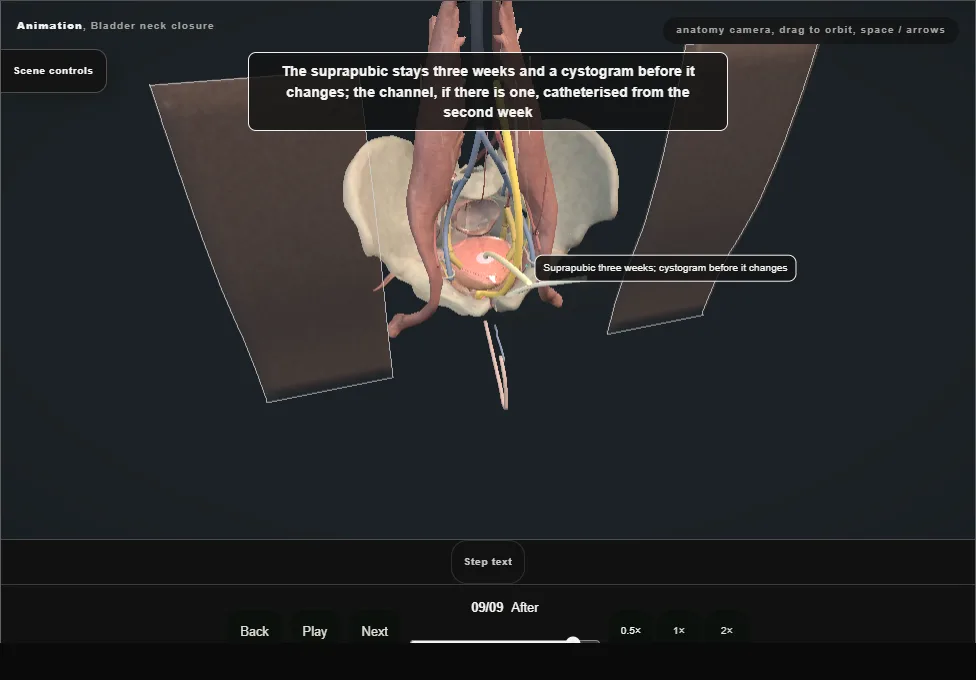
- The suprapubic stays three weeks and a cystogram before it changes; the channel catheterised from the second week.
- Lifelong: leakage per urethram means the closure has failed; stones in a bladder that no longer empties; the channel that stenoses.
Derived from pelvis/BladderNeckClosureScene.tsx at build time: every step title and caption above is the authored
ProcedureDef text, reproduced verbatim, and this page shares its readable-points renderer with the animation
itself. 9 of 9 steps have a captured frame.
Text fingerprint 462055cdd53ad09d. A caption edit without a re-capture fails the production
check, so the sheet and the animation cannot drift apart silently.