
Bladder-neck closure and devastated outlet surgery
Salvage closure of an irreparable or severely incontinent outlet, necessarily paired with a dependable alternative route for urinary drainage.
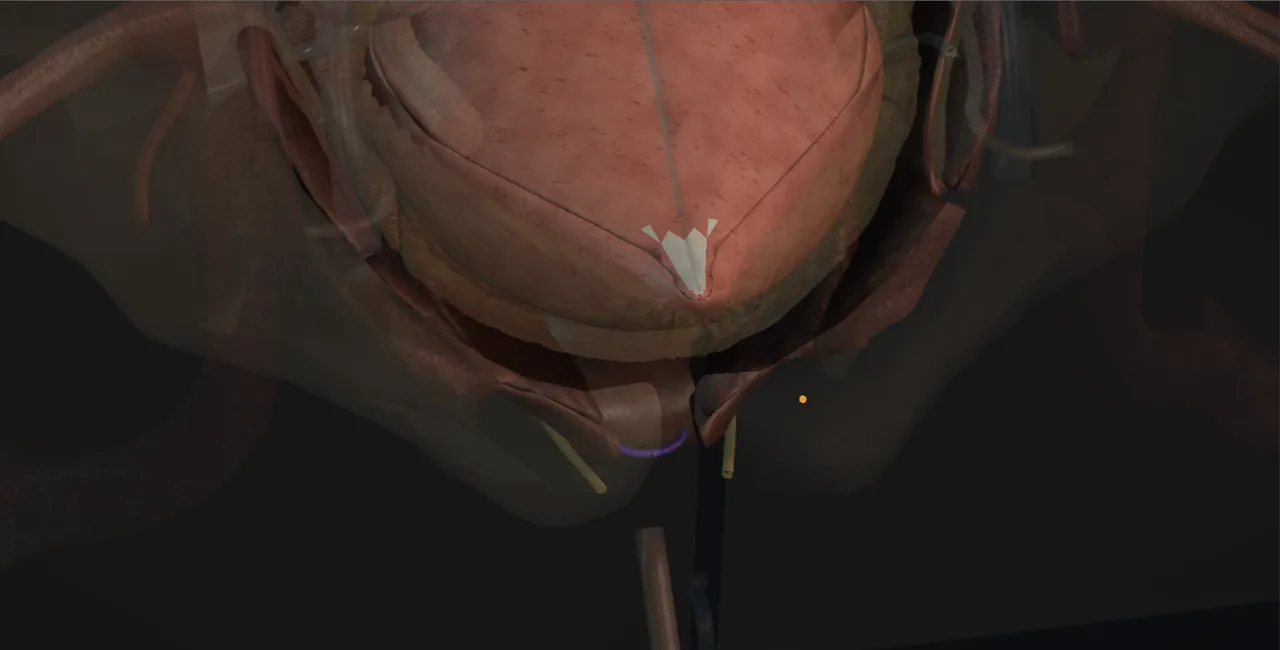 Interactive 3D Interactive bladder neck closure Open the 3D animation
Teaching catalogue only. This coverage record is not a patient pathway or operative instruction.
Typical place in practice
Selected severe urethral destruction, fistulation, erosion, neuro-urological incontinence or refractory outlet failure after multidisciplinary review.
Alternatives and neighbouring procedures
Reconstruction, artificial sphincter or sling in suitable cases, long-term catheter management, incontinent diversion or cystectomy with diversion.
Same procedure family, explicit technique branches
These are variations of this canonical operation. Complication modules below identify whether they apply to all branches or only to named approaches.
Transabdominal bladder-neck closure
Closes the outlet proximally and combines this with suprapubic or reconstructed drainage.
Transvaginal bladder-neck closure
Uses a vaginal approach in selected female patients.
Urethral closure with catheterisable channel
Pairs closure with a Mitrofanoff/Monti-type catheter route.
Closure with incontinent diversion
Uses a continuously draining alternative when catheterisation is not appropriate.
High-level sequence
Coverage outline only; not a step-by-step technical guide.
- Confirm irreversibility, bladder safety and drainage strategy
- Expose the outlet through the selected approach
- Close or disconnect the outlet in robust offset layers
- Create and test dependable urinary drainage
- Plan pressure, renal, infection and stoma surveillance
Every failure mode is its own module.
Timing and variation coverage are recorded for each module.
Closure breakdown and urinary fistula
Poor tissue quality or pressure can reopen the outlet or create a new urinary fistula.
Applies to: All variantsUreteric obstruction or injury
Trigonal dissection, closure or associated reconstruction can compromise one or both ureters.
Applies to: All variantsPelvic infection or abscess
Urinary leakage into a scarred field can lead to deep infection.
Applies to: All variantsUnsafe bladder pressure or upper-tract deterioration
Closing the outlet without adequate storage and drainage can endanger renal function.
Applies to: All variantsFailure of alternative drainage
A catheter, stoma, channel or conduit may obstruct, leak or become difficult to manage.
Applies to: All variantsBowel, rectal or vaginal injury
Dense salvage fields place adjacent pelvic organs at increased risk.
Applies to: All variantsSources for this module
Botulinum toxin, sphincterotomy, neuromodulation, augmentation and diversion.
Accessed 2026-08-03 · opens source European Association of Urology EAU Guidelines on Non-neurogenic Female LUTSFemale continence, bulking, sling, colposuspension and related procedures.
Accessed 2026-08-03 · opens source British Association of Urological Surgeons Patient information leaflets by procedureUK patient-facing procedure, alternatives, recovery and complication framing.
Accessed 2026-08-03 · opens source