
Continent catheterisable channel creation and revision
Creation of a continent abdominal route for intermittent catheterisation, either alone or within a wider bladder reconstruction.
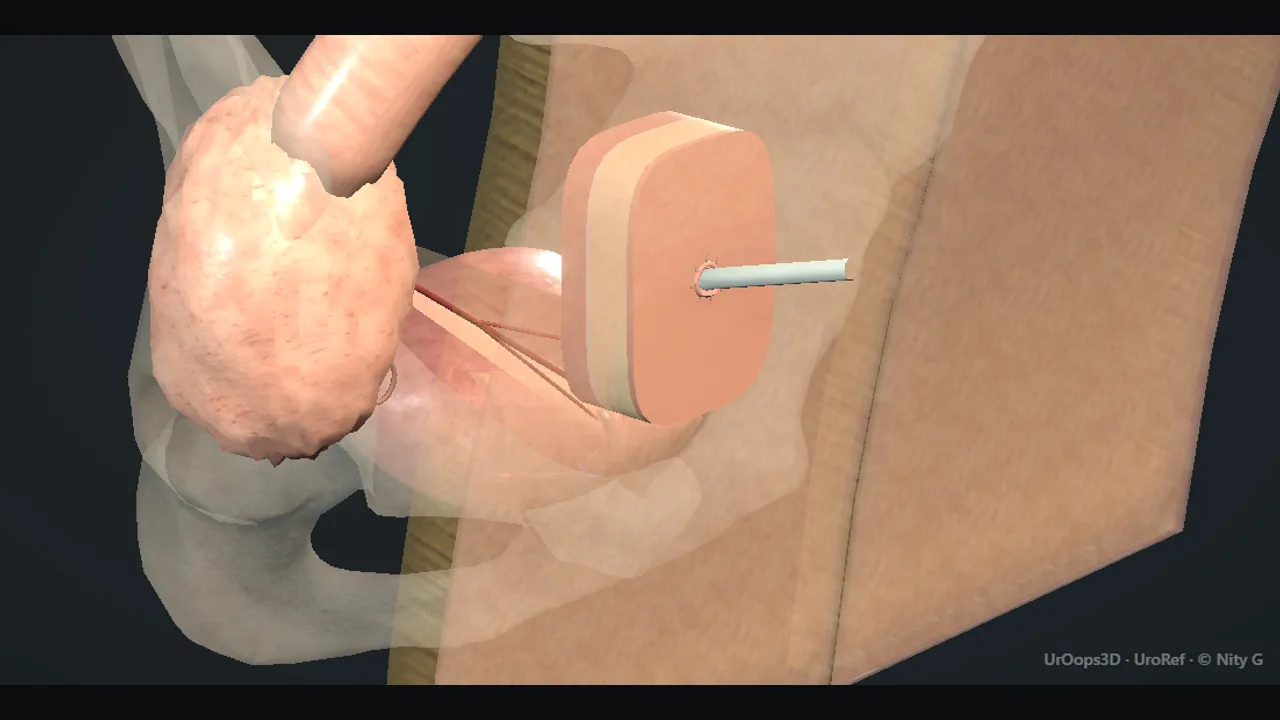 Interactive 3D Interactive operative model Open the 3D animation
Teaching catalogue only. This coverage record is not a patient pathway or operative instruction.
Typical place in practice
When urethral catheterisation is difficult or undesirable and the patient can use a catheterisable abdominal stoma.
Alternatives and neighbouring procedures
Urethral catheterisation, suprapubic catheter, incontinent diversion or other reconstructive access strategies.
Same procedure family, explicit technique branches
These are variations of this canonical operation. Complication modules below identify whether they apply to all branches or only to named approaches.
Appendicovesicostomy
Uses the appendix between skin and bladder with a continence mechanism.
Monti or spiral Monti channel
Constructs a catheterisable tube when the appendix is unavailable or unsuitable.
Channel revision
Treats narrowing, leakage, false passage, redundancy or difficult catheterisation.
Composite bladder reconstruction
Combines access with storage or outlet reconstruction.
High-level sequence
Coverage outline only; not a step-by-step technical guide.
- Plan a reachable stoma and viable channel
- Isolate appendix or bowel while preserving blood supply
- Create the channel and continence mechanism
- Mature a tension-free skin stoma
- Drain, teach catheterisation and arrange lifelong channel surveillance
Operative notes
Concise operative notes covering the key steps, landmarks and watch points, in the order you encounter them.
Mitrofanoff and Monti
What it does: a tube you catheterise through the tummy wall.
- Channel options: appendix (classic), or Monti. Monti = 4-5 cm bowel split lengthways in 3, re-rolled over a 12Ch catheter.
- Tunnel into the bladder, low and leaning down. Tunnel length = 3-4x tube width. That is the continence mechanism.
- Guard the ureteric orifices.
- Short, straight path to skin. Umbilicus or lower tummy. Rotation skin flap for the stoma.
- Stent catheter sewn in with fast-absorbing stitch. Balloon punctured so it can never be inflated and rip the channel.
- Flush every 6 h against mucus.
- Catheterise from ~6 weeks.
- Watch: Appendix already used for the ACE (constipation) channel? Plan a Monti on the other side.
From the UroRef Operative Quick Guide. Open the note page →
Every failure mode is its own module.
Timing and variation coverage are recorded for each module.
Bowel or urinary leak
Anastomotic or closure failure can cause intra-abdominal contamination or wound leakage.
Applies to: All variantsStomal or channel stenosis
Narrowing can occur at the skin, fascia or deeper channel and threaten catheter access.
Applies to: All variantsFalse passage or channel perforation
Difficult catheterisation can create an alternative tract or intraperitoneal injury.
Applies to: All variantsChannel incontinence
Failure of the continence mechanism or high reservoir pressure can cause stomal leakage.
Applies to: All variantsIschaemia, retraction or prolapse
Blood-supply or length problems can compromise the channel or stoma.
Applies to: All variantsStones and recurrent infection
Mucus, catheterisation, incomplete emptying and reconstructed bladder anatomy can promote infection and calculi.
Applies to: All variantsBowel obstruction or abdominal adhesion complication
Bowel mobilisation and anastomosis add late adhesive and mechanical risks.
Applies to: Monti or spiral Monti channel · Composite bladder reconstructionSources for this module
Botulinum toxin, sphincterotomy, neuromodulation, augmentation and diversion.
Accessed 2026-08-03 · opens source European Association of Urology EAU Guidelines on Paediatric UrologyCommon congenital, acute scrotal and paediatric reconstructive procedures.
Accessed 2026-08-03 · opens source British Association of Urological Surgeons Patient information leaflets by procedureUK patient-facing procedure, alternatives, recovery and complication framing.
Accessed 2026-08-03 · opens source