
Augmentation cystoplasty
Expansion of a low-capacity or high-pressure bladder using bowel or another selected tissue, often combined with a catheterisable channel or outlet procedure.
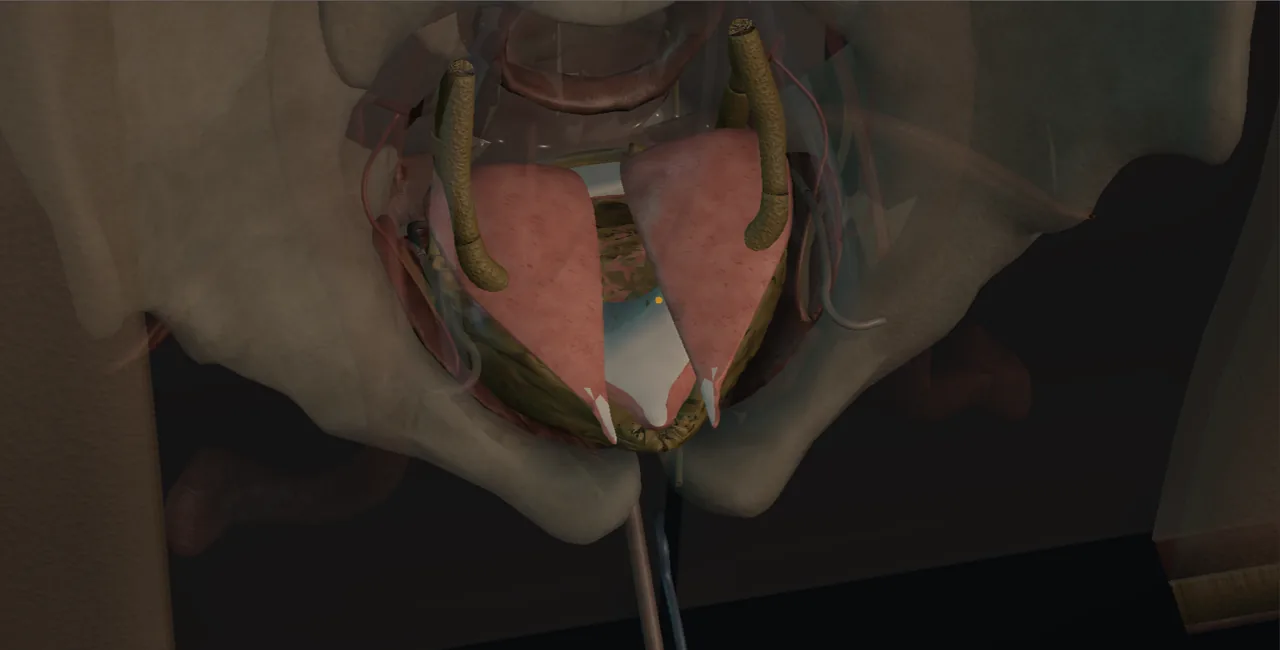 Interactive 3D Interactive clam ileocystoplasty Open the 3D animation
Teaching catalogue only. This coverage record is not a patient pathway or operative instruction.
Typical place in practice
Severe refractory storage dysfunction or unsafe bladder pressures after comprehensive functional and upper-tract assessment.
Alternatives and neighbouring procedures
Optimised conservative, pharmacological, catheter and injection treatment; neuromodulation; or urinary diversion in selected cases.
Same procedure family, explicit technique branches
These are variations of this canonical operation. Complication modules below identify whether they apply to all branches or only to named approaches.
Ileocystoplasty
Uses ileum to enlarge the opened bladder.
Colocystoplasty
Uses a selected colon segment when anatomy or prior surgery favours it.
Autoaugmentation or detrusorectomy
Attempts to increase compliance using native bladder; indications are limited.
Composite reconstruction
Combines storage, continence and access procedures in one staged or single operation.
High-level sequence
Coverage outline only; not a step-by-step technical guide.
- Define functional goals, renal risk and lifelong-care capability
- Select and isolate the reconstructive segment
- Open the bladder and create a low-pressure patch
- Restore bowel continuity and complete urinary anastomosis
- Drain, test healing and establish long-term metabolic and structural surveillance
Operative notes
Concise operative notes covering the key steps, landmarks and watch points, in the order you encounter them.
Functional bladder surgery
What it does: rebuild or control a difficult bladder.
Augmentation (ileocystoplasty)
- 20-25 cm ileum, opened along its far border.
- Bladder split front to back. The halves must not pull together again.
- Patch sewn in, 2 running 3/0 threads.
- Supra + urethral catheters + drain.
- Washouts 3x a day, against mucus.
- Supra out day 13. Urethral day 14. Cystogram if any doubt.
Detrusor myectomy
- Blue dye in the bladder.
- Inverted-U muscle cut over the dome.
- Muscle peeled OFF the lining underneath.
- Hole in the lining ~50%. Close 6/0. Drain.
- Never over-fill after.
Artificial sphincter (AUS)
- Obsession with clean technique. Minimal traffic. Double gloves. Wash the field.
- Bulbar cuff after prostate surgery. Bladder neck cuff: women, children, catheterisers.
- ContiClassic balloon 60-69 (bulbar) or 70-79 (neck) cmH2O. Redo for wear: higher balloon, or cuff 0.5 cm smaller. Irradiated: lower balloon.
- Pump in a dependent scrotal pouch in front of the LEFT testis. Button forward.
- Off for 6 weeks. Activate in clinic. Teach cycling.
- 2026 update: Device by approach: Rigicon ContiClassic for the perineal incision, AMS 800 for the penoscrotal. Erosion 3-10%. Infection 1-5%.
- 2026 update: Penoscrotal approach: before the incision, pull the shaft straight up off the scrotum. Hold it on the pubic region with a stay stitch through the glans.
- 2026 update: Sacral neuromodulation: 2 stages. Test wire. Over 50% better on a diary = permanent wire.
- 2026 update: Botox 100 U in 10 mL: 20 x 0.5 mL, into the bladder wall, spare the trigone. Effect 6-9 months. Teach self-catheterisation first.
From the UroRef Operative Quick Guide. Open the note page →
Every failure mode is its own module.
Timing and variation coverage are recorded for each module.
Bleeding, bowel injury or anastomotic complication
Abdominal and bowel surgery introduces haemorrhage, ileus, obstruction, leakage and intra-abdominal sepsis risk.
Applies to: All variantsUrinary leak or fistula
Failure of the bladder–bowel or associated channel closure can cause intraperitoneal or wound leakage.
Applies to: All variantsUrinary infection and mucus-related obstruction
Colonisation, residual urine, mucus and catheterisation contribute to infection and drainage problems.
Applies to: All variantsMetabolic or nutritional disturbance
Urine–bowel contact and bowel resection can alter acid-base, electrolyte, vitamin or nutritional status.
Applies to: Ileocystoplasty · Colocystoplasty · Composite reconstructionBladder or upper-tract stones
Mucus, infection, foreign material and incomplete emptying can promote calculi.
Applies to: All variantsReservoir perforation
A late spontaneous or traumatic rupture can present with an acute abdomen or sepsis and is a lifelong risk.
Applies to: All variantsMalignancy in reconstructed urinary tract
Long-term cancer risk is part of surveillance counselling even though absolute risk and protocols vary.
Applies to: All variantsPersistent incontinence or catheterisation difficulty
Outlet and access goals may not be achieved or can deteriorate over time.
Applies to: Composite reconstructionSources for this module
Botulinum toxin, sphincterotomy, neuromodulation, augmentation and diversion.
Accessed 2026-08-03 · opens source European Association of Urology EAU Guidelines on Paediatric UrologyCommon congenital, acute scrotal and paediatric reconstructive procedures.
Accessed 2026-08-03 · opens source British Association of Urological Surgeons Patient information leaflets by procedureUK patient-facing procedure, alternatives, recovery and complication framing.
Accessed 2026-08-03 · opens source