
Artificial urinary sphincter implantation and revision
Implantation, revision or removal of a hydraulic continence device, with cuff location and salvage context treated as operative variants.
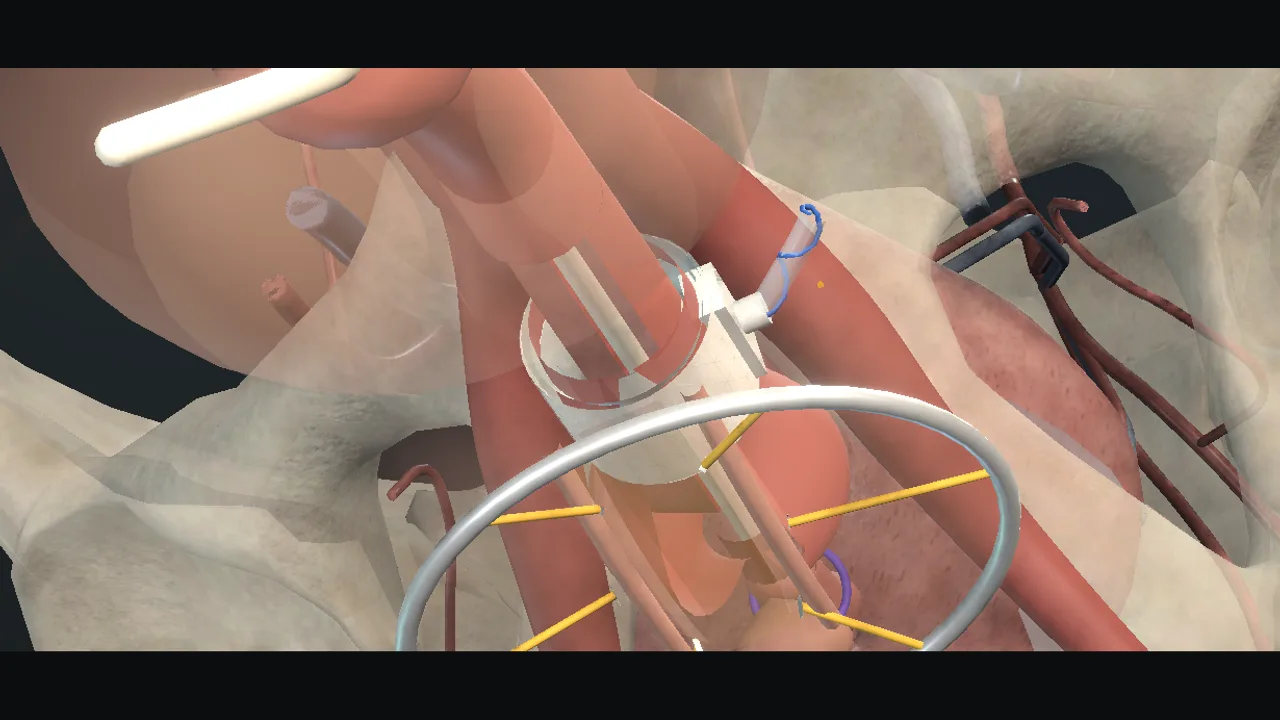 Interactive 3D Interactive operative model Open the 3D animation 3D Interactive penoscrotal approach, one incision
Teaching catalogue only. This coverage record is not a patient pathway or operative instruction.
Typical place in practice
Moderate-to-severe male stress incontinence, or selected female/neuro-urological cases in specialist practice, after counselling about device use and future revision.
Alternatives and neighbouring procedures
Conservative management, external continence devices, sling surgery, catheter strategies or urinary diversion in selected complex cases.
Same procedure family, explicit technique branches
These are variations of this canonical operation. Complication modules below identify whether they apply to all branches or only to named approaches.
Primary bulbar cuff implantation
Places a cuff around the bulbar urethra linked to pump and pressure-regulating components.
Transcorporal or alternative cuff placement
Adapts coverage for a fragile or previously operated urethra.
Revision for mechanical failure or atrophy
Restores function while reassessing urethral tissue quality.
Explantation for infection or erosion
Controls a device complication rather than providing immediate continence.
High-level sequence
Coverage outline only; not a step-by-step technical guide.
- Assess urethra, bladder function, dexterity and infection risk
- Expose the selected cuff site without urethral injury
- Size and place cuff, pump and reservoir components
- Connect and test the closed system before leaving it deactivated
- Plan activation, device education and long-term surveillance
Operative notes
Concise operative notes covering the key steps, landmarks and watch points, in the order you encounter them.
Functional bladder surgery
What it does: rebuild or control a difficult bladder.
Augmentation (ileocystoplasty)
- 20-25 cm ileum, opened along its far border.
- Bladder split front to back. The halves must not pull together again.
- Patch sewn in, 2 running 3/0 threads.
- Supra + urethral catheters + drain.
- Washouts 3x a day, against mucus.
- Supra out day 13. Urethral day 14. Cystogram if any doubt.
Detrusor myectomy
- Blue dye in the bladder.
- Inverted-U muscle cut over the dome.
- Muscle peeled OFF the lining underneath.
- Hole in the lining ~50%. Close 6/0. Drain.
- Never over-fill after.
Artificial sphincter (AUS)
- Obsession with clean technique. Minimal traffic. Double gloves. Wash the field.
- Bulbar cuff after prostate surgery. Bladder neck cuff: women, children, catheterisers.
- ContiClassic balloon 60-69 (bulbar) or 70-79 (neck) cmH2O. Redo for wear: higher balloon, or cuff 0.5 cm smaller. Irradiated: lower balloon.
- Pump in a dependent scrotal pouch in front of the LEFT testis. Button forward.
- Off for 6 weeks. Activate in clinic. Teach cycling.
- 2026 update: Device by approach: Rigicon ContiClassic for the perineal incision, AMS 800 for the penoscrotal. Erosion 3-10%. Infection 1-5%.
- 2026 update: Penoscrotal approach: before the incision, pull the shaft straight up off the scrotum. Hold it on the pubic region with a stay stitch through the glans.
- 2026 update: Sacral neuromodulation: 2 stages. Test wire. Over 50% better on a diary = permanent wire.
- 2026 update: Botox 100 U in 10 mL: 20 x 0.5 mL, into the bladder wall, spare the trigone. Effect 6-9 months. Teach self-catheterisation first.
From the UroRef Operative Quick Guide. Open the note page →
Every failure mode is its own module.
Timing and variation coverage are recorded for each module.
Urethral injury
A urethrotomy or compromised spongiosum may prevent safe primary implantation and alters future planning.
Applies to: All variantsDevice infection
Infection can involve one or all components and commonly threatens retention of the prosthesis.
Applies to: All variantsCuff erosion
Pressure, tissue fragility or later instrumentation can lead to urethral erosion.
Applies to: All variantsMechanical failure
Leakage, component disconnection or pump/reservoir failure can cause recurrent incontinence.
Applies to: All variantsRetention or difficulty cycling the device
Outlet obstruction, poor dexterity or device position can impair voiding.
Applies to: All variantsPersistent or recurrent incontinence
Urethral change, bladder dysfunction, cuff position or device malfunction can reduce continence.
Applies to: All variantsCorporal injury or erectile impact
Transcorporal dissection introduces technique-specific corporal and sexual-function considerations.
Applies to: Transcorporal or alternative cuff placementSources for this module
Male sling, artificial urinary sphincter and post-prostate-treatment continence surgery.
Accessed 2026-08-03 · opens source European Association of Urology EAU Guidelines on Neuro-urologyBotulinum toxin, sphincterotomy, neuromodulation, augmentation and diversion.
Accessed 2026-08-03 · opens source British Association of Urological Surgeons Patient information leaflets by procedureUK patient-facing procedure, alternatives, recovery and complication framing.
Accessed 2026-08-03 · opens source