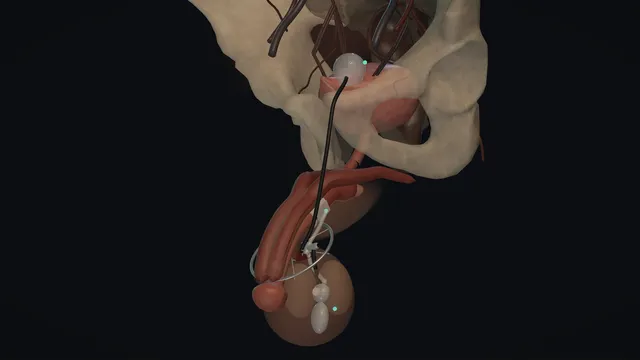
Built around the Boston Scientific AMS 800™: cuff, pressure-regulating balloon and control pump, all placed through one upper transverse scrotal incision.
The cuff sits more distally than it does through the perineum, so the case is won on how proximal the exposure reaches, on sizing without compressing, and on leaving the device deactivated while the urethra heals.
Advanced tierFRCS continence, functional urology, prostheticsInteractive 3D
How to use this module. Play through the ten steps, or use Back and Next. Each step shows the move happening: watch the cuff go round and lock, the balloon travel to its space and the pump drop into its pouch. Try a trigger to see a wrong move and its correction.
Supine, from the upper scrotal incision to the three spaces it reaches. Schematic, not to scale; relationships only.
One incision, three spaces: from the upper scrotum the cuff goes round the bulbar urethra distal to an intact bulbospongiosus, the balloon travels along the cord through the external ring into the retropubic space, and the pump drops into a dependent subdartos pouch below the wound, with the connectors hidden in the tunnel between.
›Upper scrotum at the penoscrotal junction - the single transverse incision, moved up onto the penis and held with a ring retractor and six hooks.
›Corpora cavernosa - their ventral tunica is the guide proximally; the scissors follow it toward the proximal corpora.
›Bulbar urethra and corpus spongiosum - freed by dividing the webs of Buck's fascia; the spongiosum thins toward the distal bulbar urethra.
›Bulbospongiosus - left intact in this approach, which is why the cuff sits distal to the bulb.
›Scrotal septum - exposed between the two sides and dissected sharply off the bulbar urethra.
›External inguinal ring and spermatic cord - the balloon passes along the cord, through the ring and the transversalis fascia.
›Retropubic space (space of Retzius) - the balloon's site, with the bladder behind it; a submuscular pouch anterior to the transversalis fascia is the alternative.
›Subdartos pouch - dependent, beneath the scrotal skin and dartos in front of the left testis, for the pump with its button outward.
Position and orientationSupine, legs gently abducted on boards, knees and hips straight. Lithotomy would put the urethra on stretch; supine it stays mobile. A catheter drains the bladder so it is not injured when the balloon goes in. One incision will reach three spaces: the bulbar urethra, the retropubic space and the scrotum. Before the incision, pull the shaft straight up off the scrotum and hold it on the pubic region with a stay stitch through the glans.
Upper transverse scrotal incisionIncise transversely across the upper scrotum and deepen through the subcutaneous tissue. Move the wound up onto the penis and hold it there with a ring retractor and blunt hooks at 1, 3, 5, 7, 9 and 11 o'clock. The hooks keep you out of the scrotum, where needless dissection only bleeds. where it bites: wide scrotal dissection leaves dead space and haematoma around a prosthesis.
On to the corporaExpose the tunica albuginea of both corpora sharply. Pass the scissors proximally along the ventral surface of the tunica toward the proximal corpora. Retract on one side of the urethra, then the other, until the scrotal septum is exposed; dissect it sharply off the bulbar urethra. where it bites: a plane that wanders onto the spongiosum bleeds and thins the bed the cuff must sit on.
Free the bulbar urethraDivide the webs of Buck's fascia that bind the diverging corpora to the spongiosum; the urethra then comes free. Because he is supine, a right angle passes behind it almost under direct vision; spread it to make room for the cuff. Bulbospongiosus is left intact, so this cuff sits distal to the bulb. where it bites: the posterior pass is where the urethra is torn; an injury recognised here changes the plan, and the cuff does not go round it.
Measure the urethraTake out any catheter before measuring. Pass the cuff sizer round the urethra where the cuff will sit: snug, never constricting. The reading is the cuff length. The AMS 800 cuff comes in thirteen lengths from 3.5 to 11.0 cm. where it bites: a sizer pulled tight reads small, and an undersized cuff presses too hard on the urethra.
Place and close the cuffPass the empty cuff tab first under the urethra, mesh backing outward and inflatable side toward the urethra, tubing on the pump side. Thread the tubing through the tab hole, then pull the tab over the tubing adapter so the hole sits in the adapter's slot. Rotate the adapter lateral to the midline and keep the tubing off the cuff. where it bites: the further distal the cuff, the thinner the spongiosum it wraps, and the manufacturer links thin spongiosum to erosion.
The balloon through the external ringEmpty the bladder and displace the incision to the side of the penis. Find the external inguinal ring, pierce the transversalis fascia and place the empty balloon in the retropubic space; narrow the opening with an absorbable suture. After radiotherapy or previous radical surgery, a pouch beneath the rectus but anterior to the transversalis fascia avoids that pierce. The balloon comes in three ranges, 51-60, 61-70 and 71-80 cmH2O; fill it as the manufacturer's instructions state. where it bites: the bladder lies behind the fascia you pierce; a full bladder is an easy one to injure.
Seat the pumpWork from the lower edge of the incision. Start the tunnel about 2 cm from the skin edge, so the tubing and connectors will lie concealed, and develop a dependent pouch beneath the scrotal skin and dartos, in front of the left testis. Seat the control pump there, deactivation button outward where he can feel it, on the same side as the balloon. A loose purse string round the tunnel mouth holds it low. where it bites: a pump that is not dependent is hard to find and squeeze, and a badly placed pump can migrate or erode through the scrotum.
Route and connectThe tubing is colour coded: clear from the pump to the clear cuff line, black from the pump to the black balloon line. Cut each to length, without tension and without redundant loops, and join them with the connectors where the tunnel hides them. Check the connections by cycling the cuff closed and open. where it bites: reinforced tubing still kinks if it is cut to the wrong length, and wrong tubing length is a cause of migration.
Deactivate and closeSqueeze and release the pump until the bulb stays flat: the cuff is empty. Let the bulb partly refill, about 30 to 60 seconds, then press the deactivation button firmly. The cuff stays open while the urethra heals. Close in layers. Activation is in clinic; most surgeons wait four to six weeks. No catheter or instrument passes the urethra, now or ever, until the cuff is deflated and the device deactivated.
The spatial relationships the animation is built to make automatic. Before you read each one, ask yourself: at this point in the operation, what is about to go wrong, and what is my first move? The save for each sits in the Complications tab.
RiskThe distal cuff site - this exposure reaches the urethra further out than the perineal one; the spongiosum thins distally, and thin spongiosum under a cuff is the set-up for erosion.
RiskThe posterior pass - the right angle behind the urethra is the moment of urethral injury; an injury seen here means no cuff at that site today.
RiskThe transversalis fascia - pierced blind behind the external ring, with the bladder beyond it; the bladder is emptied first.
RiskThe scrotal pouch and the tunnel - a pump that is not dependent is hard to use; tubing cut to the wrong length kinks or pulls a component out of place.
Trigger each of these live in the Animation tab, then read the save: the first move, the escalation trigger, and the line that goes in the op note.
Urethral injury during mobilisation
a tear in the urethra during the posterior dissection or the pass of the right angle, most often where the spongiosum is thin or scarred.
The save
Stop the dissection and look: a catheter or a gentle instillation shows where the urethra is breached.first move
Do not wrap a cuff round an injured urethra.
Repair the tear and leave a catheter; the sphincter is put in on another day.
A tear you cannot define or repair, or one in an irradiated urethra, needs a senior reconstructive opinion now.escalation trigger
Op note: the site and size of the injury, the repair, the catheter and the plan for a later implant.document
Cuff erosion
the cuff breaks through into the urethra; the manufacturer also names the pump eroding through the scrotum and the balloon into the bladder.
Improper cuff sizing, infection and component misplacement are among the causes it lists.
The save
Suspect it in any man with a device who has new pain or swelling over the cuff, haematuria, dysuria or a leak that has come back.first move
Deflate the cuff and deactivate the device before any catheter or instrument passes the urethra.
Confirm with flexible urethroscopy by someone who knows the device is there.
Examine all three sites the manufacturer names: urethra, scrotum and bladder.
If he needs drainage and the urethra is breached, a suprapubic catheter is considered rather than forcing one past the cuff.
An eroded cuff comes out, after senior review; sepsis or a collection makes that urgent.escalation trigger
Op note: cuff length and site, endoscopic findings, components removed or left, drainage and antibiotics.document
Device infection
infection of the prosthesis, early in the wound or pouch or later by seeding;
the manufacturer warns that infection that fails to respond to antibiotics may mean removal, and that the scarring makes reimplantation harder.
The save
Recognise it: redness, discharge or pain over a component, or fever with the device in.first move
Take cultures and start antibiotics; examine the whole device, not only the wound.
An infected implant rarely clears on antibiotics; plan removal after senior review.escalation trigger
Reimplantation is discussed later, once the tissues have healed.
Op note: cultures, components removed, debridement, antibiotic plan and the timing of any reimplantation discussion.document
Persistent or recurrent incontinence
leakage that never settles or comes back; the manufacturer notes that some men keep a degree of incontinence.
In a retrospective series the penoscrotal approach had fewer completely dry men than the perineal approach, which its authors related to a more distal cuff.
The save
Take the history of the leak and of pump use, and check the device cycles.first move
Exclude erosion with urethroscopy before any revision.
Consider fluid loss, pump position and a cuff that no longer fits the urethra beneath it.
Revision, including a cuff at another site, is a senior decision made with the patient.escalation trigger
Op note: endoscopic findings, cuff length and site before and after, and the continence plan.document
When the case turns: the problem, then the next move.
ActionThe exposure will not reach far enough proximally - the scissors follow the ventral tunica of the corpora toward their proximal ends; if the cuff can only go on thin distal spongiosum, stop and get senior advice rather than accept that site.
ActionBleeding from the spongiosum during the dissection - you have left the plane; press, come back onto the tunica of the corpora and do not wrap a cuff round a bleeding, thinned segment.
ActionThe bladder is full when the balloon is due - empty it first; the fascia you pierce behind the external ring has the bladder beyond it.
ActionA scarred retropubic space after radiotherapy or radical surgery - use the pouch beneath the rectus but anterior to the transversalis fascia, as the operating room manual describes.
ActionCatheter needed in a man with a device - deflate the cuff and deactivate the device first, as the instructions for use state; if in doubt, ask the implanting team.
The examiner stems this scene prepares you for. Try to answer out loud first, then reveal, and learn the discriminator, the detail that turns a pass into a strong pass.
QWhat are the advantages and disadvantages of the penoscrotal approach compared with the perineal approach?reveal answer
The penoscrotal approach places all three components through one upper transverse scrotal incision with the patient supine.
Wilson and colleagues described it in 2003: 37 men, operating time shorter than with two incisions, no second incision for the balloon, and no difference in complications at a year;
a penile prosthesis could go in through the same incision.
Supine, the urethra is mobile and the posterior dissection is almost under vision, and the bulbospongiosus is left intact.
The disadvantage is where the cuff lands.
Henry and colleagues compared the two approaches retrospectively: in the multicentre series the completely dry rate with a single cuff was 27.4% penoscrotal against 44.1% perineal, more penoscrotal patients went on to a tandem cuff, and penoscrotal cuffs were smaller, 4.0 cm in 86.7%.
They attributed the difference to a more distal cuff.
Later series report otherwise: Wilson reported technical changes that allow a more proximal cuff, and a 2025 single-centre cohort of 179 men found similar pad-weight reduction with fewer infections and less mechanical failure in the transverse scrotal group.
I would choose the approach I can do well, and in either I would aim for the most proximal cuff the exposure allows.
Strong pass
Say all three
Quoting the Henry figures with their retrospective design
Explaining the mechanism: a more distal cuff on thinner spongiosum
Shown by the smaller cuff sizes
Examiner note
Quoting the Henry figures with their retrospective design, and explaining the mechanism: a more distal cuff on thinner spongiosum, shown by the smaller cuff sizes.
QTake me through the steps of a penoscrotal AUS insertion.reveal answer
Supine with the legs gently apart, knees and hips straight, and a catheter draining the bladder.
An upper transverse scrotal incision, moved up onto the penis and held with a ring retractor and hooks.
I expose the tunica of both corpora and follow their ventral surface proximally, take the scrotal septum off the bulbar urethra and divide the webs of Buck's fascia; a right angle then passes behind the urethra.
I remove the catheter and measure the urethra with the sizer, snug but not constricting, and choose the cuff from the reading.
The cuff goes round tab first with its mesh backing outward, the tubing through the tab hole and the tab over the adapter.
With the bladder empty I pass the balloon along the cord, through the external inguinal ring and the transversalis fascia into the retropubic space, and narrow the opening.
The pump goes in a dependent subdartos pouch, tunnelled from the lower edge of the wound, button outward.
Clear line to clear, black to black, cut to length and joined in the tunnel, and I cycle to check.
Finally I deactivate with the cuff empty and close.
Strong pass
Say all three
Naming the supine position and why
The posterior pass under vision
The route of the balloon through the external ring and the transversalis fascia
Examiner note
Naming the supine position and why, the posterior pass under vision, and the route of the balloon through the external ring and the transversalis fascia.
QWhy is the device left deactivated after implantation, and what do you tell the patient?reveal answer
The urethra has just been freed all round and wrapped by a foreign body; it needs to heal before the cuff presses on it again and again.
The manufacturer's patient guide says the cuff should stay empty while he heals.
So at the end of the operation I squeeze the pump until the bulb stays flat, let it partly refill for about 30 to 60 seconds, and press the deactivation button firmly; the cuff stays open.
He will leak until activation, so he needs pads or a sheath in the meantime.
Activation is in clinic, and most doctors wait four to six weeks, as the patient guide says.
At activation I check the wounds, teach him to squeeze and release the pump until it is flat, and tell him the cuff takes several minutes to close again.
The rule for life is on his device card: no catheter or instrument through the urethra until the cuff is deflated and the device deactivated.
Strong pass
Say both
Describing the deactivation sequence in order (empty, partial refill, press)
Stating the lifelong catheter rule unprompted
Examiner note
Describing the deactivation sequence in order (empty, partial refill, press) and stating the lifelong catheter rule unprompted.
QA man presents two years after a penoscrotal AUS with scrotal pain and a return of his leak. How do you proceed?reveal answer
Erosion until proved otherwise, and infection until proved otherwise.
I ask about pump use, fever, haematuria and any recent catheter or instrumentation, and I examine the scrotum, the pump and the tubing, the wound and the lower abdomen.
The manufacturer names three erosion sites, the cuff into the urethra, the pump through the scrotum and the balloon into the bladder, so I look at all three.
Before anything passes the urethra the cuff is deflated and the device deactivated.
Flexible urethroscopy by someone who knows the device is there shows a cuff erosion.
If he needs drainage and the urethra is breached I would consider a suprapubic catheter rather than force a urethral one.
An eroded or infected device is a senior decision, urgent if there is sepsis or a collection, and usually means removing the eroded cuff or, with infection, the whole device.
Reimplantation is discussed once the tissues have healed.
If there is no erosion or infection, I look at fluid loss, pump position and a cuff that no longer holds.
Strong pass
Say all three
Examining all three manufacturer erosion sites
Deactivating before any instrumentation
Naming urethroscopy as the diagnostic test
Examiner note
Examining all three manufacturer erosion sites, deactivating before any instrumentation, and naming urethroscopy as the diagnostic test.
Curriculum. Supports learning relevant to the ISCP Urology Curriculum syllabus topic Stress urinary incontinence in men and women. Not a workplace-based assessment and not evidence of competence.
Two minutes
Close the lap: recall it before you leave.
Say it aloud, then reveal. Reading is not remembering.
01The relationshipSay the critical spatial relationship out loud, then reveal.reveal
Memory frame
One incision, three spaces
Why?
One incision, three spaces: from the upper scrotum the cuff goes round the bulbar urethra distal to an intact bulbospongiosus, the balloon travels along the cord through the external ring into the retropubic space, and the pump drops into a dependent subdartos pouch below the wound, with the connectors hidden in the tunnel between.
02The first moveUrethral injury during mobilisation. Your first move?reveal
First move
Stop the dissection and look: a catheter or a gentle instillation shows where the urethra is breached.
03The escalation triggerUrethral injury during mobilisation. What makes you call for help?reveal
Escalate when
A tear you cannot define or repair, or one in an irradiated urethra, needs a senior reconstructive opinion now.
04The discriminatorWhat turns a pass into a strong pass?reveal
Strong pass
Say all three
Quoting the Henry figures with their retrospective design
Explaining the mechanism: a more distal cuff on thinner spongiosum
Shown by the smaller cuff sizes
Examiner note
Quoting the Henry figures with their retrospective design, and explaining the mechanism: a more distal cuff on thinner spongiosum, shown by the smaller cuff sizes.
05The pitfallWhere does this operation bite first?reveal
Pitfall
The distal cuff site
Why?
this exposure reaches the urethra further out than the perineal one; the spongiosum thins distally, and thin spongiosum under a cuff is the set-up for erosion.
Revision practice with self-marked answers, not an assessment of clinical competence. Kept in
this browser only; it does not sync between devices.