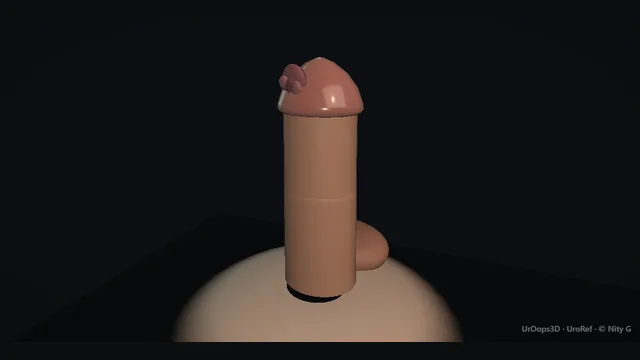
A margin operation on the distal penis: one circumferential proximal incision becomes the cut face through skin, corpora and urethra, and the pathologist judges the whole operation by that face.
The urethra is divided with extra length, spatulated and sutured to the skin as a wide new meatus, because a tense, ischaemic meatus narrows.
Advanced tierFRCS andrology, penile cancerInteractive 3D
The penile shaft in cross-section at the cut face. Schematic, not to scale; relationships only.
The penis is built in layers around a central axis: paired corpora dorsolaterally, spongiosum and urethra ventral and slightly mobile within it, dorsal bundle at 12 o'clock, skin outside everything.
The operation makes one cut through all of them, and the cut face is a circle that must be clear in every radius: skin, each corpus, urethra.
The urethra alone is given extra length beyond the corporal stumps, because it has to fold forward and reach the skin edge without tension, and it is spatulated, split and fanned, so the new meatus is an oval opening rather than a hole.
Everything that goes wrong afterwards happens at that opening.
›Glans tumour - the lesion that dictates the margin; its apparent edge and its true edge are not the same thing.
›Corpora cavernosa - paired erectile cylinders divided at the margin; their stumps are closed and they carry the deep margin.
›Corpus spongiosum + urethra - ventral and slightly mobile; divided with extra length to reach the skin without tension.
›Dorsal neurovascular bundle - vein, arteries and nerves at 12 o'clock, ligated at the margin; what remains supplies the remnant.
›The new meatus - a spatulated urethral opening sutured wide to the skin; the structure whose fate is stenosis or stricture.
Biopsy + stagingThe diagnosis is confirmed on biopsy sampled from representative tumour rather than from necrotic or infected surface, and the histology is available before the date. The primary and both groins are staged with imaging, because the groins drive prognosis and their pathway runs in parallel with the primary from the outset. With staging complete, the operation is planned on known disease: the intended margin, the intended reconstruction and the frozen section request are agreed before the first incision. Biopsy and staging are what make the margin a decision rather than a guess. where it bites: operating on an unbiopsied penile lesion is the original error; every other decision depends on the histology.
Proximal margin markedThe tumour is first covered with a glove or condom sewn to the shaft so it is never handled, the penis is emptied and a tourniquet is applied at the base; only then is a circumferential incision line marked with a pen proximal to the tumour in healthy, settled skin, clear of the visible and palpable edge and of any previous biopsy tract. With the marking complete the penis is inspected from every angle, because the mark describes a circle and every radius of that circle is a margin. The mark is the cut face itself, not a guide for the pathologist to interpret: the margin reported is the margin actually taken. A line drawn optimistically through inflamed or previously biopsied skin is an optimistic line, not a margin. where it bites: a margin measured optimistically in inflamed, infected or previously biopsied skin is not a margin.
Skin + corporal transectionThe skin is divided along the marked circle through the subcutaneous tissues, and the dorsal neurovascular bundle is ligated where it is met at 12 o'clock, with what remains supplying the remnant. Each corpus cavernosum is transected cleanly at the marked level, and bleeding from the erectile tissue is controlled as the cut is made. The corporal margin, not the skin margin, is the deep one, because tumour tracks along the erectile tissue beyond what the surface shows. Frozen section of the corporal stump is requested where the laboratory provides it, and an equivocal margin is answered with a further slice rather than reassurance. where it bites: tumour can track along the corpora beyond what the surface shows; the corporal margin, not the skin margin, is the deep one.
Urethra divided with lengthThe urethra with its spongiosal sleeve is divided deliberately distal to the corporal stumps, so the stump projects beyond the cut face of the corpora with healthy length in hand. The spongiosum is preserved around the urethra as it is mobilised, because the blood supply travelling in that sleeve is what keeps the future meatus alive. Every spare millimetre of healthy urethra is banked at this step, since the stump has to fold forward and reach skin without tension. A urethra cut flush with the corporal stumps, or stripped of spongiosum on the way out, arrives at the skin edge short and ischaemic, and tension becomes retraction and then stenosis. where it bites: a urethra stripped of spongiosum or cut flush with the stumps reaches the skin under tension, and tension becomes stenosis.
Spatulation + reconstructionThe tourniquet is released and haemostasis confirmed, then the corporal stumps are closed with a running absorbable suture that opposes the tunical edges, converting a bleeding cut face into a sealed stump. The urethral tip is then spatulated, split and fanned open, and sutured to the skin edge as a wide oval meatus rather than a buttonhole. The skin is advanced and closed over the stumps so the urethra sits at the apex of the closure without being asked to bridge any gap. Spatulation is functional rather than decorative: a wide, tension-free, well-vascularised meatus is the entire defence against the stenosis that follows ischaemia and tension. where it bites: a small buttonhole meatus is the setup for meatal stenosis; wide spatulation is the prevention, not decoration.
Catheter + follow-upA catheter drains the reconstruction while the meatus heals, chosen to drain without pressing on the new suture line, and the specimen is oriented for the pathologist with sutures or a diagram so the cut face is reported as it was made. The groins are staged on their own pathway according to the histology, because clinically impalpable groins are not necessarily negative groins. Follow-up runs on two clocks: the remnant and the new meatus examined regularly for recurrence and stenosis, and the groins watched on their own schedule. Self-examination is taught before discharge, because the patient is part of both clocks. where it bites: clinically impalpable groins are not necessarily negative groins; staging them is part of the operation.
The spatial relationships the animation is built to make automatic. Before you read each one, ask yourself: at this point in the operation, what is about to go wrong, and what is my first move? The save for each sits in the Complications tab.
RiskThe cut face - one circle, every radius a margin: skin, corpora, urethra; the pathologist reports the operation by it.
RiskUrethral reach - the gap between the corporal stumps and the skin edge is where tension lives, and tension becomes retraction then stenosis.
RiskThe new meatus - the smallest, most ischaemia-prone structure in the field; spatulation and a tension-free anastomosis are its whole protection.
Trigger each of these live in the Animation tab, then read the save: the first move, the escalation trigger, and the line that goes in the op note.
Positive margin
tumour at the cut face in skin, corpora or urethra, reported after definitive pathology; the risk rises with poorly defined tumour edges and optimistic marking.
The save
Prevent at index surgery: mark in healthy tissue on a settled, biopsied penis and use frozen section of the corporal margin where available.first move
When the report returns positive, re-stage locally and systemically before re-excising: imaging of the remnant and the groins.
Re-excision with a further clear margin is the standard; a completion or total penectomy is reserved for extensive residual disease.
Take the case back through the MDT: adjuvant radiotherapy has selected roles, but surgery remains the backbone of local control.
Positive margin with groin nodal disease or distant staging change → systemic and nodal pathway decisions override further local surgery.escalation trigger
Note: which radius was positive, the re-excision margin, and the pathology of the second specimen.document
Meatal stenosis
the new meatus narrows weeks to months later from ischaemia, tension or over-cauterisation, presenting with a thin, deviated or spraying stream.
The save
Recognise the presentation: a progressively thinner, deviated stream with straining after an initially reasonable flow.first move
Examine the meatus directly and assess with flow rate where the history is unclear.
Dilate gently and briefly: it buys time, rarely cures, and repeated blind dilation alone postpones proper repair.
Definitive treatment is meatotomy or meatoplasty with healthy tissue, often with a temporary catheter across the repair.
Recurrent stenosis, dense scarring or lichen sclerosus involvement → formal reconstructive referral rather than endless dilation.escalation trigger
Note: timing, calibre, procedures performed and the reconstructive plan.document
Urethral retraction
the urethra sinks below the skin edge, usually from a tensioned reach or a stripped spongiosal blood supply; stenosis follows retraction almost inevitably.
The save
Prevent at surgery: divide the urethra distal to the stumps, keep its spongiosal sleeve, and bring it to skin that reaches it, not the reverse.first move
Recognise it early: a meatus that recedes below the skin line, with spraying then narrowing over the following weeks.
Catheterise across the acute phase if the stream fails, and let the tissue settle before deciding the repair.
Definitive management is meatoplasty or a flap reconstruction to rebuild a wide, well-vascularised opening at the skin level.
Recurrent retraction with fibrosis → staged reconstructive surgery in a specialist centre.escalation trigger
Note: reach and tension at index surgery, the recession observed, and the reconstruction done.document
When the case turns: the problem, then the next move.
ActionThe urethra will not reach the skin edge without tension - mobilise the urethra proximally with its spongiosum rather than stretching it; if it still will not reach, close skin to it and plan a delayed meatoplasty.
ActionFrozen section is equivocal at the corporal margin - take a further slice and orient it for the pathologist; a further few millimetres of margin costs less than a second cancer operation.
ActionBrisk bleeding from the corporal stumps - over-sew the stump edges with a running suture; diathermy alone on erectile tissue is unreliable.
ActionThe tumour edge is indistinct on the glans - biopsy the margins before cutting, use the clock face to map biopsies to the incision, and re-mark rather than guess.
The examiner stems this scene prepares you for. Try to answer out loud first, then reveal, and learn the discriminator, the detail that turns a pass into a strong pass.
QWhat is your margin philosophy in partial penectomy?reveal answer
The margin is the operation.
Local control in penile cancer is achieved by the knife, with radiotherapy in selected roles, so the cut face decides whether this was a cancer operation or a biopsy with complications.
I think in radii: one circular cut, but several margins, skin, each corpus cavernosum, and urethra, and each must be clear.
I mark in healthy skin beyond the visible and palpable edge of the tumour, taking account of previous biopsy tracts and any lichen sclerosus field change, which is not a margin-friendly disease.
The corporal margin is the deep one, because tumour tracks along the erectile tissue further than the surface suggests, and frozen section of the corporal edge is worth requesting where the laboratory can do it reliably.
The urethral margin must also be clear, but the urethra is the one structure I want to keep length in, so the division is planned, not accidental.
If the definitive histology returns a positive radius, I re-stage and re-excise;
a further margin early is a small operation, whereas local recurrence is a much bigger one, and completion penectomy for recurrence after an inadequate first margin is the outcome the philosophy exists to prevent.
Width in words rather than numbers: enough tissue that the pathologist is comfortable, and never so little that the reconstruction is gambling.
Strong pass
Thinking in radii, skin, corpora, urethra, rather than one margin, and naming the corporal margin as the deep one and frozen section as its servant.
QWhen would you consider glans-sparing surgery instead of partial penectomy?reveal answer
Glans-sparing belongs to a narrow, selected group: small, well or moderately differentiated tumours confined to the glans, without invasion of the corpora or the urethra, negative at mapping biopsies, and in a patient who will attend surveillance reliably.
The argument for it is functional: preserving the glans and shaft length preserves standing voiding and sexual function, and the quality-of-life difference is real.
The argument against is local control: recurrence after organ-sparing is a real possibility, and salvage of a recurrence is usually possible but not always comfortable, so the strategy depends on disciplined follow-up with regular examination of the retained glans.
A positive margin philosophy and glans-sparing are opposites, and the selection must be honest: a large, poorly differentiated, or deeply invasive lesion has given up its claim to the glans, and a patient who cannot attend surveillance has given up the strategy.
The techniques sit on a ladder, topical therapy for the smallest selected lesions, laser or glans resurfacing for others, glans-sparing excision with reconstruction where the disease allows, and partial penectomy when it does not.
Every step up that ladder is paid for with more tissue and every step down is paid for with more watching.
The MDT makes the recommendation; the follow-up commitment is part of the consent.
Strong pass
Say both
Making surveillance compliance an explicit selection criterion
Presenting the ladder as a trade between tissue and follow-up intensity rather than a catalogue of techniques
Examiner note
Making surveillance compliance an explicit selection criterion, and presenting the ladder as a trade between tissue and follow-up intensity rather than a catalogue of techniques.
QHow do you manage the groin nodes in penile cancer?reveal answer
The groins drive survival more than the primary does, so nodal management is decided at the same sitting as the local operation.
Clinically impalpable groins are stratified by risk from the primary histology: low-risk primaries are observed with structured surveillance, while higher-risk groins are staged, because impalpable does not mean negative, and occult nodal disease is the classic route to late mortality.
Staging uses ultrasound with fine needle aspiration of suspicious nodes, cross-sectional imaging, and dynamic sentinel node biopsy where the centre has the technique, which stages the clinically negative groin with far less morbidity than elective dissection.
Palpable nodes are sampled by fine needle aspiration, and proven metastatic disease leads to an ipsilateral inguinal dissection after staging for distant disease, with a contralateral approach guided by staging and risk.
Bulky or fixed nodes, or metastatic nodes beyond the groin, belong to the multimodal pathway: chemotherapy, sometimes radiotherapy, and delayed surgery, all through the MDT.
The morbidity of dissection is real, wound breakdown and lymphoedema above all, so the modern principle is to stage the negative groin accurately and reserve the dissection for groins that need it.
And the primary is treated first: tumour in the groin is not a reason to leave the primary behind.
Strong pass
Separating the impalpable groin, staged with ultrasound, aspiration and sentinel techniques, from the palpable groin, aspirated then dissected, and naming the primary histology as the risk engine.
QWhat happens to function and follow-up after partial penectomy?reveal answer
Functionally, the honest position is mixed but often better than patients fear.
With a sufficient remnant, standing voiding is usually preserved, and the spatulated meatus keeps the stream usable, though some men sit to void and that should be consented rather than discovered.
Sexual function survives in most patients with a partial rather than total procedure: erections depend on the remaining corpora and the penile nerves, orgasm and ejaculation are typically retained, and shortening is expected and matters psychosexually more than mechanically.
Early input from a specialist nurse and, where wanted, psychosexual counselling is part of the operation, not an optional extra.
Follow-up runs on two clocks.
The local clock examines the remnant and the new meatus, because local recurrence and meatal stenosis are both early-ish and both treatable when caught, with examination of the scar, the meatus and the stream.
The nodal clock follows the groins, first with clinical examination and imaging as indicated, since the groins determine prognosis.
Self-examination is taught before discharge.
The duration and intensity of follow-up track the histology: higher grade and higher stage are watched harder and longer.
The recurring theme is that penile cancer is followed on two fronts, the penis and the groin, and the meatus is the structure where the surgery itself keeps causing trouble.
Strong pass
Say all three
Naming the two clocks
Local recurrence and nodal disease
Presenting psychosexual support and self-examination as part of the treatment rather than afterthoughts
Examiner note
Naming the two clocks, local recurrence and nodal disease, and presenting psychosexual support and self-examination as part of the treatment rather than afterthoughts.
Say it aloud, then reveal. Reading is not remembering.
01The relationshipSay the critical spatial relationship out loud, then reveal.reveal
Memory frame
The penis is built in layers around a central axis
Why?
The penis is built in layers around a central axis: paired corpora dorsolaterally, spongiosum and urethra ventral and slightly mobile within it, dorsal bundle at 12 o'clock, skin outside everything. The operation makes one cut through all of them, and the cut face is a circle that must be clear in every radius: skin, each corpus, urethra. The urethra alone is given extra length beyond the corporal stumps, because it has to fold forward and reach the skin edge without tension, and it is spatulated, split and fanned, so the new meatus is an oval opening rather than a hole. Everything that goes wrong afterwards happens at that opening.
02The first movePositive margin. Your first move?reveal
First move
Prevent at index surgery: mark in healthy tissue on a settled, biopsied penis and use frozen section of the corporal margin where available.
03The escalation triggerPositive margin. What makes you call for help?reveal
Escalate when
Positive margin with groin nodal disease or distant staging change → systemic and nodal pathway decisions override further local surgery.
04The discriminatorWhat turns a pass into a strong pass?reveal
Strong pass
Thinking in radii, skin, corpora, urethra, rather than one margin, and naming the corporal margin as the deep one and frozen section as its servant.
05The pitfallWhere does this operation bite first?reveal
Pitfall
The cut face
Why?
one circle, every radius a margin: skin, corpora, urethra; the pathologist reports the operation by it.
Revision practice with self-marked answers, not an assessment of clinical competence. Kept in
this browser only; it does not sync between devices.