
Primary-tumour surgery for penile cancer
Organ-preserving and amputative treatment of penile malignancy, keeping resurfacing, glansectomy and penectomy outcomes distinct.
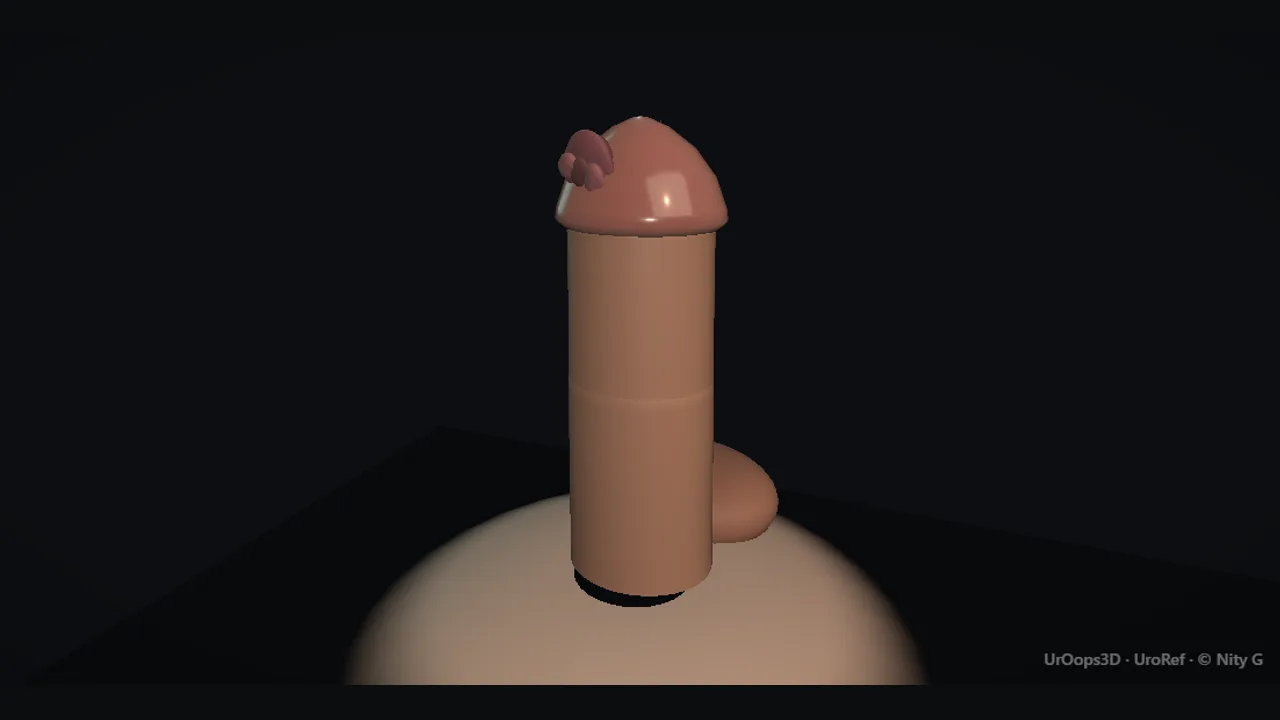 Interactive 3D Interactive operative model Open the 3D animation 3D Interactive total penectomy
Teaching catalogue only. This coverage record is not a patient pathway or operative instruction.
Typical place in practice
Biopsy-proven penile malignancy requiring local control after staging and review in a specialist penile-cancer pathway.
Alternatives and neighbouring procedures
Topical, laser or radiotherapy pathways in selected superficial disease, or systemic/palliative treatment for unresectable disease.
Same procedure family, explicit technique branches
These are variations of this canonical operation. Complication modules below identify whether they apply to all branches or only to named approaches.
Wide local excision or glans resurfacing
Removes superficial disease while preserving glans structure when oncologically appropriate.
Glansectomy with neoglans reconstruction
Achieves deeper distal clearance while preserving shaft length.
Partial penectomy
Removes tumour with a functional residual stump when feasible.
Total penectomy with perineal urethrostomy
Provides local control when a functional safe stump cannot be retained.
Salvage or recurrent-tumour excision
Treats recurrence after prior organ-preserving or radiotherapy treatment.
High-level sequence
Coverage outline only; not a step-by-step technical guide.
- Confirm histology, local extent, nodal plan and patient priorities
- Mark an oncologically appropriate excision while preserving function where safe
- Protect urethra and obtain controlled margins without tumour violation
- Reconstruct glans, shaft or urinary outlet for dependable healing
- Review pathology, urinary/sexual function and nodal surveillance
Operative notes
Concise operative notes covering the key steps, landmarks and watch points, in the order you encounter them.
Penile cancer surgery
What it does: remove penile tumour, keep function where safe.
partial penectomy
- Leave 3-4 cm minimum. He voids standing.
- Glove sewn over the tumour.
- Tourniquet at the base, penis emptied first.
- Mark the margin: a clear margin of a few mm is oncologically safe (EAU); the old 2 cm rule is historical.
- Skin cut. Dorsal bundle tied.
- Corpora cut, top to bottom.
- Cavernosal arteries tied, 3/0.
- Urethra cut 1 cm BEYOND the corporal cut. Spatulate it.
- Corpora closed with transverse 2/0.
- Skin closed upright. Full-thickness urethra to skin. Catheter 10 days.
total penectomy + perineal urethrostomy
- Circle cut at the base, plus 2 cm up and down.
- Suspensory ligament cut. Vessels clipped.
- Urethra freed at mid-shaft, right angle behind it.
- Corpora divided at the pubic rami. Oversewn.
- Urethra tunnelled under skin to a perineal hole.
- Spatulate. Stitch full thickness. Close sideways.
- 2026 update: Sentinel node biopsy in the groin is now standard in UK centres. Not routine full groin clearance.
- 2026 update: Laser, brachytherapy, glans resurfacing: penis-sparing options for low risk.
From the UroRef Operative Quick Guide. Open the note page →
Every failure mode is its own module.
Timing and variation coverage are recorded for each module.
Bleeding, infection or graft loss
Penile excision and reconstruction can produce haematoma, contamination and partial or complete graft failure.
Applies to: All variantsUrethral leak, fistula or meatal stenosis
The reconstructed urinary outlet can break down or scar.
Applies to: All variantsFlap, glans or stump ischaemia
Extensive resection can compromise the remaining blood supply.
Applies to: All variantsPositive margin or local recurrence
Organ preservation requires pathology-led review and structured local surveillance.
Applies to: All variantsUrinary spraying, sitting to void or outlet-care difficulty
Altered urethral position and calibre affect urinary function.
Applies to: Partial penectomy · Total penectomy with perineal urethrostomy · Salvage or recurrent-tumour excisionSexual, sensory, body-image and psychological morbidity
Functional and emotional consequences vary substantially by the amount of organ preserved.
Applies to: All variantsDonor-site morbidity
Skin-graft harvest creates an additional wound and scar.
Applies to: Wide local excision or glans resurfacing · Glansectomy with neoglans reconstructionSources for this module
Organ-preserving treatment, penectomy, reconstruction and nodal surgery.
Accessed 2026-08-03 · opens source British Association of Urological Surgeons Patient information leaflets by procedureUK patient-facing procedure, alternatives, recovery and complication framing.
Accessed 2026-08-03 · opens source