
Prostatic artery embolisation pathway
Image-guided embolisation of prostatic arterial supply for selected benign prostatic obstruction, with urological selection and radiological technical risks combined in one pathway.
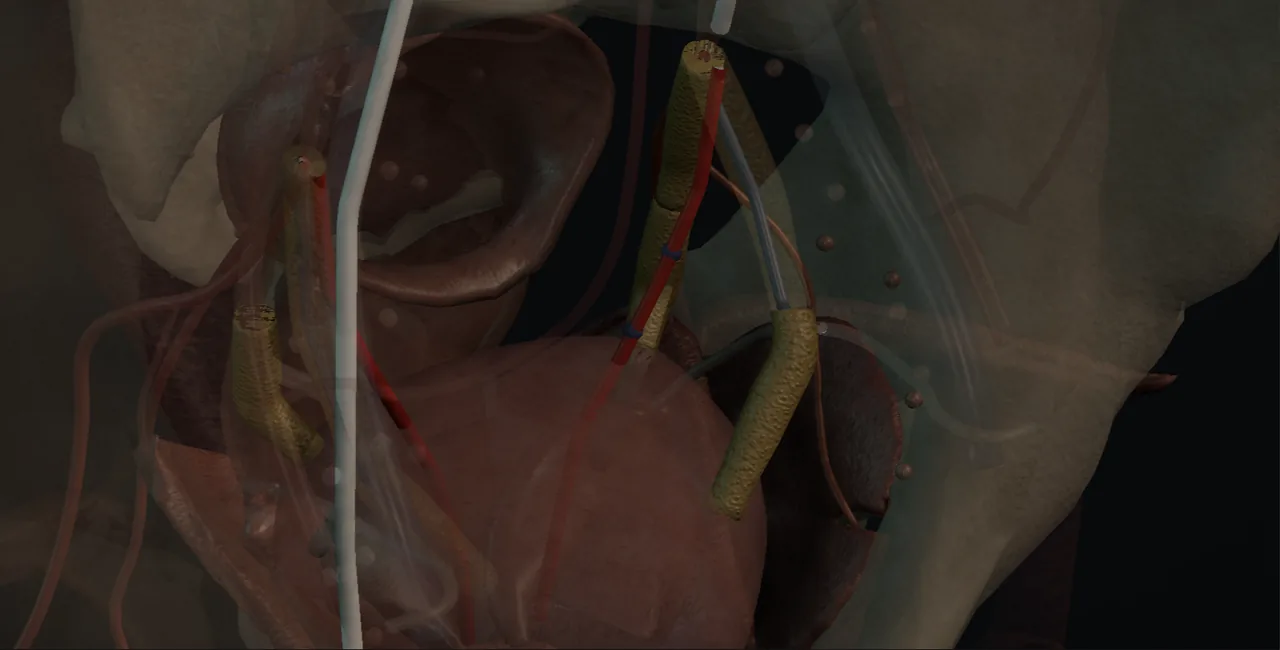 Interactive 3D Interactive prostatic artery embolisation Open the 3D animation
Teaching catalogue only. This coverage record is not a patient pathway or operative instruction.
Typical place in practice
Selected bothersome benign prostatic enlargement after objective assessment and multidisciplinary discussion of comparative efficacy, radiation and retreatment.
Alternatives and neighbouring procedures
Observation, medication, catheter management and established endoscopic, enucleation, vaporisation or simple-prostatectomy procedures.
Same procedure family, explicit technique branches
These are variations of this canonical operation. Complication modules below identify whether they apply to all branches or only to named approaches.
Bilateral prostatic artery embolisation
Attempts symmetrical gland devascularisation where vascular anatomy permits.
Unilateral embolisation
Provides a potentially less complete treatment in difficult anatomy.
Repeat embolisation
Reassesses altered collateral anatomy before further treatment.
High-level sequence
Coverage outline only; not a step-by-step technical guide.
- Confirm benign indication and exclude other causes of symptoms
- Map pelvic arterial anatomy and non-target branches
- Selectively catheterise the prostatic arterial supply
- Deliver embolic material while protecting bladder, rectum and penile circulation
- Assess urinary response, complications and need for further treatment
The operation, step by step
A step that touches one of this module's danger zones is marked and cross-linked below.
- SetupPlanning imaging reviewed in the multidisciplinary meeting, antibiotic prophylaxis and scheduled analgesia prescribed, local anaesthesia with conscious sedation, arterial access kit and calibrated microspheres prepared.
- AccessUltrasound-guided common femoral artery puncture, or a radial alternative, with a flush catheter positioned for pelvic angiography.
- Perform bilateral internal iliac angiography and map the prostatic arterial supply and its origins.
- Select the prostatic artery with a microcatheter, usually from the anterior division of the internal iliac.
- Run cone-beam CT or steep obliques to confirm prostatic blush and exclude prostatic capsular anastomoses to adjacent organs. danger zone: Prostatic capsular anastomoses
- Protect the bladder, rectal and penile arterial collaterals with coils or temporary particles before any embolisation. danger zone: Bladder, rectal and penile arterial collaterals
- Deliver microspheres under continuous fluoroscopy to near-stasis without reflux.
- Complete the contralateral side through direct selection or collateral cross-fill for bilateral treatment.
- Confirm devascularisation on control angiography with no non-target opacification.
- Treat the internal iliac and access-site vessels gently through every exchange, because spasm or dissection there ends the procedure. danger zone: Internal iliac and access-site vessels
- Close the access site with a closure device or manual pressure and inspect the foot pulses.
- Record the cumulative contrast and radiation exposure as a stated limit for any repeat procedure. danger zone: Cumulative contrast and radiation exposure
- ClosureArterial closure only, no drains; the urological team documents catheter status and retention risk.
- AftercareDay-case or overnight stay with scheduled analgesia for post-embolisation syndrome, catheter only for retention, and urological review with a flow study at about three months.
Every failure mode is its own module.
Timing and variation coverage are recorded for each module.
Non-target embolisation
Embolic material can injure bladder, rectum, penis, skin or other pelvic organs through collateral vessels.
Applies to: All variantsAccess-site bleeding, pseudoaneurysm or arterial injury
Femoral or radial access and selective catheterisation can injure vessels.
Applies to: All variantsPost-embolisation pain and systemic inflammatory symptoms
Ischaemic prostate tissue can produce pelvic symptoms and systemic malaise.
Applies to: All variantsUrinary retention or infection
Swelling and pre-existing obstruction can impair voiding and increase infection risk.
Applies to: All variantsContrast-related kidney or allergic complication
Angiography introduces contrast-specific renal and hypersensitivity risks.
Applies to: All variantsErectile, ejaculatory or penile ischaemic dysfunction
Intended and unintended vascular changes can affect sexual function.
Applies to: All variantsIncomplete response, recurrence or retreatment
Technical success does not guarantee durable symptom and flow improvement.
Applies to: All variantsSources for this module
Contemporary outlet procedures, selection, variants and functional trade-offs.
Accessed 2026-08-03 · opens source British Association of Urological Surgeons Patient information leaflets by procedureUK patient-facing procedure, alternatives, recovery and complication framing.
Accessed 2026-08-03 · opens source