
Revision sheet
Prostatic artery embolisation
9 steps, each one the authored title and caption from the interactive animation, with the frame captured from that step. Read it before the case, or print it and work through the steps in order.
Teaching only, not for diagnosis or treatment decisions. The text on this sheet is the animation's own step copy, reproduced verbatim.
UrOops3D · UroRef · © Nity G
- 01
Who chooses embolisation
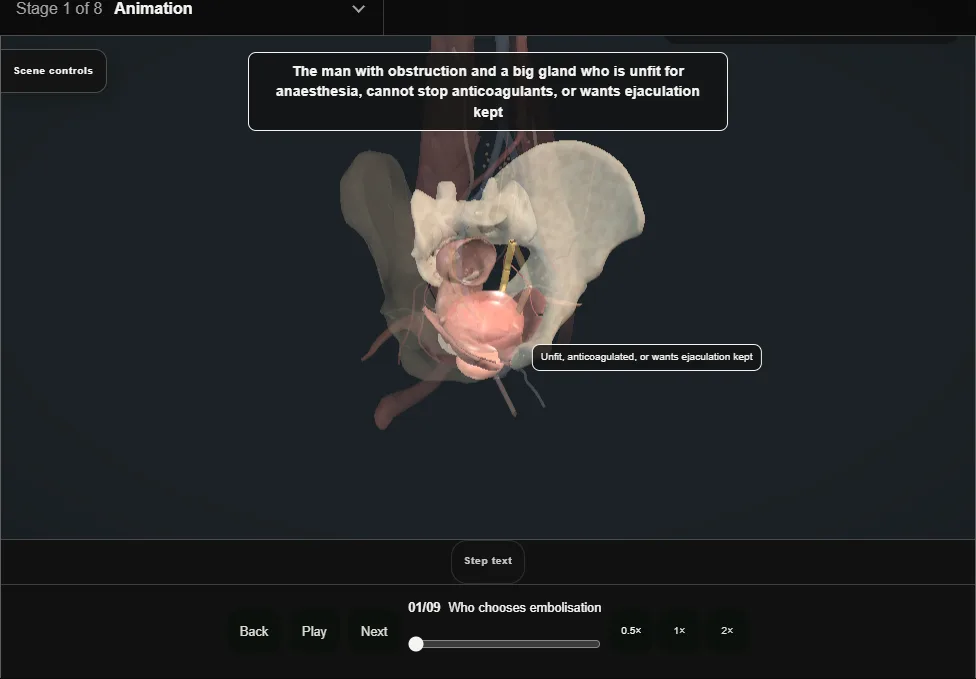
- Obstruction and a big gland in a man unfit for anaesthesia, unable to stop anticoagulants, or who wants ejaculation kept.
- Less effective than resection, more than tablets, done awake.
- 02
CT angiography and the plan
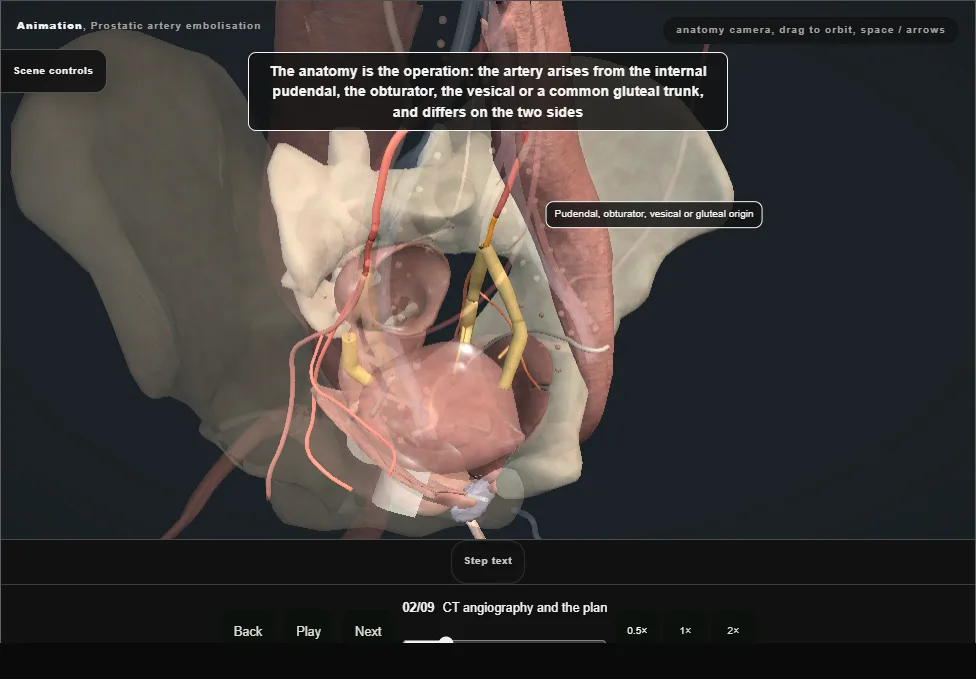
- The origin of each prostatic artery, its calibre, atheroma, and its anastomoses to rectum, bladder and penis.
- It arises from the internal pudendal, obturator, vesical or a gluteal trunk, and differs on the two sides.
- 03
Access and the internal iliac
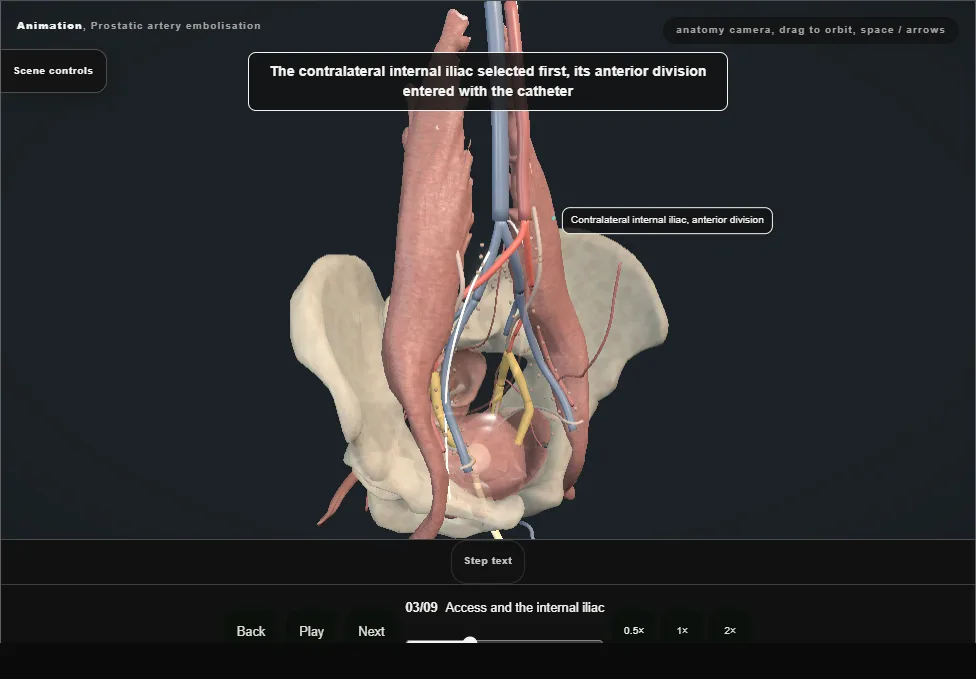
- Right femoral or left radial, heparin, a catheter up the external iliac and over the bifurcation; the contralateral internal iliac selected first and its anterior division entered.
- 04
The prostatic artery
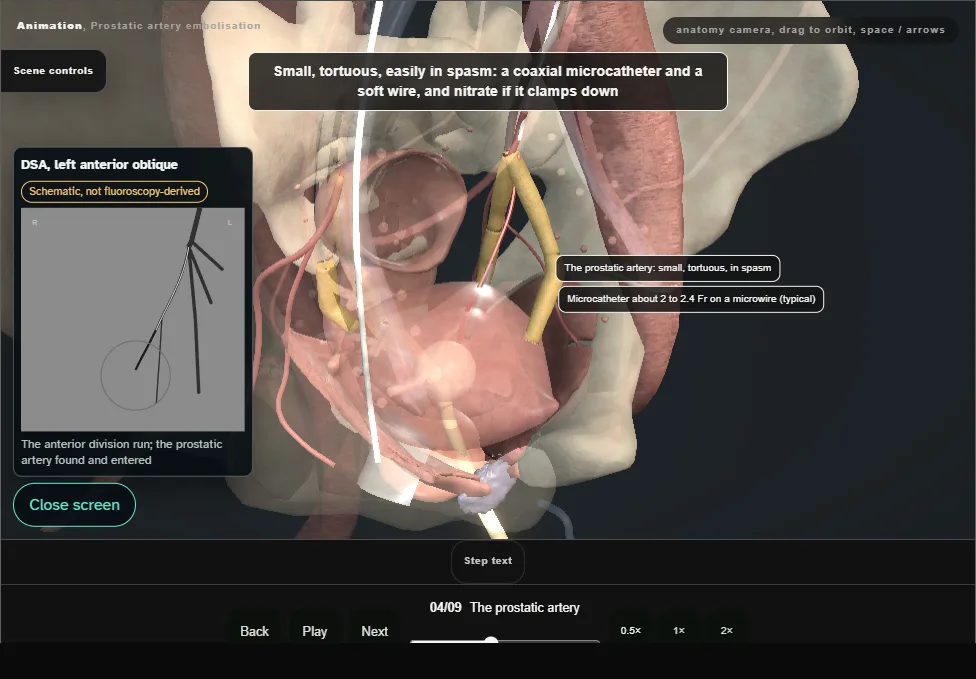
- Found on the anterior division where the CT said it would be: small, tortuous, easily in spasm.
- A coaxial microcatheter and a soft wire, and nitrate if it clamps down.
- 05
Microcatheter, cone-beam CT, the non-target check
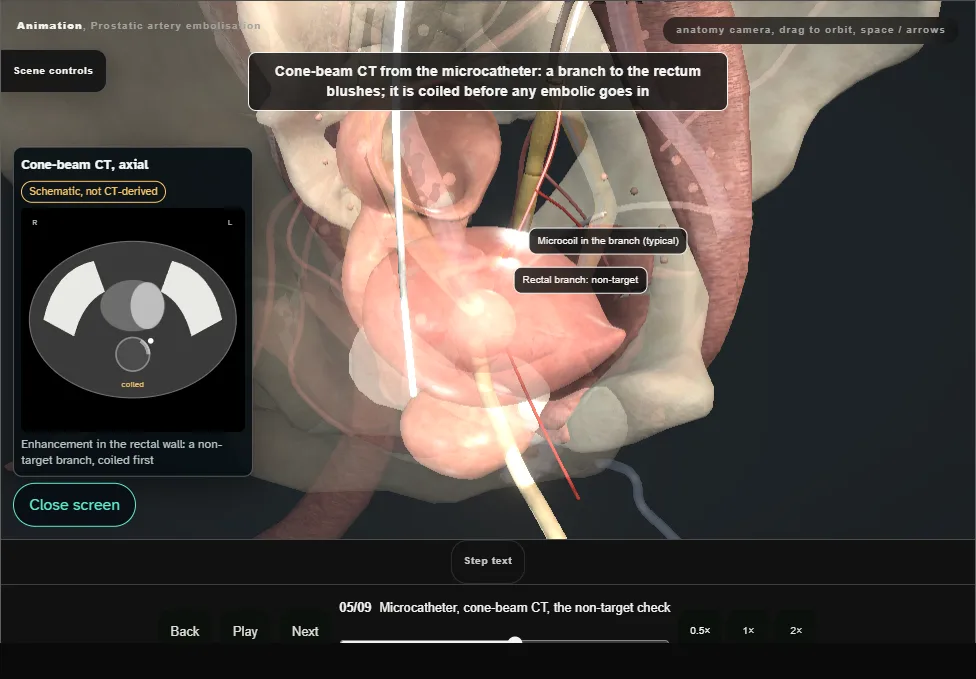
- Contrast through the microcatheter: the gland blushes and every branch that leaves it is looked for.
- Cone-beam CT shows a blush in the rectum, bladder or penis that is coiled or bypassed before any embolic goes in.
- 06
Embolisation to stasis
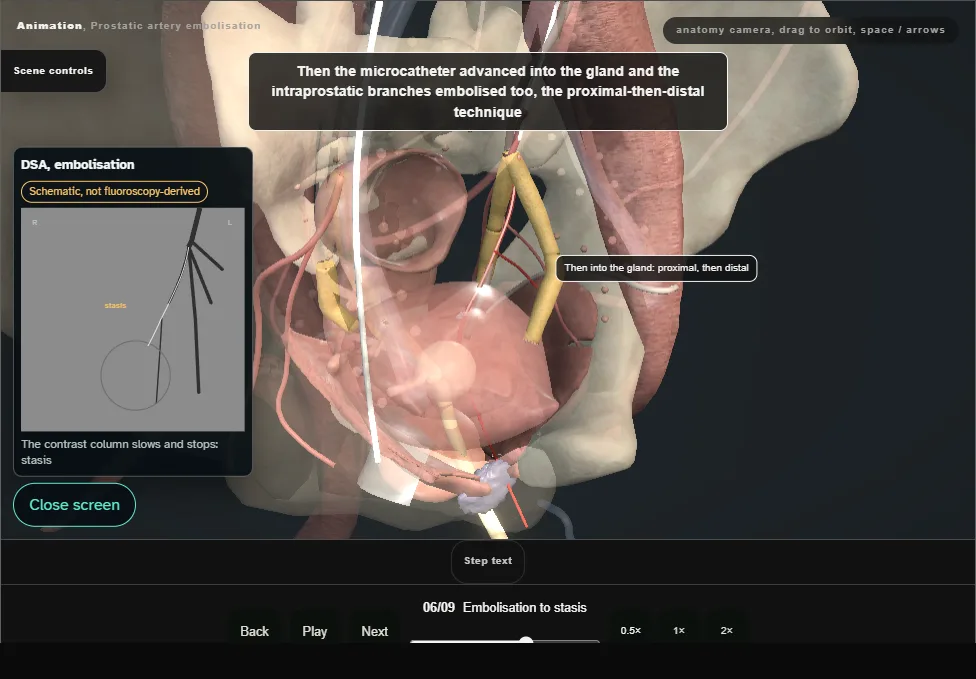
- Microspheres (typically 100 to 300 microns) in contrast, slowly, until the flow stops; then the microcatheter advanced into the gland and the intraprostatic branches embolised too.
- 07
The other side
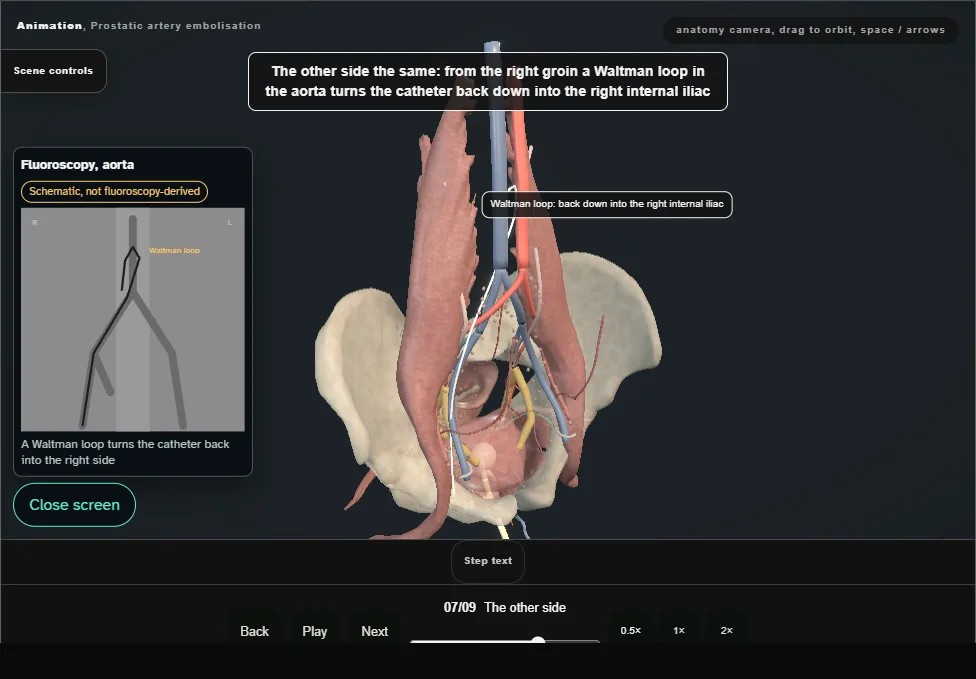
- The same on the right, reached from the right groin with a Waltman loop or from the wrist: a bilateral embolisation is what works and a unilateral one is a partial answer.
- Catheters out, the groin closed or the wrist banded, home the same day.
- 08
After: the post-embolisation syndrome
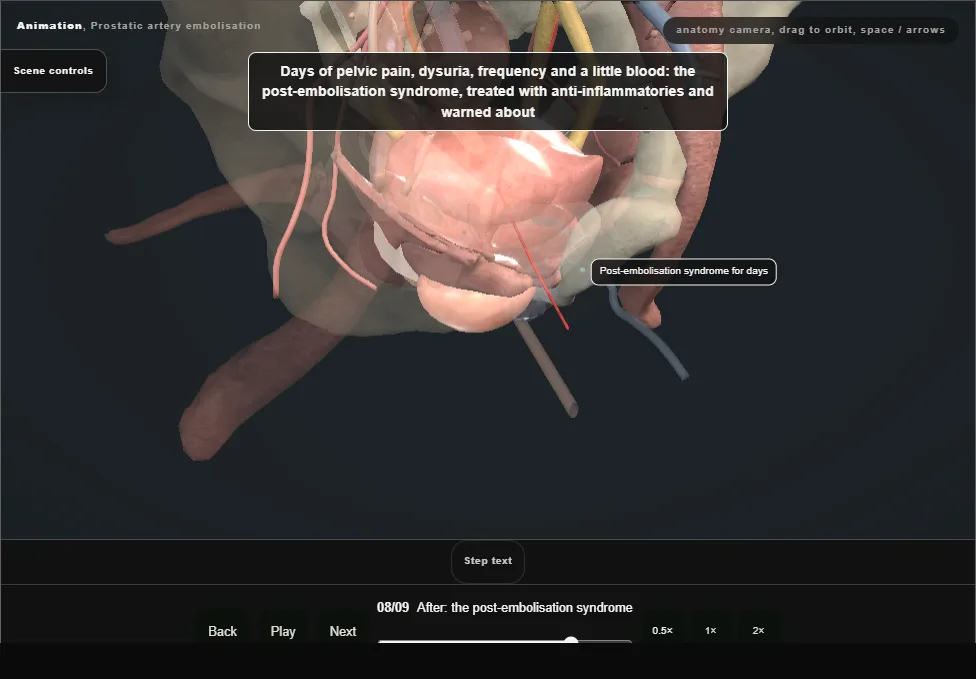
- Days of pelvic pain, dysuria, frequency and a little blood, treated with anti-inflammatories and warned about; retention in a few from the swollen gland, a catheter for a week.
- 09
Outcomes and re-treatment
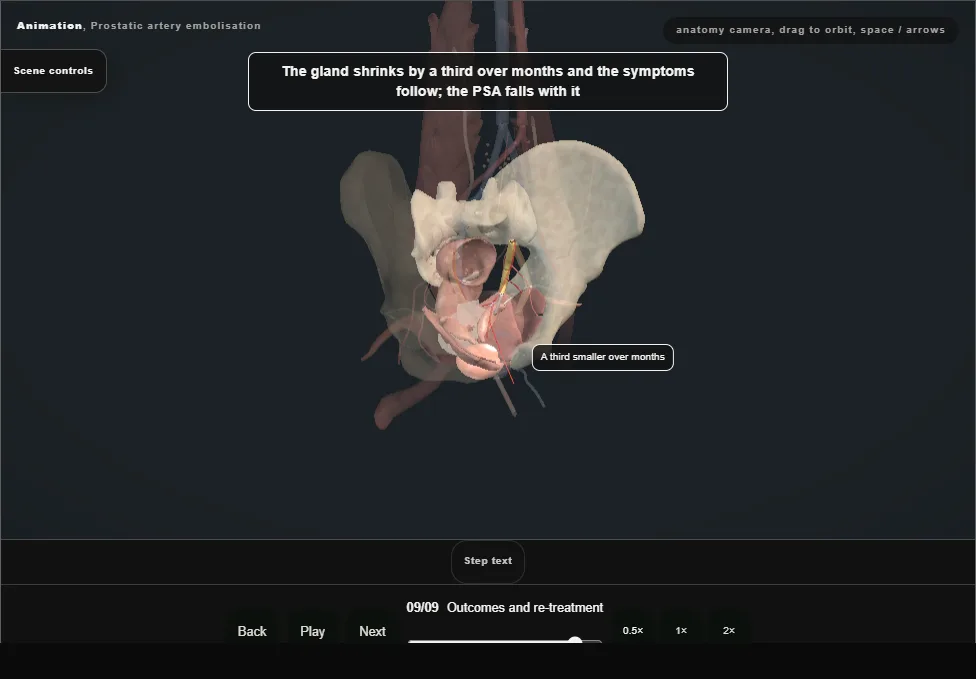
- The gland shrinks by a third over months and the symptoms follow.
- Re-treatment in a fifth within a few years, and the resection still possible if it fails.
Derived from pelvis/PaeScene.tsx at build time: every step title and caption above is the authored
ProcedureDef text, reproduced verbatim, and this page shares its readable-points renderer with the animation
itself. 9 of 9 steps have a captured frame.
Text fingerprint 353cc4e8c472a1a8. A caption edit without a re-capture fails the production
check, so the sheet and the animation cannot drift apart silently.