
Recipient kidney transplantation
Implantation of a living- or deceased-donor kidney with vascular and ureteric reconstruction, including complex-vessel and intraperitoneal variants.
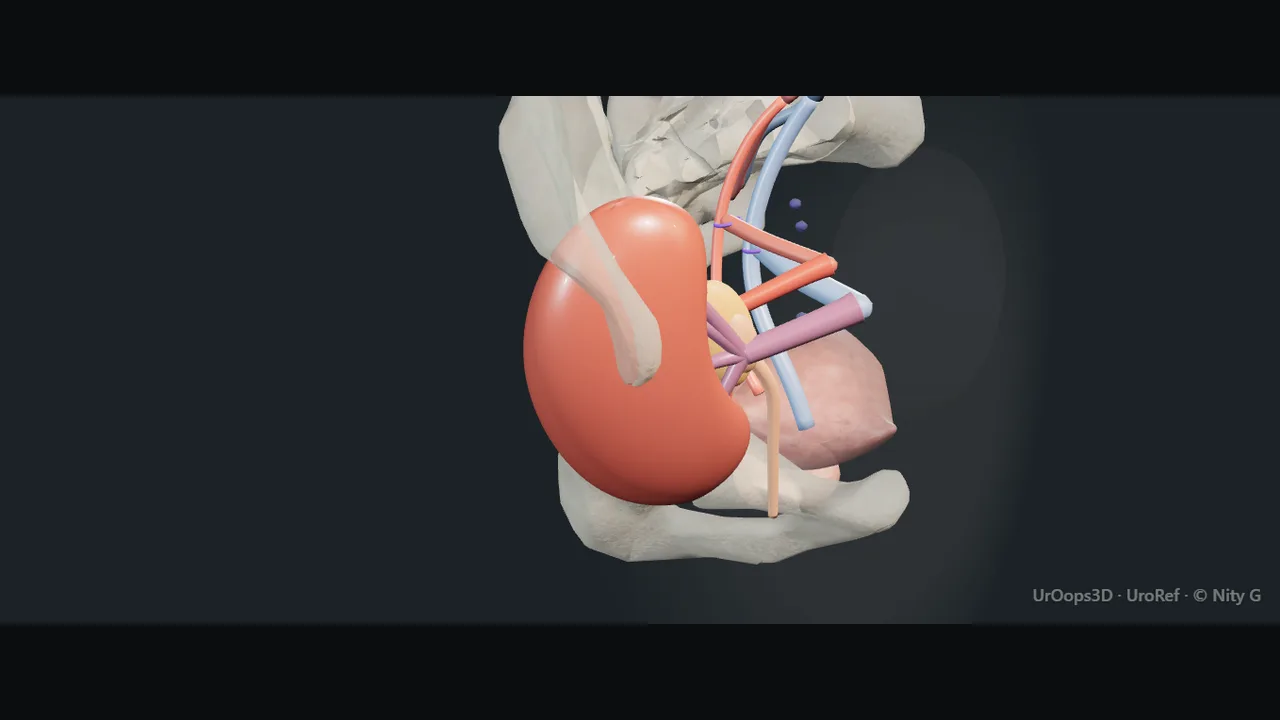 Interactive 3D Interactive kidney transplant into the iliac fossa Open the 3D animation
Teaching catalogue only. This coverage record is not a patient pathway or operative instruction.
Typical place in practice
Eligible end-stage kidney disease after recipient, donor-organ, immunological, vascular and lower-urinary-tract assessment.
Alternatives and neighbouring procedures
Haemodialysis, peritoneal dialysis, conservative kidney care or deferral until recipient/donor factors are optimised.
Same procedure family, explicit technique branches
These are variations of this canonical operation. Complication modules below identify whether they apply to all branches or only to named approaches.
Standard extraperitoneal iliac-fossa transplant
The usual recipient implantation route for an adult-sized graft.
Paediatric or intraperitoneal transplant
Accommodates a graft in a small child or selected complex abdomen.
Multiple-vessel or vascular-reconstruction transplant
Manages accessory arteries, short veins or donor vascular variation.
Transplant into reconstructed or diverted urinary tract
Adapts drainage for abnormal bladder function or prior diversion.
Dual or en bloc kidney transplant
Uses a graft configuration with distinct vascular and space requirements.
High-level sequence
Coverage outline only; not a step-by-step technical guide.
- Confirm recipient, organ and immunological readiness
- Expose suitable recipient vessels and prepare graft anatomy
- Create tension-free arterial and venous anastomoses
- Reperfuse and assess graft perfusion before urinary reconstruction
- Construct drainage and monitor vascular, urinary, functional and immunological outcomes
Every failure mode is its own module.
Timing and variation coverage are recorded for each module.
Renal artery or vein thrombosis
Early graft-vessel thrombosis can cause abrupt allograft loss and requires time-critical recognition.
Applies to: All variantsMajor haemorrhage or anastomotic disruption
Recipient or graft vessels can bleed during or after implantation.
Applies to: All variantsUreteric leak, necrosis or stricture
Compromised graft-ureter blood supply or anastomotic issues can cause leakage or obstruction.
Applies to: All variantsLymphocele or lymphatic leak
Recipient iliac lymphatic division can produce a compressive or infected collection.
Applies to: All variantsDelayed graft function or primary non-function
Ischaemia–reperfusion injury, donor quality and technical factors can delay or prevent graft function.
Applies to: All variantsRejection, infection or immunosuppression-related morbidity
Surgical recovery occurs within a lifelong immunological and infectious-risk pathway.
Applies to: All variantsIliac-vessel thrombosis or limb ischaemia
Clamping, dissection or anastomosis can compromise recipient lower-limb circulation.
Applies to: All variantsBowel, bladder or adjacent-organ injury
Prior surgery and intraperitoneal placement increase adjacent-organ risk.
Applies to: All variants