
Renal allograft biopsy
Image-guided or open sampling of a transplanted kidney for graft dysfunction or protocol surveillance, with specimen triage integral to the procedure.
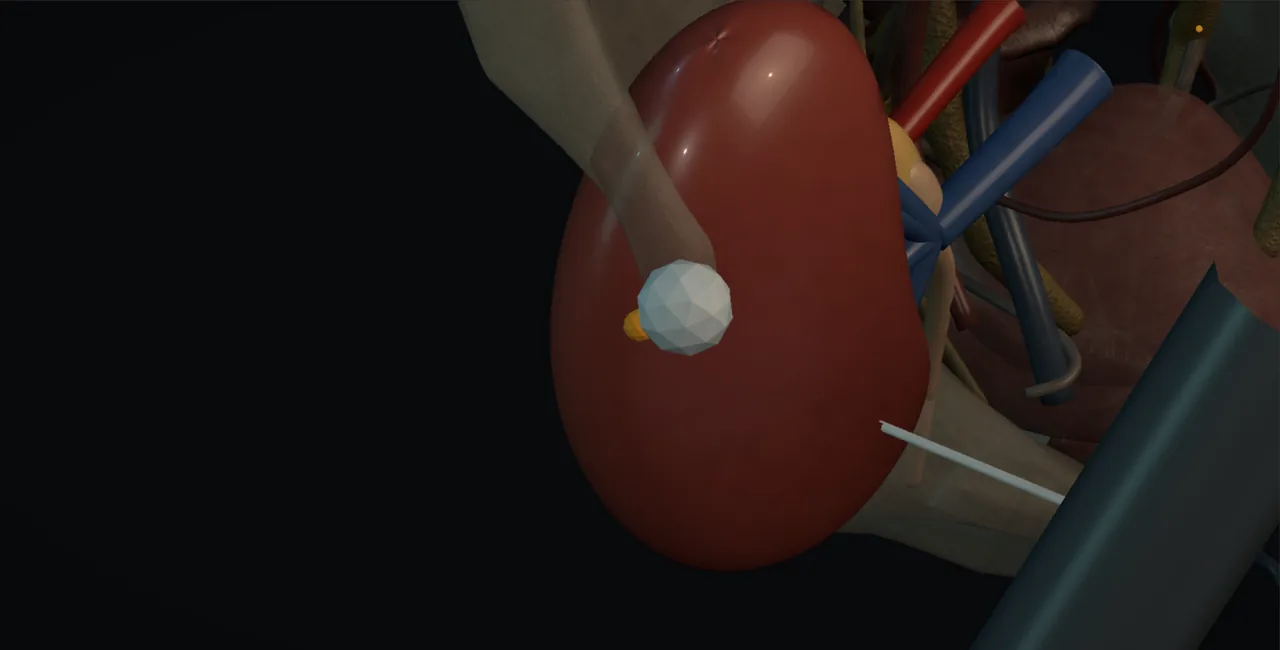 Interactive 3D Interactive allograft biopsy under ultrasound Open the 3D animation
Teaching catalogue only. This coverage record is not a patient pathway or operative instruction.
Typical place in practice
Unexplained graft dysfunction, proteinuria, suspected rejection or infection, or a protocol-defined surveillance time point.
Alternatives and neighbouring procedures
Clinical, biochemical and imaging assessment; non-invasive biomarkers where validated; or transvenous/surgical biopsy when percutaneous access is unsafe.
Same procedure family, explicit technique branches
These are variations of this canonical operation. Complication modules below identify whether they apply to all branches or only to named approaches.
Ultrasound-guided percutaneous core biopsy
The standard route for an accessible iliac-fossa graft.
Open or laparoscopic biopsy
Provides haemostatic control when percutaneous biopsy is unsafe or during another operation.
Transvenous biopsy pathway
A specialist option for severe bleeding risk or inaccessible grafts.
High-level sequence
Coverage outline only; not a step-by-step technical guide.
- Confirm indication, imaging, haemostasis and specimen requirements
- Localise a safe cortical trajectory away from hilum and collecting system
- Obtain adequate cores with immediate specimen triage
- Assess for bleeding and graft complications
- Act on pathology within the transplant clinical context
Every failure mode is its own module.
Timing and variation coverage are recorded for each module.
Perigraft haematoma or major haemorrhage
A biopsy tract can injure arterial or venous branches and occasionally require transfusion or intervention.
Applies to: All variantsArteriovenous fistula or pseudoaneurysm
Paired vessel injury can create a persistent vascular lesion.
Applies to: All variantsMacroscopic haematuria or ureteric obstruction by clot
Communication with the collecting system can cause bleeding and impaired graft drainage.
Applies to: All variantsInfection
Needle or surgical access can seed a graft or surrounding collection in an immunosuppressed patient.
Applies to: All variantsBowel, bladder or iliac-vessel injury
An atypical graft position or unsafe trajectory can injure adjacent structures.
Applies to: All variantsInadequate, crushed or misallocated specimen
Sampling and laboratory triage failure can make an invasive procedure non-diagnostic.
Applies to: All variantsGraft dysfunction or loss
Severe bleeding, obstruction or vascular injury can impair the transplanted kidney.
Applies to: All variants