
Renal autotransplantation and ex vivo repair
Nephrectomy, cold perfusion, bench reconstruction and iliac-fossa reimplantation for selected complex vascular, ureteric, tumour or pain indications.
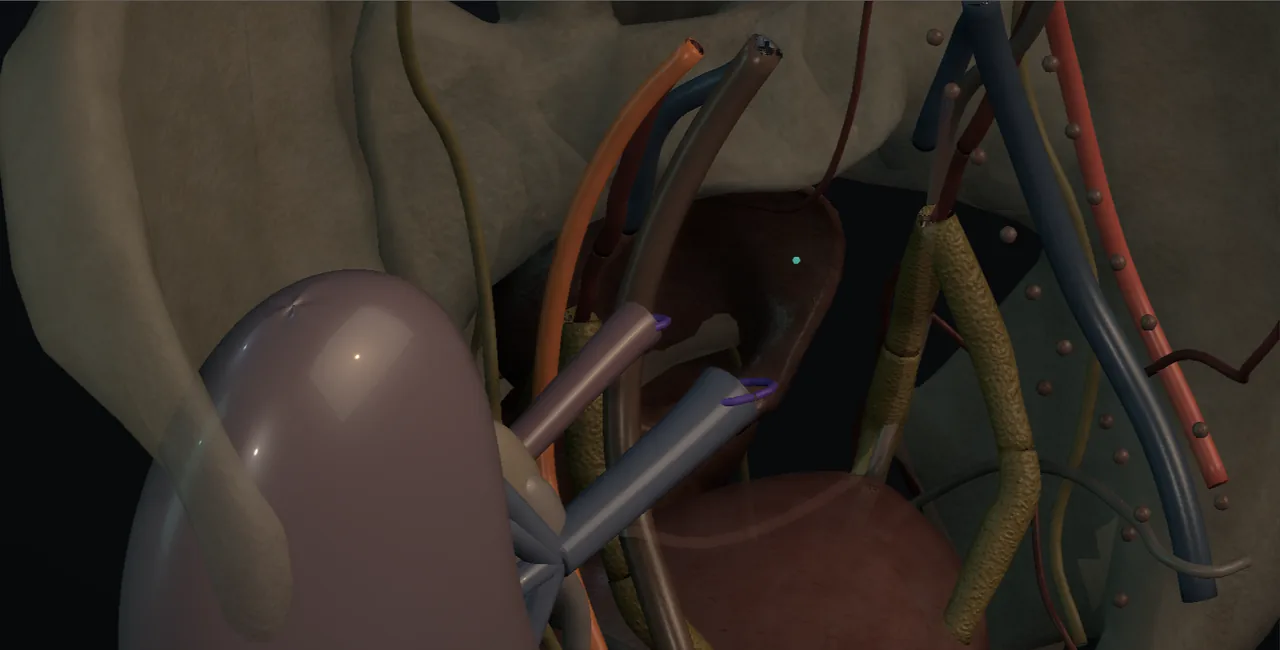 Interactive 3D Interactive autotransplant with bench repair Open the 3D animation
Teaching catalogue only. This coverage record is not a patient pathway or operative instruction.
Typical place in practice
Exceptional disease not safely reconstructable in situ where preserving the kidney justifies transplant-level vascular and urinary risk.
Alternatives and neighbouring procedures
In situ vascular or ureteric reconstruction, bowel/graft ureteric substitution, partial nephrectomy, chronic drainage, nephrectomy or non-operative management.
Same procedure family, explicit technique branches
These are variations of this canonical operation. Complication modules below identify whether they apply to all branches or only to named approaches.
Autotransplant for complex ureteric loss
Avoids a long substitute ureter by moving the kidney to the iliac fossa.
Ex vivo renovascular reconstruction
Treats complex branch aneurysm, stenosis or vascular injury.
Ex vivo tumour excision
Allows cold, bloodless resection of exceptional central or multifocal tumours.
Autotransplant for selected pain syndrome
A highly selected pathway after multidisciplinary confirmation and expectation setting.
High-level sequence
Coverage outline only; not a step-by-step technical guide.
- Confirm exceptional indication, renal function and realistic alternatives
- Perform organ-preserving nephrectomy with transplant-quality vessels and ureter/pelvis
- Cold-perfuse and complete bench vascular, tumour or collecting-system repair
- Reimplant vessels and urinary drainage in the iliac fossa
- Monitor perfusion, leak, function, recurrence and indication-specific outcomes
Every failure mode is its own module.
Timing and variation coverage are recorded for each module.
Arterial or venous thrombosis and renal loss
Multiple reconstructed vessels and cold-ischaemia exposure can lead to early graft failure.
Applies to: All variantsMajor haemorrhage or vascular anastomotic disruption
Both nephrectomy and reimplantation create major vascular risk.
Applies to: All variantsUrinary leak or ureteric obstruction
Bench collecting-system repair and new urinary anastomosis can leak or scar.
Applies to: All variantsIschaemic renal dysfunction
Warm/cold ischaemia, perfusion and branch reconstruction affect renal recovery.
Applies to: All variantsBowel, solid-organ or iliac-vessel injury
The operation combines upper-abdominal nephrectomy and pelvic transplant exposures.
Applies to: All variantsInfection, lymphocele or wound complication
Two operative fields and iliac lymphatic dissection increase wound and collection morbidity.
Applies to: All variantsPersistent pain or failure of indication-specific benefit
Technically successful reimplantation may not achieve the intended pain outcome.
Applies to: Autotransplant for selected pain syndromeResidual or recurrent tumour
Bench excision must maintain margin quality and surveillance despite maximal preservation intent.
Applies to: Ex vivo tumour excisionSources for this module
Living-donor nephrectomy, recipient surgery and transplant complications.
Accessed 2026-08-03 · opens source European Association of Urology EAU Guidelines on Renal Cell CarcinomaPartial and radical nephrectomy, approach selection and renal-tumour ablation.
Accessed 2026-08-03 · opens source European Association of Urology EAU Guidelines on Urological TraumaRenal, ureteric, bladder, urethral and genital trauma and reconstruction.
Accessed 2026-08-03 · opens source