
Renal tumour ablation
Image-guided or laparoscopic destruction of a selected renal mass by cryothermal or heat-based energy, with biopsy and imaging follow-up as integral steps.
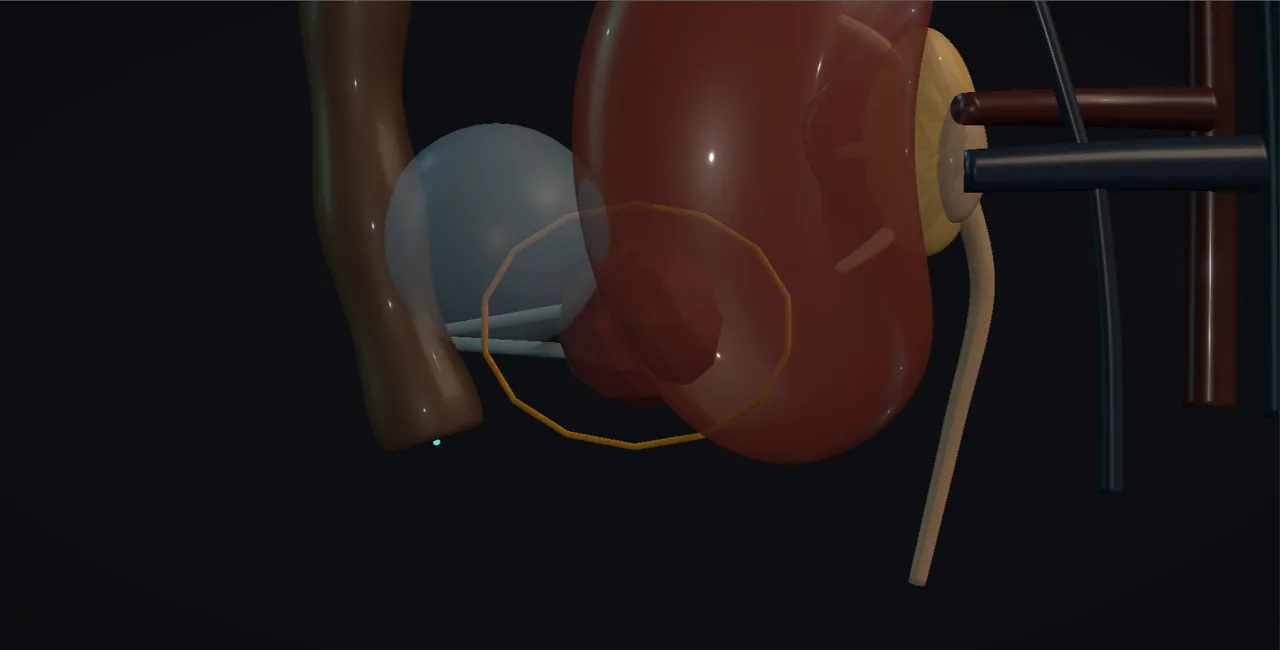 Interactive 3D Interactive percutaneous tumour ablation Open the 3D animation
Teaching catalogue only. This coverage record is not a patient pathway or operative instruction.
Typical place in practice
Selected small renal masses where nephron preservation and lower procedural burden are priorities after comparison with surveillance and surgery.
Alternatives and neighbouring procedures
Active surveillance, partial nephrectomy, radical nephrectomy, or systemic treatment according to tumour and patient factors.
Same procedure family, explicit technique branches
These are variations of this canonical operation. Complication modules below identify whether they apply to all branches or only to named approaches.
Percutaneous cryoablation
Creates a monitored ice ball around the target while protecting adjacent structures.
Laparoscopic cryoablation
Uses operative mobilisation for a lesion inaccessible or unsafe percutaneously.
Radiofrequency ablation
Causes thermal coagulation around an electrode.
Microwave ablation
Uses a microwave field to create a thermal treatment zone.
High-level sequence
Coverage outline only; not a step-by-step technical guide.
- Confirm imaging, biopsy strategy and suitability for ablation
- Plan probe trajectory and protection of bowel, ureter and collecting system
- Place probes to cover tumour with an intended margin
- Monitor the treatment zone and immediate complications
- Complete structured contrast-imaging follow-up for residual or recurrent enhancement
Every failure mode is its own module.
Timing and variation coverage are recorded for each module.
Perirenal bleeding or vascular injury
Probe passage and tissue necrosis can cause haematoma, pseudoaneurysm or active haemorrhage.
Applies to: All variantsCollecting-system injury, urine leak or ureteric stricture
Central treatment or heat/cold spread can injure urothelium and impair drainage.
Applies to: All variantsBowel or adjacent-organ thermal injury
An insufficient protective window can transmit energy beyond the kidney.
Applies to: All variantsPleural injury or pneumothorax
An upper-pole percutaneous trajectory may traverse or irritate the pleura.
Applies to: All variantsInfection or abscess
Necrotic tissue and urinary communication can become infected.
Applies to: All variantsResidual viable tumour or local recurrence
Incomplete treatment requires imaging recognition and may prompt repeat ablation or surgery.
Applies to: All variantsCold- or heat-specific skin and nerve injury
Energy can injure the abdominal wall, psoas or nearby sensory and motor nerves.
Applies to: All variantsSources for this module
Partial and radical nephrectomy, approach selection and renal-tumour ablation.
Accessed 2026-08-03 · opens source British Association of Urological Surgeons Patient information leaflets by procedureUK patient-facing procedure, alternatives, recovery and complication framing.
Accessed 2026-08-03 · opens source