
Renal vein and inferior vena cava tumour thrombectomy
Radical nephrectomy with renal-vein or caval tumour-thrombus removal, escalating through liver mobilisation, vascular isolation and cardiothoracic support by thrombus level.
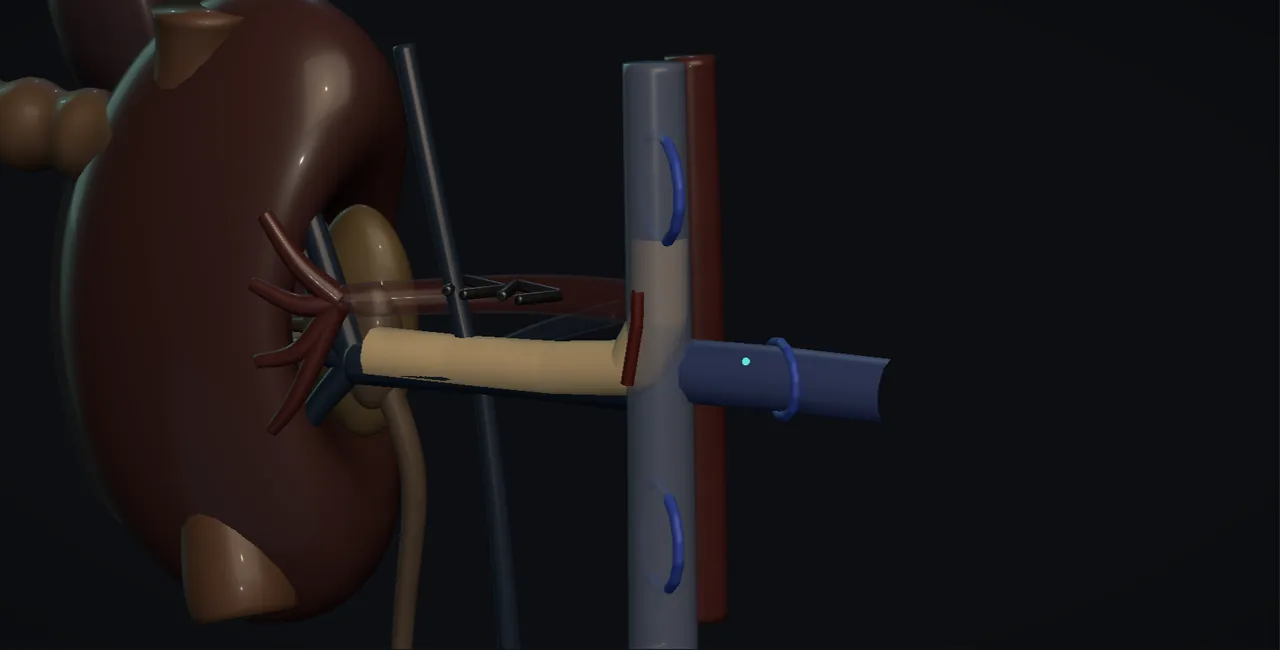 Interactive 3D Interactive caval thrombectomy, loop by loop Open the 3D animation
Teaching catalogue only. This coverage record is not a patient pathway or operative instruction.
Typical place in practice
Potentially resectable renal malignancy with venous tumour extension after complete staging and multidisciplinary assessment.
Alternatives and neighbouring procedures
Systemic therapy, non-operative palliation or another staged oncological strategy when complete safe resection is not feasible.
Same procedure family, explicit technique branches
These are variations of this canonical operation. Complication modules below identify whether they apply to all branches or only to named approaches.
Renal-vein or low-caval thrombectomy
Removes limited thrombus with local renal-vein/IVC control.
Retrohepatic caval thrombectomy
Controls the cava above and below a thrombus behind the liver.
Suprahepatic or atrial thrombectomy
May require cardiopulmonary bypass or other specialist circulatory-control techniques.
Caval wall resection and reconstruction
Addresses adherent or invasive tumour involving the vena-caval wall.
High-level sequence
Coverage outline only; not a step-by-step technical guide.
- Stage tumour and map cranial thrombus extent and venous collaterals
- Assemble vascular, hepatobiliary and cardiothoracic support appropriate to level
- Control renal artery and obtain secure venous inflow/outflow control
- Remove kidney and thrombus without fragmentation
- Reconstruct or manage the cava and monitor embolic, hepatic and renal consequences
Every failure mode is its own module.
Timing and variation coverage are recorded for each module.
Massive haemorrhage
Caval, hepatic, lumbar or collateral-vessel injury can produce rapid life-threatening blood loss.
Applies to: All variantsTumour or bland-thrombus embolisation
Thrombus manipulation can send material to the pulmonary circulation or heart.
Applies to: All variantsCaval thrombosis, stenosis or lower-body oedema
Reconstruction or ligation can impair venous return and threaten the contralateral renal vein.
Applies to: All variantsHepatic or cardiac injury and organ failure
High-level exposure and circulatory control can injure liver, hepatic veins, diaphragm or heart.
Applies to: Retrohepatic caval thrombectomy · Suprahepatic or atrial thrombectomyAcute kidney injury
Nephrectomy, venous control, blood loss and haemodynamic instability stress the remaining kidney.
Applies to: All variantsNeurological, coagulopathic or bypass-related event
Complex circulatory support adds neurological, inflammatory and coagulation risks.
Applies to: Suprahepatic or atrial thrombectomyPositive vascular margin or tumour spill
Thrombus fragmentation or unrecognised wall invasion can compromise oncological clearance.
Applies to: All variantsDeath or prolonged critical illness
This is a major multiorgan operation with a recognised risk of severe postoperative morbidity.
Applies to: All variants