
Retroperitoneal lymph-node dissection
Template or mass-directed retroperitoneal dissection for testicular germ-cell tumour, separating primary from post-chemotherapy and open from minimally invasive pathways.
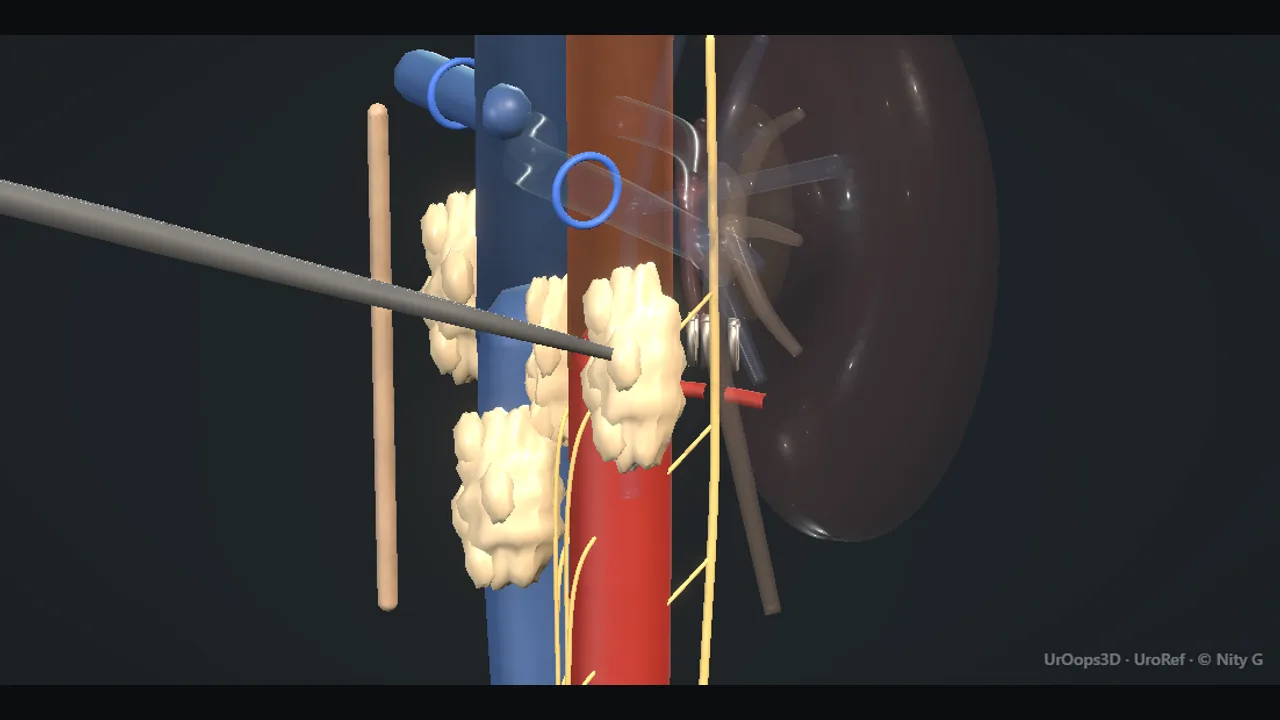 Interactive 3D Interactive operative model Open the 3D animation
Teaching catalogue only. This coverage record is not a patient pathway or operative instruction.
Typical place in practice
Selected stage and histology in primary disease or residual post-chemotherapy mass after specialist multidisciplinary review.
Alternatives and neighbouring procedures
Surveillance, chemotherapy, radiotherapy in selected seminoma pathways, or further systemic treatment according to disease context.
Same procedure family, explicit technique branches
These are variations of this canonical operation. Complication modules below identify whether they apply to all branches or only to named approaches.
Primary open nerve-sparing RPLND
Removes nodal tissue while preserving sympathetic fibres where oncologically safe.
Post-chemotherapy open RPLND
Addresses fibrotic, adherent residual disease after systemic treatment.
Laparoscopic or robotic RPLND
A specialist option for carefully selected lower-volume disease.
Extended or en bloc multivisceral resection
Achieves clearance when a residual mass invades or is inseparable from adjacent structures.
High-level sequence
Coverage outline only; not a step-by-step technical guide.
- Confirm tumour markers, imaging, laterality and treatment context
- Define an oncologically appropriate template and organ-salvage plan
- Control great vessels and remove nodal tissue without tumour violation
- Preserve sympathetic nerves where safe
- Monitor chyle, bowel, vascular, renal, ejaculatory and oncological outcomes
Operative notes
Concise operative notes covering the key steps, landmarks and watch points, in the order you encounter them.
RPLND
What it does: node clearance behind the bowel, for testis cancer.
- Role / scope Type 1: template, nerve sparing, no known spread.
- Role / scope Type 2: small known nodes.
- Role / scope Type 3: post-chemo lumps. May need vessel grafts.
- Midline, breastbone to pubis.
- Peritoneum opened inside the mesenteric vein, up to Treitz. Right colon + small bowel bagged onto the chest. Guard the SMA artery. Slings on both ureters = side limits.
- "Split and roll": clear the left renal vein. Cut adrenal, gonadal and lumbar branches off it.
- Split node fat down the FRONT of IVC and aorta, right on the wall.
- Roll each leaf off. Cut lumbar vessels as met.
- Clear front and back of both great vessels.
- Clip every lymph leak.
Templates (learn these)
- RIGHT tumour: right hilum, down the ureter to the iliac, up the aorta (right of the IMA artery) to the left renal artery, back to the right hilum. 3 in 10 positive nodes hide BEHIND the vessels.
- LEFT tumour: renal vein to IMA, down the aorta's right edge, across at the iliac, up the ureter to the renal vein. Does not cross the midline.
- Watch: Extra renal arteries: 1 in 5.
- Watch: Left renal vein behind the aorta: 2-3 in 100.
- 2026 update: Europe: watch, or 1 cycle chemo, before RPLND.
- 2026 update: Robotic RPLND exists in big centres.
- 2026 update: Templates unchanged. Still the exam core.
From the UroRef Operative Quick Guide. Open the note page →
Every failure mode is its own module.
Timing and variation coverage are recorded for each module.
Major vascular bleeding or thrombosis
Dissection from great vessels and fibrotic post-treatment masses can require vascular repair or reconstruction.
Applies to: All variantsBowel, pancreatic, ureteric or renal injury
Adjacent organs may be injured or require planned en bloc excision.
Applies to: All variantsChylous leak or chylous ascites
Lymphatic disruption can cause persistent high-output drainage or abdominal collection.
Applies to: All variantsEjaculatory dysfunction
Sympathetic nerve injury can impair emission despite preserved erection.
Applies to: All variantsIleus, bowel obstruction or abdominal wound morbidity
Extensive retroperitoneal exposure affects bowel recovery and creates adhesion or incisional risks.
Applies to: All variantsPort-site or conversion complication
Minimally invasive access adds port injury and the possibility of unplanned open conversion.
Applies to: Laparoscopic or robotic RPLNDIncomplete template or residual viable tumour
Oncological quality depends on complete indicated resection without violating masses.
Applies to: All variantsSources for this module
Radical inguinal orchidectomy and retroperitoneal lymph-node dissection.
Accessed 2026-08-03 · opens source British Association of Urological Surgeons Patient information leaflets by procedureUK patient-facing procedure, alternatives, recovery and complication framing.
Accessed 2026-08-03 · opens source