
Salvage pelvic oncology and pelvic exenteration
En bloc salvage resection of recurrent or locally advanced pelvic malignancy, integrating urinary diversion, bowel reconstruction, vascular/sidewall resection and flap coverage.
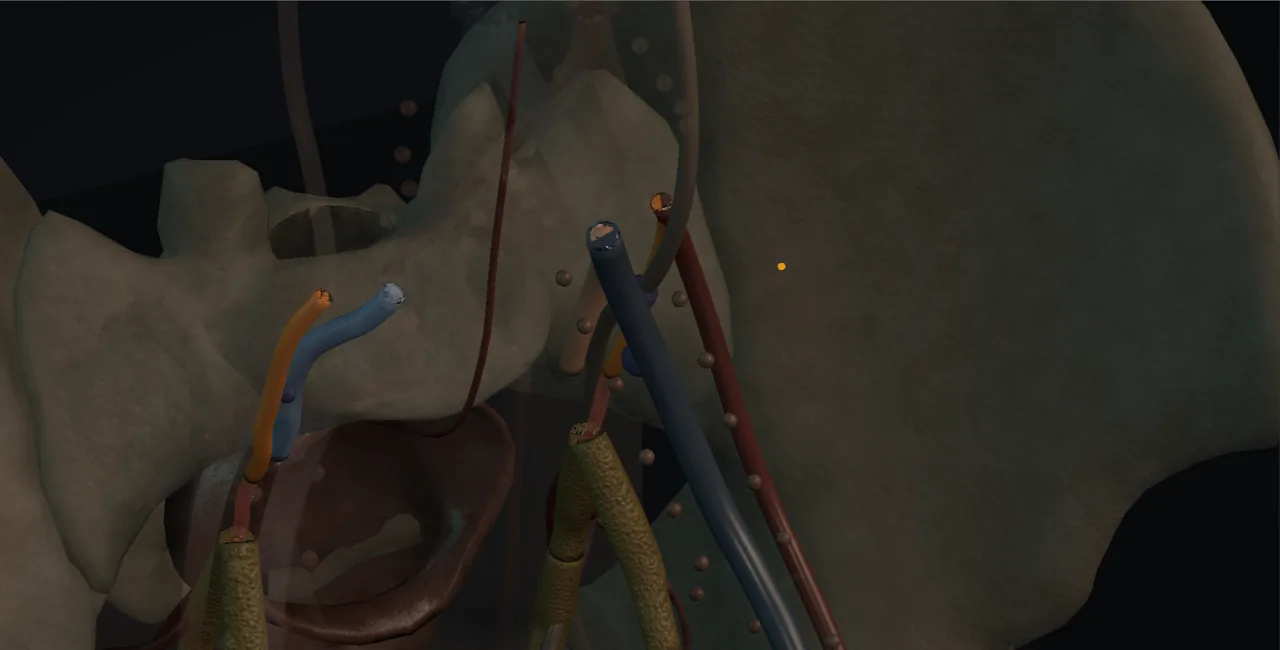 Interactive 3D Interactive pelvic exenteration Open the 3D animation
Teaching catalogue only. This coverage record is not a patient pathway or operative instruction.
Typical place in practice
Selected potentially resectable locally advanced or recurrent pelvic cancer after full staging, treatment-goal definition and multi-specialty review.
Alternatives and neighbouring procedures
Systemic therapy, radiotherapy or re-irradiation, palliative diversion, symptom-directed procedures, or supportive care.
Same procedure family, explicit technique branches
These are variations of this canonical operation. Complication modules below identify whether they apply to all branches or only to named approaches.
Anterior exenteration
Targets disease predominantly in the anterior pelvic compartment.
Total pelvic exenteration
Removes multiple pelvic organ systems for central disease.
Lateral compartment or sidewall resection
Pursues clearance in selected laterally invasive disease.
Palliative pelvic resection or diversion
Prioritises control of bleeding, fistula, obstruction or pain rather than curative margins.
High-level sequence
Coverage outline only; not a step-by-step technical guide.
- Define curative or palliative intent and map sidewall, bone, vessel and organ involvement
- Coordinate urological, colorectal, gynaecological, vascular and reconstructive teams
- Control pelvic vessels and remove involved organs en bloc without tumour violation
- Construct urinary and bowel diversions and fill the pelvic defect
- Monitor critical illness, leaks, function, margins and rehabilitation
Every failure mode is its own module.
Timing and variation coverage are recorded for each module.
Massive haemorrhage and vascular reconstruction complication
Scarred pelvic vessels and planned sidewall resection can cause major bleeding, thrombosis or limb ischaemia.
Applies to: All variantsUrinary or bowel anastomotic leak and fistula
Multiple joins in irradiated or malnourished tissue can break down and cross-communicate.
Applies to: All variantsPelvic abscess, sepsis or empty-pelvis complication
Large dead space and contaminated organ systems predispose to deep infection and bowel descent.
Applies to: All variantsWound or flap failure
Perineal and abdominal closure may fail in previously treated tissue.
Applies to: All variantsRenal, respiratory or multiorgan failure
Long complex surgery, blood loss and infection can lead to prolonged critical illness.
Applies to: All variantsNerve injury, pain or loss of lower-limb/pelvic function
Sidewall and sacral dissection can affect gait, pelvic function and chronic pain.
Applies to: All variantsPositive margin or early recurrence
The value of extreme surgery depends on achieving the agreed oncological objective.
Applies to: All variantsPermanent urinary, bowel and sexual-function change
Diversions and organ loss create substantial lifelong functional and body-image consequences.
Applies to: All variantsSources for this module
Radical cystectomy, lymph-node dissection and urinary diversion.
Accessed 2026-08-03 · opens source European Association of Urology EAU Guidelines on Prostate Cancer - TreatmentRadical prostatectomy, lymph-node dissection and selected focal-treatment context.
Accessed 2026-08-03 · opens source British Association of Urological Surgeons Patient information leaflets by procedureUK patient-facing procedure, alternatives, recovery and complication framing.
Accessed 2026-08-03 · opens source