
Transplant nephrectomy
Removal of a failed, infected, bleeding or symptomatic renal allograft through subcapsular or extracapsular planes, with vascular-stump safety central.
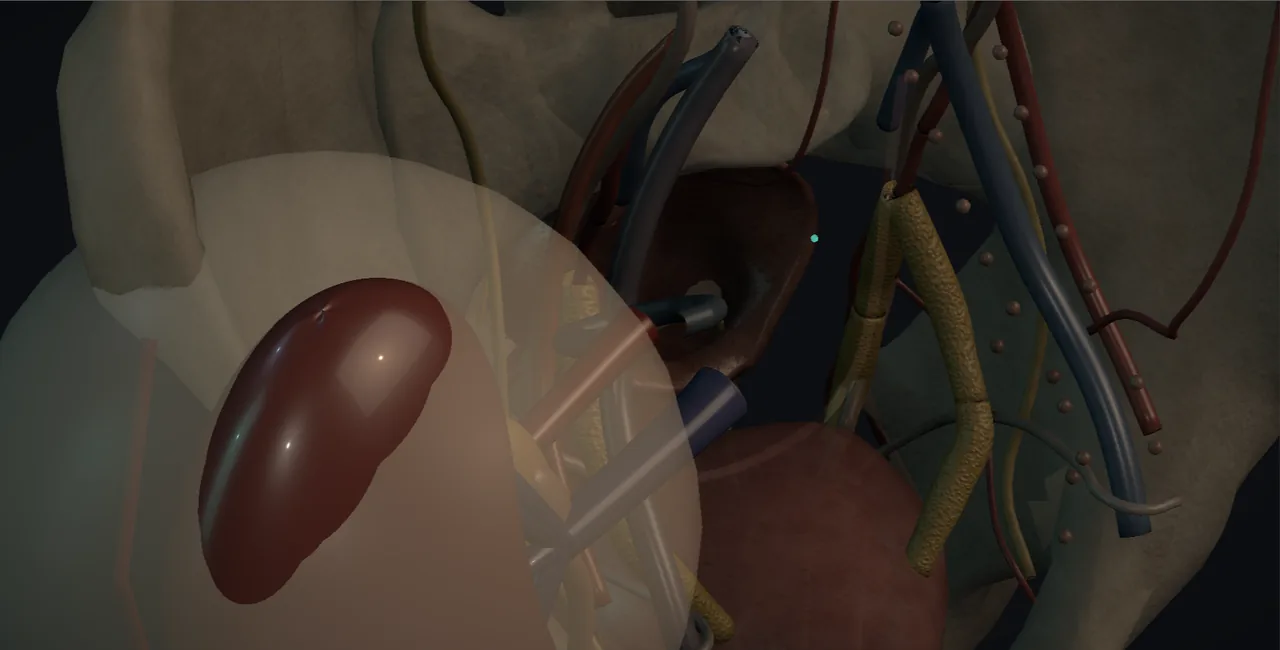 Interactive 3D Interactive subcapsular transplant nephrectomy Open the 3D animation
Teaching catalogue only. This coverage record is not a patient pathway or operative instruction.
Typical place in practice
Selected graft intolerance, uncontrolled infection, haemorrhage, thrombosis, malignancy or space requirement after transplant-team review.
Alternatives and neighbouring procedures
Retention of a failed asymptomatic graft with immunosuppression adjustment, embolisation, drainage or targeted treatment according to the indication.
Same procedure family, explicit technique branches
These are variations of this canonical operation. Complication modules below identify whether they apply to all branches or only to named approaches.
Early extracapsular transplant nephrectomy
Removes a recent graft before dense scarring develops.
Late subcapsular transplant nephrectomy
Limits dissection near adherent iliac vessels in a chronically scarred graft.
Emergency nephrectomy for rupture, infection or thrombosis
Prioritises haemorrhage or source control.
Allograft embolisation
A selected alternative or adjunct for graft intolerance or bleeding.
High-level sequence
Coverage outline only; not a step-by-step technical guide.
- Confirm indication, graft anatomy, immunological and dialysis plan
- Prepare for major iliac-vessel control
- Choose extracapsular or subcapsular plane based on timing and scarring
- Secure renal arterial/venous stumps and remove indicated tissue
- Monitor bleeding, infection, sensitisation and return to renal replacement therapy
Every failure mode is its own module.
Timing and variation coverage are recorded for each module.
Catastrophic iliac-vessel haemorrhage
Dense scarring and infected vascular stumps can cause intraoperative or delayed arterial/venous disruption.
Applies to: All variantsRetained infected tissue or pelvic abscess
Subcapsular removal may leave capsule or material that can remain infected.
Applies to: All variantsBladder, bowel or adjacent-organ injury
Reoperative inflammatory planes obscure nearby structures.
Applies to: All variantsVenous thrombosis or limb ischaemia
Iliac vessel manipulation and repair can compromise lower-limb circulation.
Applies to: All variantsWound breakdown or incisional hernia
Immunosuppression, infection and repeated iliac-fossa access impair wound healing.
Applies to: All variantsHLA sensitisation affecting future transplantation
Allograft removal and immunosuppression change can influence future donor compatibility.
Applies to: All variantsPost-embolisation pain, fever or non-target injury
Endovascular devascularisation creates an inflammatory syndrome and can affect adjacent circulation.
Applies to: Allograft embolisation