
Transplant ureteric reconstruction
Endourological, percutaneous and open/robotic repair of allograft ureteric leak, necrosis or stricture, using recipient urinary tract when direct reimplantation is insufficient.
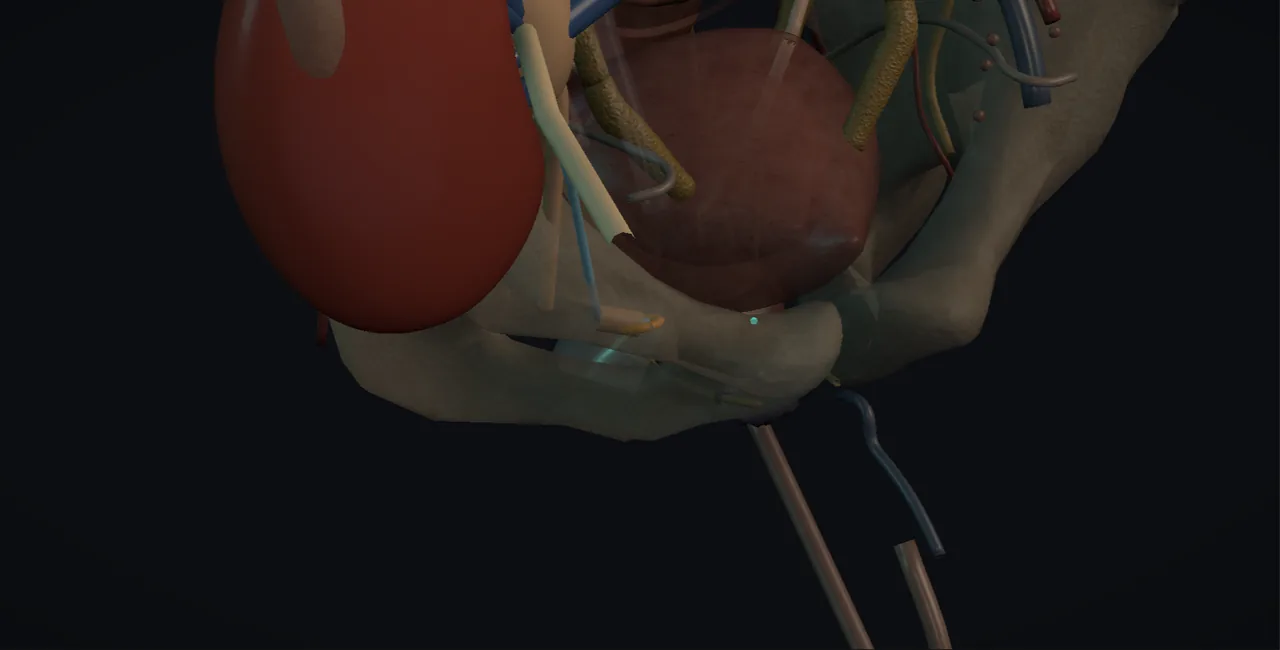 Interactive 3D Interactive transplant ureteric reconstruction Open the 3D animation
Teaching catalogue only. This coverage record is not a patient pathway or operative instruction.
Typical place in practice
Persistent leak, obstruction, ischaemic ureter, failed stent treatment or complex transplant drainage complication threatening graft function.
Alternatives and neighbouring procedures
Temporary nephrostomy and stent management, observation for selected minor issues, or graft nephrectomy when function cannot be preserved safely.
Same procedure family, explicit technique branches
These are variations of this canonical operation. Complication modules below identify whether they apply to all branches or only to named approaches.
Endoscopic or percutaneous treatment
Treats selected short strictures and controls drainage before definitive planning.
Repeat ureteroneocystostomy
Reimplants a viable shortened transplant ureter into bladder.
Native ureteropyelostomy or ureteroureterostomy
Bypasses an unusable transplant ureter using native drainage.
Boari flap, bowel substitution or complex urinary reconstruction
A tertiary solution when both transplant and native ureteric length are inadequate.
High-level sequence
Coverage outline only; not a step-by-step technical guide.
- Decompress the graft and define level, length and cause
- Assess graft function, infection and native urinary anatomy
- Excise non-viable tissue and preserve peri-pelvic blood supply
- Create the simplest tension-free watertight drainage route
- Monitor leak, obstruction, infection, rejection and device removal
Operative notes
Concise operative notes covering the key steps, landmarks and watch points, in the order you encounter them.
Ureteric stricture - endoscopic cut
What it does: slit a narrow ureter from inside.
- Slippery Terumo wire across, into the kidney.
- Swap over a 5Fr catheter for a stiff wire.
- Suture-around-ureter cause? A stent alone may cure. 3 months. Then image at 4 weeks and 3 months.
- Else: balloon, or cut (cold knife, wire, laser).
- Cut full thickness, till fat is seen.
- Direction: side, in the middle ureter. EXCEPT over the iliac vessels: cut front-inner. (Vessels sit behind the ureter there.)
- Stent 4-6 weeks. Catheter a day.
- Watch: Balloon ~55% cure. Cut ~70%.
- Watch: Over 1 cm, or poor blood supply: poor results.
- Watch: Middle ureter worse than ends: 25% vs 80%.
From the UroRef Operative Quick Guide. Open the note page →
Every failure mode is its own module.
Timing and variation coverage are recorded for each module.
Graft vascular injury and haemorrhage
The urinary reconstruction lies close to superficially placed transplant vessels.
Applies to: All variantsPersistent urinary leak or fistula
Ischaemic tissue or a failed anastomosis can continue to leak.
Applies to: All variantsRecurrent stricture and graft obstruction
Scar, tension and continuing ischaemia can compromise the revision.
Applies to: All variantsUrinary infection or sepsis
Obstruction, leak, devices and immunosuppression amplify infection risk.
Applies to: All variantsLoss of graft function or graft loss
Delayed or unsuccessful drainage can irreversibly damage the allograft.
Applies to: All variantsBowel or bladder injury
Reoperative pelvic planes can be densely adherent.
Applies to: Repeat ureteroneocystostomy · Native ureteropyelostomy or ureteroureterostomy · Boari flap, bowel substitution or complex urinary reconstructionStent or nephrostomy complication
Temporary devices can displace, block, encrust or be overlooked.
Applies to: Endoscopic or percutaneous treatmentSources for this module
Living-donor nephrectomy, recipient surgery and transplant complications.
Accessed 2026-08-03 · opens source British Association of Urological Surgeons Patient information leaflets by procedureUK patient-facing procedure, alternatives, recovery and complication framing.
Accessed 2026-08-03 · opens source