
Revision sheet
Transplant ureteric reconstruction
9 steps, each one the authored title and caption from the interactive animation, with the frame captured from that step. Read it before the case, or print it and work through the steps in order.
Teaching only, not for diagnosis or treatment decisions. The text on this sheet is the animation's own step copy, reproduced verbatim.
UrOops3D · UroRef · © Nity G
- 01
Who: the leak early, the stricture late
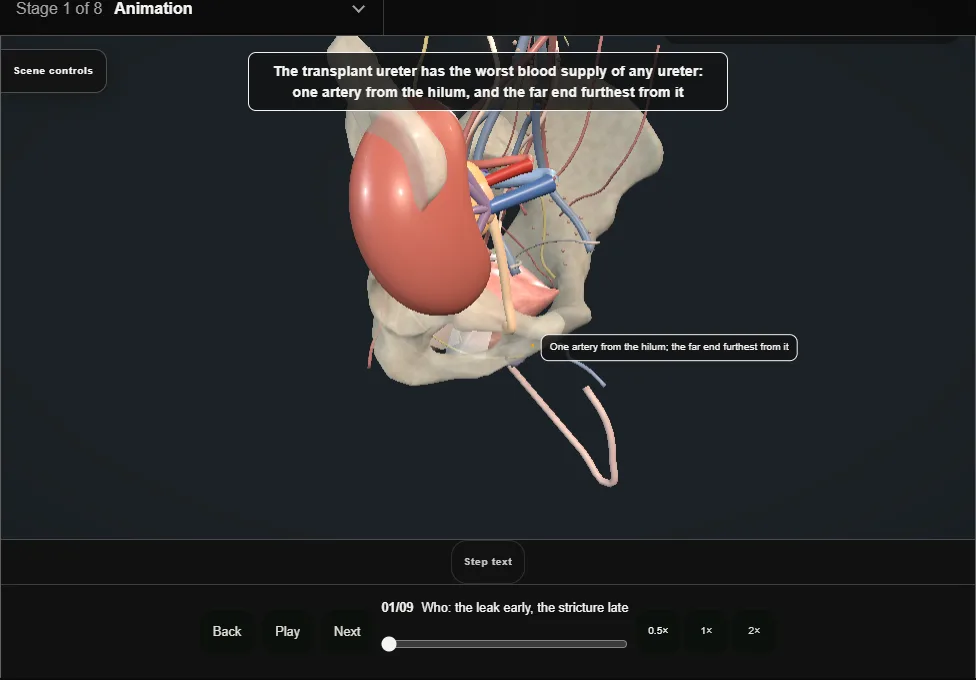
- The transplant ureter has the worst blood supply of any ureter: one artery from the hilum and the far end furthest from it.
- A leak in the first weeks when the end dies; a stricture months or years later when it scars.
- 02
Presentation and the creatinine
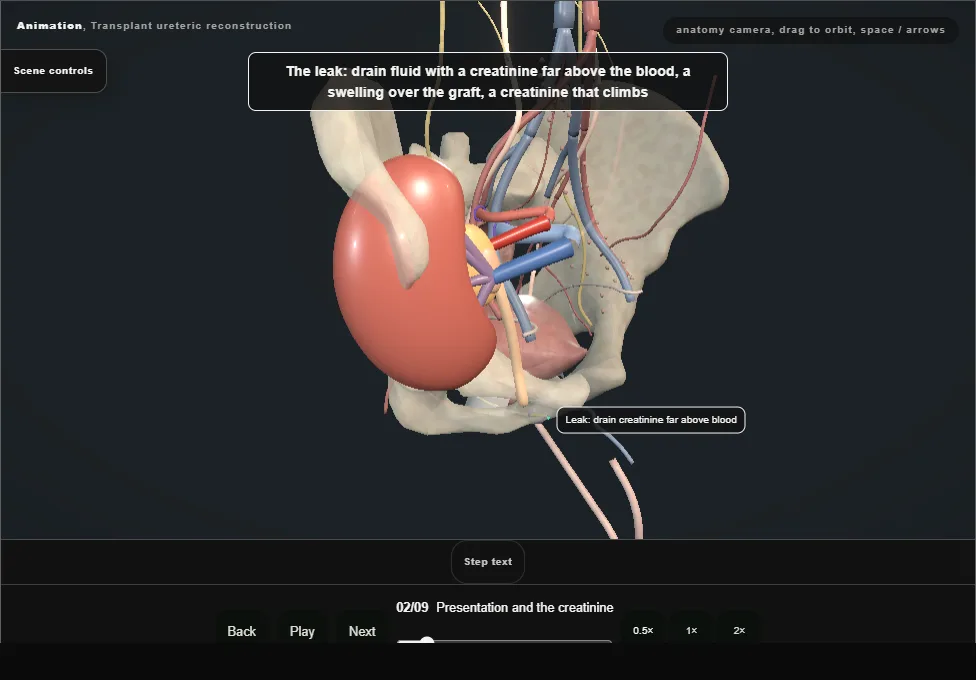
- The leak: drain fluid with a creatinine far above the blood, a swelling over the graft.
- The stricture: hydronephrosis on the routine ultrasound and a creatinine that drifts up, with no pain because the graft has no nerves.
- 03
Imaging: ultrasound, nephrostomy and the antegrade study
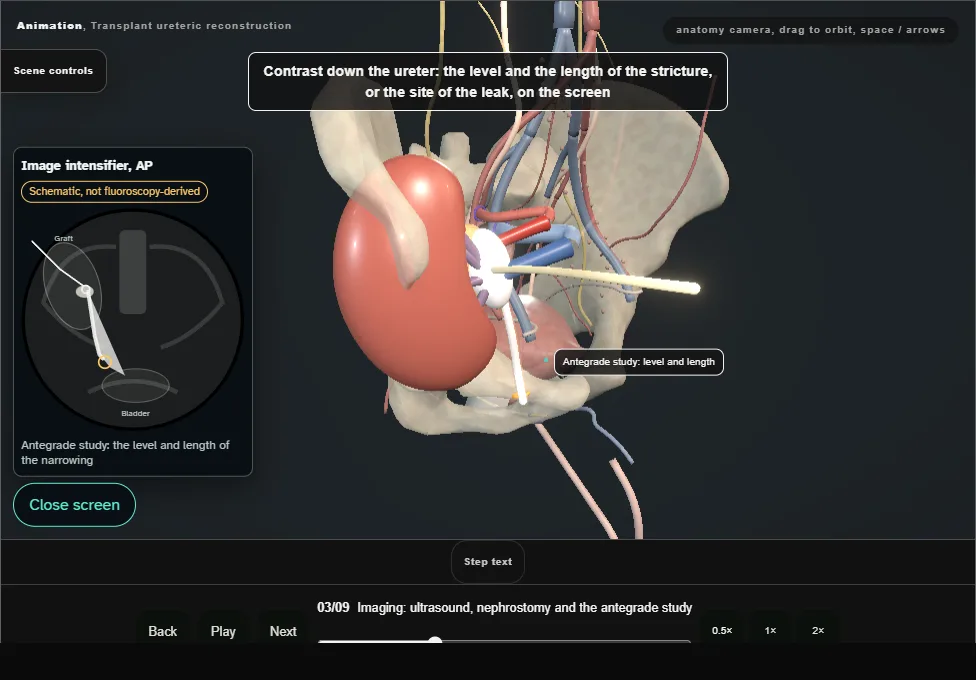
- Ultrasound first, then a nephrostomy into the graft: it drains, it decompresses, and contrast down the ureter gives the level and the length of the stricture or the site of the leak.
- 04
First control: nephrostomy and stent
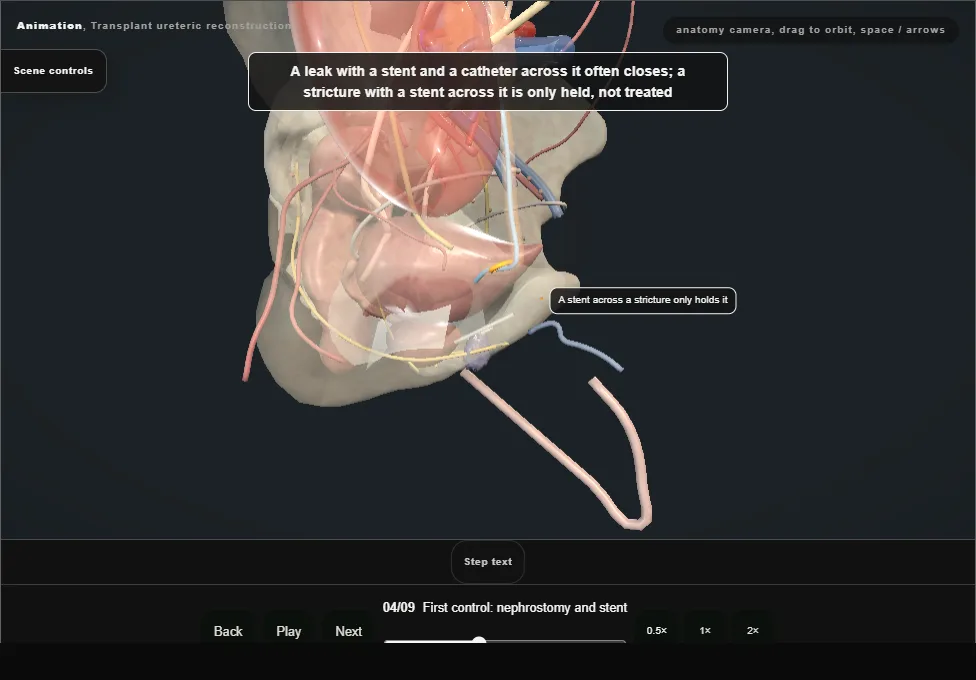
- Drainage first, and an antegrade stent across the problem if a wire will pass.
- A leak with a stent and a catheter often closes; a stricture with a stent across it is only held, not treated.
- 05
Endoscopic options
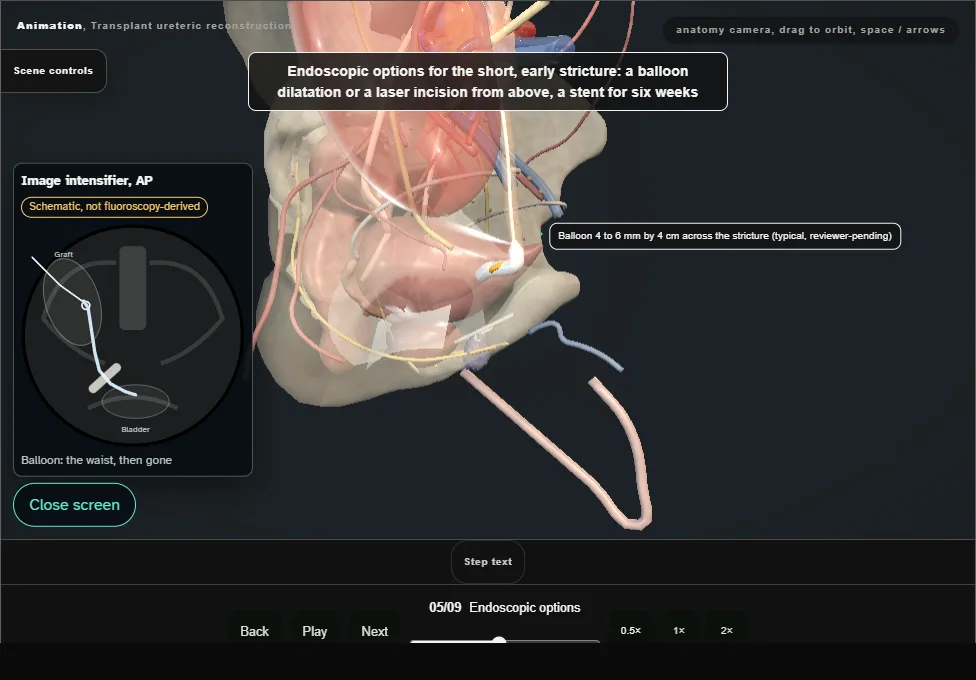
- For the short, early stricture: balloon dilatation or a laser incision from above and a stent for six weeks.
- About half hold; the long or recurrent stricture goes to reconstruction.
- 06
Redo ureteroneocystostomy
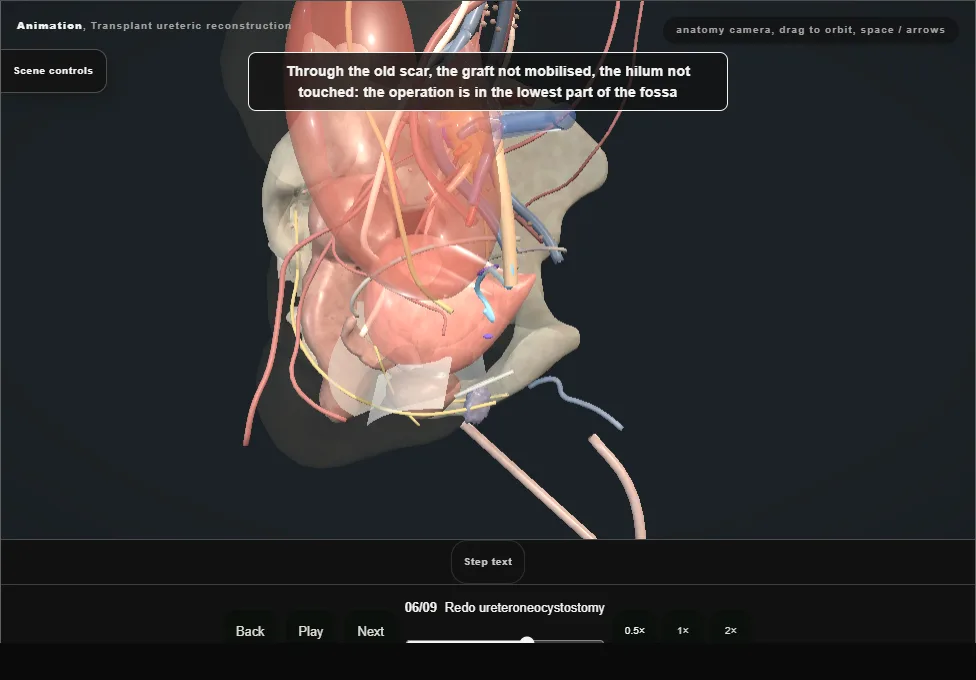
- For the distal stricture with enough healthy ureter: the dead end excised, the bladder mobilised, a fresh reimplant over a stent, through the old scar with the graft and its hilum untouched.
- 07
Native ureter to the transplant
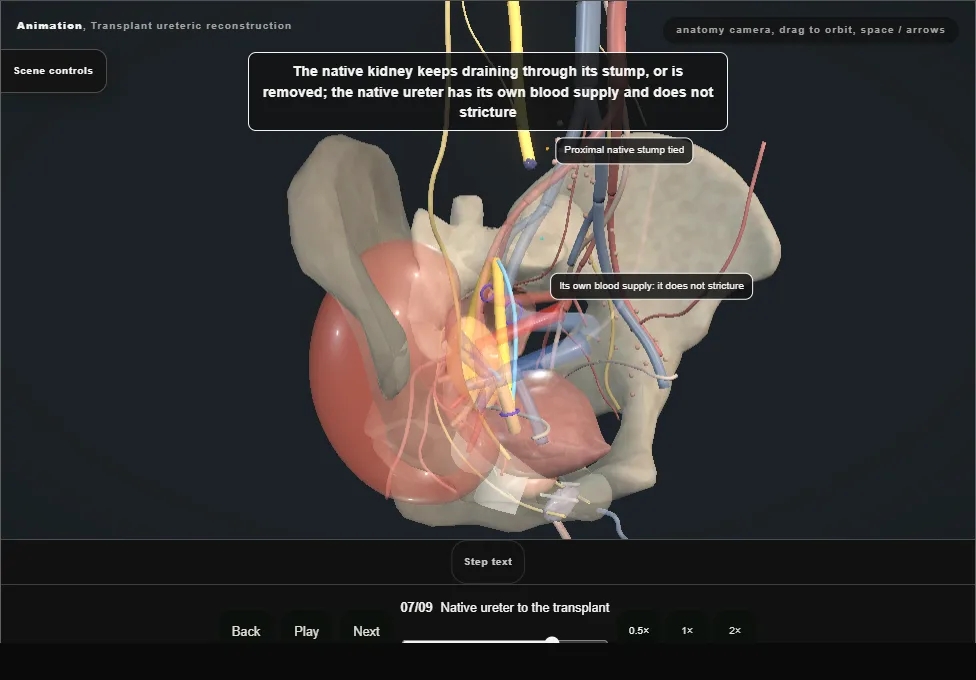
- When the transplant ureter is too short or too dead: the native ureter divided at the brim and joined to the graft pelvis or ureter.
- It has its own blood supply and does not stricture; the native kidney drains through its stump or is removed.
- 08
Boari flap and psoas hitch
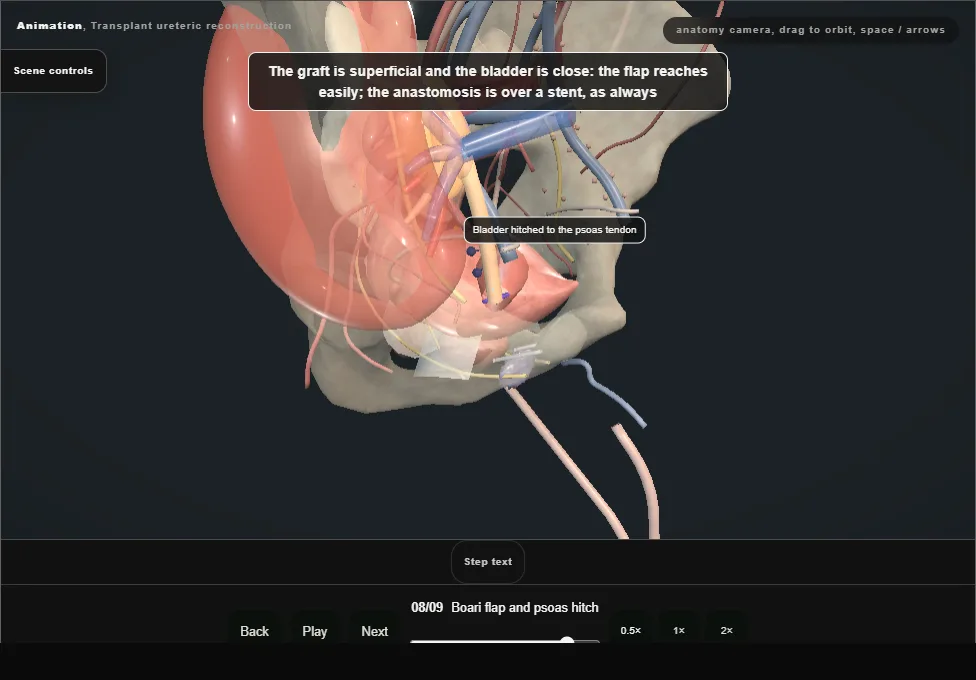
- When the native ureter is not there or not usable: the bladder brought up to the graft ureter.
- The graft is superficial and the bladder is close, so the flap reaches easily; over a stent, as always.
- 09
After
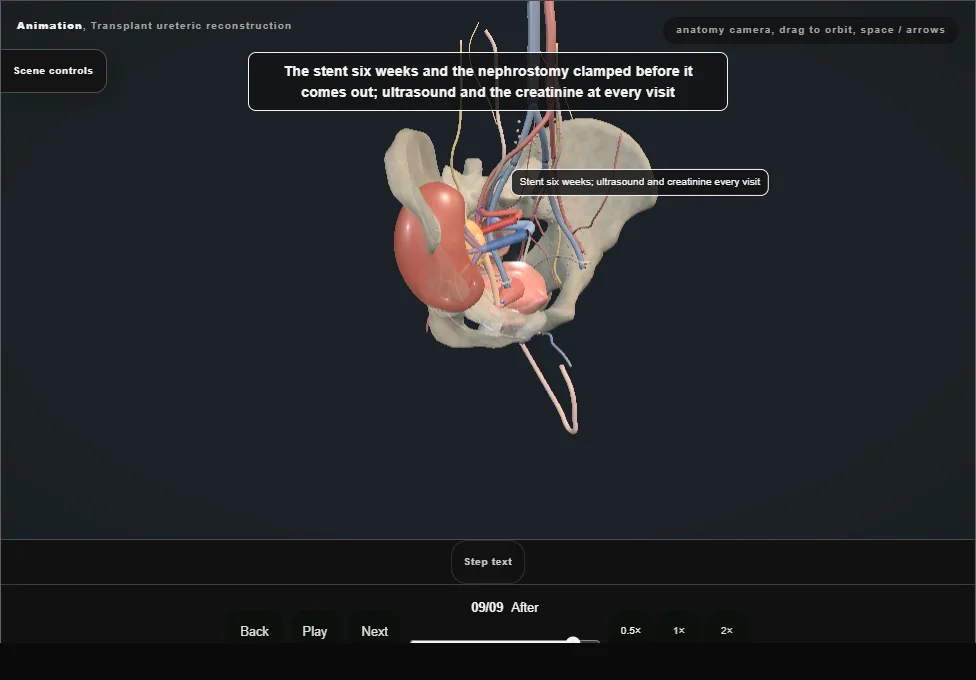
- The stent six weeks and the nephrostomy clamped before it comes out; ultrasound and the creatinine at every visit.
- Every episode costs the graft nephrons, and is recognised on the routine scan, not on the creatinine.
Derived from pelvis/TransplantUreterScene.tsx at build time: every step title and caption above is the authored
ProcedureDef text, reproduced verbatim, and this page shares its readable-points renderer with the animation
itself. 9 of 9 steps have a captured frame.
Text fingerprint 6873f2a5d3bec34a. A caption edit without a re-capture fails the production
check, so the sheet and the animation cannot drift apart silently.