
Treatment of transplant lymphocele and perigraft collections
Diagnostic aspiration, image-guided drainage, sclerotherapy and surgical fenestration of collections compressing a renal allograft, ureter or iliac vessels.
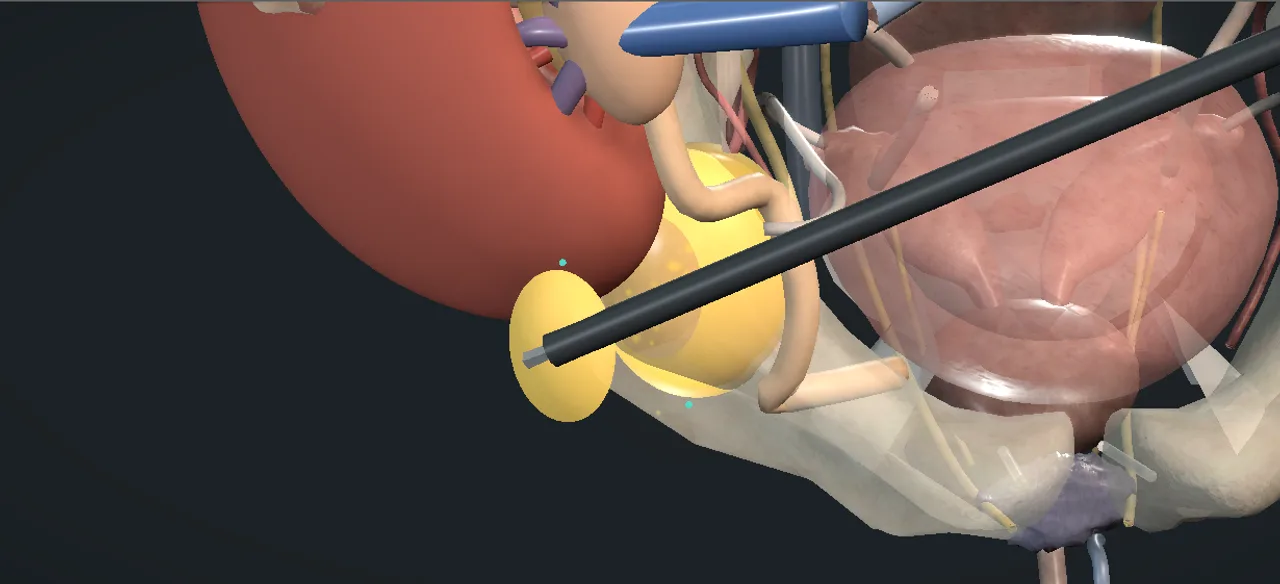 Interactive 3D Interactive transplant lymphocele: drainage and the laparoscopic window Open the 3D animation
Teaching catalogue only. This coverage record is not a patient pathway or operative instruction.
Typical place in practice
Symptomatic, infected, enlarging or compressive lymphocele or another defined perigraft collection after diagnostic distinction from urine, blood or abscess.
Alternatives and neighbouring procedures
Observation for small asymptomatic collections, treatment of an underlying urinary leak, or open exploration when diagnosis or anatomy is unsafe for limited drainage.
Same procedure family, explicit technique branches
These are variations of this canonical operation. Complication modules below identify whether they apply to all branches or only to named approaches.
Image-guided aspiration or catheter drainage
Confirms collection type and provides temporary or definitive drainage.
Percutaneous sclerotherapy
Attempts to obliterate a persistent lymphocele cavity under agent-specific governance.
Laparoscopic or robotic fenestration
Creates a durable window while protecting graft, ureter and vessels.
Open drainage and revision
Treats complex, infected or recurrent collections and permits repair of an underlying cause.
High-level sequence
Coverage outline only; not a step-by-step technical guide.
- Differentiate lymph, urine, blood and infection before intervention
- Map graft, ureter, bladder, bowel and iliac vessels
- Drain through the safest image-guided or operative route
- Create durable internal drainage or treat the underlying leak when required
- Monitor recurrence, infection, graft function and vascular/ureteric compression
Every failure mode is its own module.
Timing and variation coverage are recorded for each module.
Graft, ureteric or iliac-vessel injury
Needle, trocar or dissection close to the graft can cause bleeding, urine leak or loss of perfusion.
Applies to: All variantsBowel injury or internal herniation
Operative entry and a peritoneal window can injure or later trap bowel.
Applies to: Laparoscopic or robotic fenestration · Open drainage and revisionInfection or abscess
An initially sterile collection can become infected after instrumentation.
Applies to: All variantsPersistent drainage or recurrence
A narrow window or continuing lymphatic source can recreate the collection.
Applies to: All variantsChemical injury or systemic reaction
Sclerosant can leak, inflame adjacent tissues or cause agent-specific systemic effects.
Applies to: Percutaneous sclerotherapyMissed urinary leak or misclassified collection
Treating a urinoma as a lymphocele delays repair of the actual urinary complication.
Applies to: All variantsGraft dysfunction from persistent compression
Incomplete treatment can continue to obstruct the ureter or compromise renal perfusion.
Applies to: All variants