UrOops3D, danger-zone atlas

Schematic model.

Operative animation, Total penectomy

Total penectomy with perineal urethrostomy

Amputation of the whole penis for a cancer whose position leaves no remnant that could void standing, with the urine diverted to a perineal urethrostomy.

The urethra is divided with length before the corpora, each corpus is divided at the ischiopubic ramus and its stump closed separately, and the urethral end is drawn through a tunnel beneath the scrotum to a small perineal opening.

This is not the flap urethrostomy of stricture surgery, which opens the bulb in continuity under a skin flap: here a divided urethral end is brought to a small opening. The lesson is the order of division, haemostasis stump by stump, and a neomeatus made wide enough to stay open.

Advanced tier FRCS andrology, penile cancer, reconstruction Interactive 3D

Operative visualisation

Schematic scene preview: Total penectomy with perineal urethrostomy
Preparing the 3D anatomy…

UrOops3D · UroRef · © Nity G

How to use this module. Play the nine steps, or use Back and Next. Watch the order: bundle tied, urethra divided long, each crus divided and closed, then the urethra drawn through the tunnel to the opening on one smooth curve. Triggers show a bleeding stump, a folded tunnel, a narrowed opening and a positive margin.

Click me next Section 2 of 8 Anatomy The structures this operation works between, and the one it must not cross.

The structures in the scene

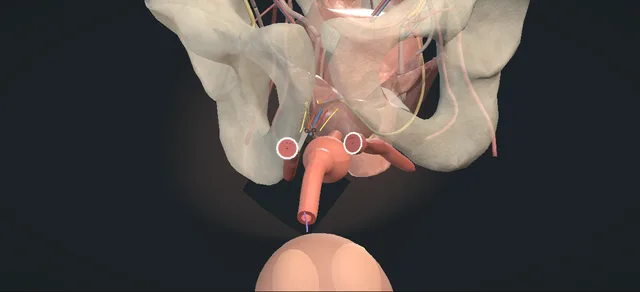
Total penectomy: how the structures relateThe penile root from the foot of the table, back to the crura and the perineum. Penile root, inside the diamond: holds it to the pubis until divided Suspensory ligament to the symphysis. Penile root, inside the diamond: on its dorsum; tied before it is cut Dorsal bundle: vein, arteries, nerves (danger). Penile root, inside the diamond: ventral; divided before the corpora Urethra in its spongiosum, kept long. Penile root, inside the diamond: the corpora part here; each is divided and closed Crura on the ischiopubic rami. Penile root, inside the diamond: the urethra is drawn through it on one smooth curve Tunnel beneath the scrotum (danger). Penile root, inside the diamond: where the urethra ends: spatulated, wide Neomeatus on the median raphe.Penile root, inside thediamondSuspensory ligamentto the symphysis!Dorsal bundle: vein,arteries, nervesUrethra in itsspongiosum, keptlongCrura on theischiopubic rami!Tunnel beneath thescrotumNeomeatus on themedian rapheholds it to thepubis until dividedon its dorsum; tiedbefore it is cutventral; dividedbefore the corporathe corpora parthere; each isdivided and closedthe urethra isdrawn through it onone smooth curvewhere the urethraends: spatulated,wideTargetDangerLandmarkContext
The penile root from the foot of the table, back to the crura and the perineum. Schematic, not to scale; relationships only.
  • From the foot of the table the penis hangs from the pubis by its suspensory ligament, the dorsal bundle on its dorsum, the urethra in its spongiosum on the ventral side.
  • Deep to the root the two corpora part as the crura, each running back along an ischiopubic ramus, with the bulb between them.
  • The operation divides in that order: skin, ligament and bundle; then the urethra, kept long; then each crus at its ramus.
  • The urethral end no longer has a penis to travel in, so it is drawn through the tunnel beneath the scrotum to the opening on one smooth curve.
  • ›Tumour of the proximal shaft - covered before the first incision; its position at the root is what makes the amputation total.
  • ›Suspensory ligament - from the symphysis to the dorsum of the root; divided so the root drops away from the pubis.
  • ›Dorsal bundle - deep dorsal vein, dorsal arteries and nerves on the dorsum; tied at the root, then divided.
  • ›Buck's fascia - opened on the ventral midline to reach the plane between the spongiosum and the corpora.
  • ›Urethra and corpus spongiosum - kept together, freed back to the edge of the bulb and divided with length; the proximal end becomes the neomeatus.
  • ›Bulb of the penis - left in its bed; the freed urethra turns at its distal edge.
  • ›Corpora cavernosa and crura - each divided at its ischiopubic ramus; each stump closed separately.
  • ›Ischiopubic rami - the bony level of the corporal division; a crus lies along each.
  • ›Scrotum and testes - left in place; the urethra passes beneath the scrotum to reach the perineum.
  • ›Median raphe of the perineum - where the ellipse is excised, between the scrotum and the anal verge.
Click me next Section 3 of 8 Steps The operation in order, with the landmark that guards each move.

Operative steps

  1. Isolate the tumour Biopsy-proven invasive squamous cancer of the proximal shaft, reaching the root, staged, in a man for whom a safe resection would leave a stump too short to void standing. Antibiotics, then lithotomy, the genitalia prepared and draped. The whole tumour is covered with a condom or glove secured proximal to it, so that it is not handled again. A diamond is marked at the base of the penis, its upper apex on the infrapubic skin and its lower apex on the anterior scrotal wall, with a margin of healthy tissue proximal to the tumour.
    where it bites: tumour handled in an open wound is tumour shed into it; the cover goes on before the knife.
  2. Skin and suspensory ligament The incision follows the diamond through skin and dartos. Superiorly the dissection is carried down to the suspensory ligament, which is divided: the root comes away from the pubis and the penis gains mobility. The superficial penile vessels and the deep dorsal neurovascular bundle are isolated and tied, and only then divided. Diathermy deals with the smaller points.
    where it bites: the dorsal vessels are tied under vision before they are cut; a vessel divided first has to be found again in a wet field.
  3. Free the spongiosum The penis is reflected cephalad and the scrotum retracted caudally, which brings the ventral surface of the urethra into view. Buck's fascia is incised sharply over the corpus spongiosum, and the spongiosum is separated from the corpora cavernosa by sharp and blunt dissection, back as far as the edge of the bulb. The urethra is taken with its spongiosum around it; it is not skeletonised.
    where it bites: the spongiosum carries the blood supply of the urethra that will become the neomeatus; a stripped urethra is an ischaemic one.
  4. Divide the urethra The urethra is divided at this level, with as much healthy length on the proximal end as the margin allows. A stay suture marks the end and keeps its orientation, and the end is placed within the scrotum, out of the way. The length kept now is what lets the end reach the perineum later without tension.
    where it bites: a short urethra reaches the perineum only under tension, and a neomeatus under tension narrows.
  5. Transect the corpora Each corpus cavernosum is isolated circumferentially at the level of the ischiopubic ramus. The two are divided symmetrically, again with healthy tissue proximal to the tumour, and the specimen is sent to pathology. The European guideline gives no fixed width for the margin of an amputation. Frozen section of the corporal and urethral cut faces is used when the completeness of the resection is in doubt, not routinely.
    where it bites: the corporal margin is the deep margin; if it is in doubt it is answered at the table, with a frozen section and a further slice.
  6. Close each corpus The tunica albuginea of each corporal stump is approximated with interrupted absorbable sutures, one stump at a time. Each closure is haemostatic on its own; the two stumps are not gathered into a single suture line. The field is dry before the perineal part begins.
    where it bites: haemostasis here is the closure itself: each stump closed and seen to be dry.
  7. Perineal opening and tunnel The scrotum is lifted. A small ellipse of skin is excised in the mid perineum over the median raphe, and the wound is carried through Colles fascia and the subcutaneous fat. A right-angle clamp is passed from the perineal wound beneath the scrotum, the urethral end is grasped, and it is drawn through the tunnel to the opening on one smooth curve. Only the urethra distal to the bulb moves; the bulb is left in its bed.
    where it bites: an angle or a twist in the tunnel obstructs the stream however well the neomeatus is made.
  8. Mature the neomeatus The end lies at the skin without tension. It is spatulated dorsally, one blade in the lumen cutting toward the scrotum. Interrupted fine absorbable sutures bring the urethral edge to the perineal skin round the ellipse, making an elliptical, patulous neomeatus. A urethral catheter is passed to the bladder for drainage.
    where it bites: a narrow ring round an unspatulated end is how neomeatal stenosis is made; the opening is left wide on purpose.
  9. Close the anterior wound Haemostasis is checked again. The dartos and the skin of the anterior wound are approximated transversely, in two layers, with interrupted absorbable sutures. Ointment and a non-adherent dressing on the suture line, a pressure dressing and a scrotal support. The operation note records the margins sent, each stump closure, the course of the tunnel, the neomeatus and the catheter.
    where it bites: the skin edges must meet without tension; skin necrosis is a listed complication of this wound.
Click me next Section 4 of 8 Danger zones Where this operation bites, and why it bites there.
Critical relationship

Danger zones

The spatial relationships the animation is built to make automatic. Before you read each one, ask yourself: at this point in the operation, what is about to go wrong, and what is my first move? The save for each sits in the Complications tab.

  • RiskThe tumour itself - covered before the incision and not handled again.
  • RiskThe dorsal bundle - tied at the root, under vision, before it is divided.
  • RiskUrethral length - divided as far distally as the margin allows; the length is what reaches the perineum.
  • RiskThe corporal margins - the deep margin; frozen section when clearance is in doubt.
  • RiskEach corporal stump - closed on its own and seen to be dry.
  • RiskThe tunnel - one smooth curve beneath the scrotum: no twist, no angle.
  • RiskThe neomeatus - spatulated and wide; a narrow opening stenoses.
Practise it Take me into the scene Opens the animation at a danger moment and asks you to predict the mechanism and your first move before it reveals.
Click me next Section 5 of 8 Complications The save for each one: the first move, the escalation trigger, the op-note line.

Complications and immediate saves

Trigger each of these live in the Animation tab, then read the save: the first move, the escalation trigger, and the line that goes in the op note.

Corporal stump bleeding

  • dark bleeding from a corporal stump during or after the amputation: a stump not yet closed, or a closure that has not taken the tunica all the way round.
The save
  1. Pressure on the stump with a swab while the field is cleared and the suction is set. first move
  2. Take the tunical edge and close that stump on its own with interrupted absorbable sutures; do not gather both stumps in one stitch.
  3. Bleeding from a stump that has retracted beneath the pubic arch, or that continues after a sound closure, needs senior help in theatre now. escalation trigger
  4. Check the other stump and the tied dorsal vessels before turning to the perineum; the field is dry before the tunnel is made.
  5. Op note: which stump, how it was controlled, the estimated loss and the dressing plan. document

Angulated tunnel

  • the urethra lies folded where it leaves the bulb, or twisted in the tunnel: there was no room for its turn beneath the scrotum, or its orientation was lost as it was drawn through.
The save
  1. Withdraw the urethra into the anterior wound and look at it: its colour, its length and the stay suture that marks its orientation. first move
  2. Pass the clamp again, with room for the turn beneath the scrotum, and bring the end through without rotation.
  3. If it is tight, free more urethra from the corpora rather than pull on it.
  4. A urethra that will not reach the perineum without tension is a reconstructive problem: stop and get a senior or reconstructive opinion before the neomeatus is made. escalation trigger
  5. Op note: the course of the tunnel, that the urethra lies without twist or angle, and that a catheter passes easily. document

Neomeatal stenosis

  • the perineal opening narrows in the months after surgery.
  • In a seven-centre series of 299 men it developed in 12 per cent, most within eighteen months, and about three quarters of those needed surgical revision.
The save
  1. Take the history of the stream, examine the opening and calibrate it gently. first move
  2. Measure the residual: a narrowed outlet that is not emptying changes the urgency.
  3. Dilatation may hold a soft narrowing until revision.
  4. A stenosis that recurs, or that will not admit a catheter, is referred for revision of the urethrostomy. escalation trigger
  5. Clinic letter: the calibre found, the residual, what was done and the plan for revision. document

Positive margin

  • tumour at a corporal or urethral cut face, on frozen section at the table or on the final report.
The save
  1. At the table: take a further slice from the face in question and send it marked. first move
  2. Send each new margin orientated, so the report can say which face is clear.
  3. There is no agreed safe width for the margin; a clear margin is what is asked for.
  4. A margin that cannot be cleared, or a positive margin on the final report, goes to the penile cancer multidisciplinary meeting. escalation trigger
  5. Op note and pathology form: which faces were sent, their orientation and the frozen section result. document
Click me next Section 6 of 8 Troubleshooting When the case turns: the problem, then the next move.

Intra-operative troubleshooting

When the case turns: the problem, then the next move.

  • ActionThe urethra will not reach the perineal opening without tension - free more of it from the corpora and check that the tunnel is not what is holding it; a neomeatus is not matured under tension.
  • ActionFrozen section of a corporal face is positive - take a further slice from that face and send it again before either stump is closed.
  • ActionExposure of the urethra and the crura from above is poor - A perineal approach through an inverted-Y incision is the described alternative, chosen beforehand.
  • ActionThe defect after a wide resection will not close without tension - this is a wound for planned cover: the guideline notes that advancement or myocutaneous flaps may be needed.
  • ActionThe catheter will not pass at the end - the tunnel or the neomeatus is at fault; look for a fold in the tunnel before anything is forced.
  • ActionThe man asks whether anything can be rebuilt - total phallic reconstruction may be offered after total or subtotal amputation; it is a later, separate operation, and the conversation starts before this one.
Click me next Section 7 of 8 FRCS viva Say it out loud, then mark yourself against the model answer.

FRCS viva questions

The examiner stems this scene prepares you for. Try to answer out loud first, then reveal, and learn the discriminator, the detail that turns a pass into a strong pass.

QWhen is total penectomy with perineal urethrostomy indicated, and what are the alternatives?reveal answer
  • I offer total penectomy for penile cancer whose position precludes a functional remnant: a large or proximal invasive tumour where resection with a clear margin would leave a stump too short to void standing, or without wetting the scrotum.
  • The European guideline offers total penectomy with perineal urethrostomy for large invasive tumours not amenable to partial amputation, as a strong recommendation, and reserves the perineal urethrostomy for exactly that situation.
  • The alternatives I would discuss depend on stage.
  • Partial penectomy, with or without reconstruction, is standard where the corpora are involved but a functional stump can be kept.
  • For non-resectable or locally advanced disease the guideline offers induction chemotherapy followed by surgery, or chemoradiotherapy.
  • I would tell him that total phallic reconstruction may be offered later, and I would stage and treat the groins on their own pathway.
Strong pass

Say all four

  • Giving the functional test
  • A stump that can void standing
  • As the line between partial and total amputation
  • Naming the strength of the recommendation
Examiner note
Giving the functional test, a stump that can void standing, as the line between partial and total amputation, and naming the strength of the recommendation.
QTalk through the operation step by step.reveal answer
  • Antibiotics, lithotomy.
  • I cover the tumour with a condom or glove secured proximal to it.
  • I mark a diamond at the root, from the infrapubic skin to the anterior scrotal wall, with a margin of healthy tissue, and incise it through skin and dartos.
  • I divide the suspensory ligament, then tie and divide the superficial vessels and the deep dorsal bundle.
  • With the penis reflected cephalad and the scrotum retracted, I open Buck's fascia ventrally, separate the spongiosum from the corpora and divide the urethra, keeping length on the proximal end.
  • I isolate each corpus at the ischiopubic ramus and divide it, send the specimen, and close the tunica of each stump separately with interrupted absorbable sutures.
  • I excise a small ellipse of skin over the median raphe in the mid perineum, pass a right-angle clamp beneath the scrotum and bring the urethral end out without angulation.
  • I spatulate it dorsally, suture it to skin as a wide elliptical neomeatus, and then place a urethral catheter.
  • I close the anterior wound transversely in two layers, with a pressure dressing and a scrotal support.
Strong pass

Say all three

  • The order: urethra divided with length before the corpora
  • Each corpus closed individually
  • A tunnel described as free of angulation
Examiner note
The order: urethra divided with length before the corpora, each corpus closed individually, and a tunnel described as free of angulation.
QWhat margin is taken, and what is the place of frozen section?reveal answer
  • I want a clear margin through skin, both corpora and the urethra.
  • The operative dictation I follow asks for a cuff of at least 2 cm of healthy tissue proximal to the tumour, which is the traditional margin.
  • Beside that, the European guideline states that there is no clear evidence for what width of macroscopically negative margin is oncologically safe, so I give 2 cm as the dictation's figure and not as an evidence-based threshold.
  • Frozen section is a helpful way to confirm clear margins, and the guideline recommends it, weakly, when completeness of resection is in doubt.
  • Here I would send the corporal stumps and the urethral end.
  • It is not recommended as a routine.
  • If a face is positive I take a further slice at the same operation and send it orientated, and I take the final report to the cancer multidisciplinary meeting.
Strong pass

Say both

  • Giving the dictation's traditional figure while saying that no fixed margin width is evidence based
  • That frozen section is reserved for the case in doubt
Examiner note
Giving the dictation's traditional figure while saying that no fixed margin width is evidence based, and that frozen section is reserved for the case in doubt.
QWhat are the complications, and how is neomeatal stenosis prevented and managed?reveal answer
  • The operative text lists bleeding, infection, neomeatal stenosis and skin necrosis.
  • The largest series of perineal urethrostomy for penile cancer at publication, 299 men from seven centres, reported a complication within thirty days in 19 per cent, most of them minor, with wound infection the commonest at 11 per cent and dehiscence in 4 per cent.
  • Stenosis of the urethrostomy developed in 12 per cent, most within eighteen months, and about three quarters of those came to surgical revision.
  • That series does not say what prevents it.
  • The principle of the operation is that I keep enough urethral length to reach the perineum without tension, make a tunnel beneath the scrotum that does not angulate, and leave a dorsally spatulated, wide, elliptical opening sutured mucosa to skin.
  • I assess an established stenosis by the stream, the residual and gentle calibration; dilatation may hold a soft narrowing, and revision of the urethrostomy is the definitive treatment.
Strong pass

Quoting a stenosis rate from a named series, and presenting length, the tunnel and the spatulated opening as the principle of the operation rather than as a finding of that series.

QWhat must be true of the urethra and sphincter for a perineal urethrostomy to work, and what is the man told about voiding?reveal answer
  • A perineal urethrostomy relies on preserved sphincteric continence and a urethra free of stenosis proximal to the opening.
  • Continence is kept because the membranous urethra and the sphincter are not part of the resection; a proximal narrowing would obstruct the new outlet.
  • I would tell him that he will void sitting, through an opening behind the scrotum.
  • I discuss that change, the loss of the penis and the possibility of later phallic reconstruction with him before the operation.
Strong pass

Say both

  • Naming sphincteric continence and a healthy proximal urethra as the prerequisites
  • Counselling sitting voiding before the operation
Examiner note
Naming sphincteric continence and a healthy proximal urethra as the prerequisites, and counselling sitting voiding before the operation.
Click me next Section 8 of 8 Evidence The guidance each of these answers is built on.

Evidence and guidance

Operative Dictations in Urologic Surgery
Armenakas NA, Fracchia JA, Golan R. Total penectomy. Chapter 32. Wiley, 2019
The indication (cancer whose location precludes a functional remnant); the six essential steps (cover the tumour, a cuff of healthy tissue proximal to it, a haemostatic closure of each corpus individually, no angulation of the urethra in the tunnel, a patulous perineal urethrostomy, a catheter); the perineal inverted-Y variation; the complication list. The book's margin figure, a cuff of at least 2 cm, is given once, in the margin viva answer, beside the guideline; its figures for the ellipse, the catheter and the sutures are kept out of the teaching text. Keeping length on the proximal urethra, the stay suture, stopping the dissection at the edge of the bulb and the check for a twist are authored from general practice, not from the chapter.
Open guideline
EAU-ASCO Guidelines
Penile Cancer: Disease management, treatment of the primary tumour (sections 6.1.2 to 6.1.5), read 13 October 2026
No clear evidence for an oncologically safe width of negative margin. Frozen section helpful but not routine; recommended (weak) when completeness of resection is in doubt. Perineal urethrostomy reserved for men whom a safe resection would leave unable to void standing. Total penectomy with perineal urethrostomy for large invasive tumours not amenable to partial amputation (strong). Total phallic reconstruction may be offered; flaps may be needed for the defect; induction chemotherapy or chemoradiotherapy for non-resectable disease (weak).
Open guideline
Urologic Oncology
de Vries HM, Chipollini J, Slongo J, et al. Outcomes of perineal urethrostomy for penile cancer: a 20-year international multicenter experience. Urol Oncol 2021;39(8):500.e9-500.e13
299 men, seven centres, 2000 to 2020; described by its authors as the most extensive series at publication. Complications within 30 days in 19 per cent, 79 per cent of them Clavien-Dindo I or II; wound infection 11 per cent, dehiscence 4.0 per cent. Stenosis in 12 per cent (35 of 299), of which 74 per cent needed surgical revision; only two stenoses after two years. The abstract reports rates; it does not attribute stenosis to any step of the operation (abstract read 13 October 2026).
Open guideline
Journal of Clinical Medicine
Velarde Ramos L, Martins F. Role of perineal urethrostomy in reconstructive urology. J Clin Med 2026;15(11):4133
Review. Perineal urethrostomy is the definitive urinary diversion after total penectomy and is designed on the same reconstructive principles as any other; it requires preserved sphincteric continence and no proximal urethral stenosis (abstract read 13 October 2026).
Open guideline

Curriculum. Supports learning relevant to the ISCP Urology Curriculum syllabus topic Penile cancer. Not a workplace-based assessment and not evidence of competence.

Two minutes

Close the lap: recall it before you leave.

Say it aloud, then reveal. Reading is not remembering.

  1. 01 The relationship Say the critical spatial relationship out loud, then reveal. reveal
    Memory frame

    From the foot of the table the penis hangs from the pubis by its suspensory ligament, the dorsal bundle on its dorsum, the urethra in its spongiosum on the ventral side.

    Why?
    Deep to the root the two corpora part as the crura, each running back along an ischiopubic ramus, with the bulb between them. The operation divides in that order: skin, ligament and bundle; then the urethra, kept long; then each crus at its ramus. The urethral end no longer has a penis to travel in, so it is drawn through the tunnel beneath the scrotum to the opening on one smooth curve.
  2. 02 The first move Corporal stump bleeding. Your first move? reveal
    First move

    Pressure on the stump with a swab while the field is cleared and the suction is set.

  3. 03 The escalation trigger Corporal stump bleeding. What makes you call for help? reveal
    Escalate when

    Bleeding from a stump that has retracted beneath the pubic arch, or that continues after a sound closure, needs senior help in theatre now.

  4. 04 The discriminator What turns a pass into a strong pass? reveal
    Strong pass

    Say all four

    • Giving the functional test
    • A stump that can void standing
    • As the line between partial and total amputation
    • Naming the strength of the recommendation
    Examiner note
    Giving the functional test, a stump that can void standing, as the line between partial and total amputation, and naming the strength of the recommendation.
  5. 05 The pitfall Where does this operation bite first? reveal
    Pitfall

    The tumour itself

    Why?
    covered before the incision and not handled again.

Revision practice with self-marked answers, not an assessment of clinical competence. Kept in this browser only; it does not sync between devices.