
Vesicovaginal fistula repair
Layered closure of an abnormal connection between bladder and vagina using healthy, well-vascularised tissue, with approach selected for location, cause, complexity and prior repair.
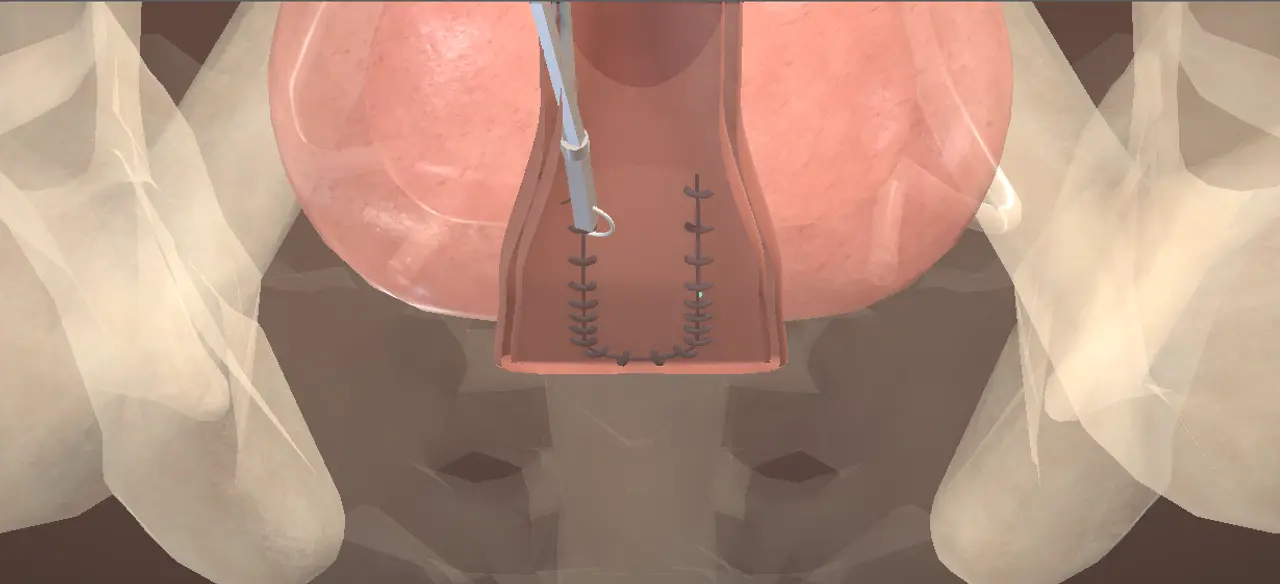 Interactive 3D Interactive transvaginal repair Open the 3D animation 3D Interactive robotic repair
Teaching catalogue only. This coverage record is not a patient pathway or operative instruction.
Typical place in practice
Persistent vesicovaginal fistula after pelvic surgery, obstetric injury, radiation or other tissue damage when conservative healing is unlikely.
Alternatives and neighbouring procedures
Continued drainage for selected early small fistulae, urinary diversion or other individualised reconstruction for severe tissue loss.
Same procedure family, explicit technique branches
These are variations of this canonical operation. Complication modules below identify whether they apply to all branches or only to named approaches.
Transvaginal layered repair
The fistula is exposed vaginally and closed in offset layers with minimal bladder mobilisation.
Transvaginal repair with interposition flap
Local vascularised tissue is placed between bladder and vaginal closures for selected complex or recurrent defects.
Open transabdominal repair
Abdominal exposure supports high, complex or ureter-adjacent fistula repair and interposition.
Laparoscopic fistula repair
Minimally invasive dissection separates bladder and vagina before layered intracorporeal closure.
Robot-assisted fistula repair
Robotic suturing supports high or complex layered repair and tissue interposition.
Radiation-associated or redo fistula repair
Scarred, ischaemic tissue may require wider mobilisation, interposition or diversion and has a distinct failure profile.
High-level sequence
Coverage outline only; not a step-by-step technical guide.
- Map fistula number, size, location, ureteric relationship and tissue quality
- Select timing and route that provide healthy exposure
- Separate bladder and vagina without enlarging devascularisation
- Close each organ in offset, watertight layers with interposition when planned
- Establish low-pressure drainage and document imaging, catheter and recurrence follow-up
Every failure mode is its own module.
Timing and variation coverage are recorded for each module.
Persistent or recurrent fistula
Ischaemia, tension, infection, missed additional tracts or poor tissue quality can prevent durable closure.
Applies to: Transvaginal layered repair · Transvaginal repair with interposition flap · Open transabdominal repair · Laparoscopic fistula repair · Robot-assisted fistula repair · Radiation-associated or redo fistula repairUreteric injury or obstruction
Trigonal fistulae and deep sutures can injure, ligate or kink a distal ureter.
Applies to: Transvaginal layered repair · Transvaginal repair with interposition flap · Open transabdominal repair · Laparoscopic fistula repair · Robot-assisted fistula repair · Radiation-associated or redo fistula repairBladder leak, pelvic collection or infection
Failure of bladder closure or contaminated dead space may cause collection, wound infection or systemic illness.
Applies to: Transvaginal layered repair · Transvaginal repair with interposition flap · Open transabdominal repair · Laparoscopic fistula repair · Robot-assisted fistula repair · Radiation-associated or redo fistula repairBleeding or adjacent-organ injury
Scarred planes may involve pelvic vessels, bowel, urethra or surrounding organs.
Applies to: Transvaginal layered repair · Transvaginal repair with interposition flap · Open transabdominal repair · Laparoscopic fistula repair · Robot-assisted fistula repair · Radiation-associated or redo fistula repairReduced bladder capacity, urgency or voiding dysfunction
Underlying bladder injury, radiation, tissue excision and reconstruction may leave persistent storage or emptying symptoms after closure.
Applies to: Transvaginal layered repair · Transvaginal repair with interposition flap · Open transabdominal repair · Laparoscopic fistula repair · Robot-assisted fistula repair · Radiation-associated or redo fistula repairStress urinary incontinence
Fistula leakage may mask sphincter weakness, and repair near the bladder neck or urethra may affect continence.
Applies to: Transvaginal layered repair · Transvaginal repair with interposition flap · Open transabdominal repair · Laparoscopic fistula repair · Robot-assisted fistula repair · Radiation-associated or redo fistula repairVaginal shortening, stenosis, pain or sexual dysfunction
Vaginal incision, scarring and interposition can affect length, calibre, sensation and sexual function.
Applies to: Transvaginal layered repair · Transvaginal repair with interposition flap · Open transabdominal repair · Laparoscopic fistula repair · Robot-assisted fistula repair · Radiation-associated or redo fistula repairInterposition-flap morbidity
Harvesting vascularised tissue adds donor-site pain, weakness, ischaemia or hernia risk depending on the selected flap.
Applies to: Transvaginal repair with interposition flap · Open transabdominal repair · Laparoscopic fistula repair · Robot-assisted fistula repair · Radiation-associated or redo fistula repairSources for this module
Female continence, bulking, sling, colposuspension and related procedures.
Accessed 2026-08-03 · opens source European Association of Urology EAU Guidelines on Urological TraumaRenal, ureteric, bladder, urethral and genital trauma and reconstruction.
Accessed 2026-08-03 · opens source European Association of Urology EAU Guidelines on Urological InfectionsInfection prevention, recognition and procedure-associated infection context.
Accessed 2026-08-03 · opens source British Association of Urological Surgeons Patient information leaflets by procedureUK patient-facing procedure, alternatives, recovery and complication framing.
Accessed 2026-08-03 · opens source