
Ureteroureterostomy and short-segment ureteric reconstruction
Excision or bypass of a short ureteric defect followed by a spatulated, tension-free anastomosis between well-vascularised ureteric ends.
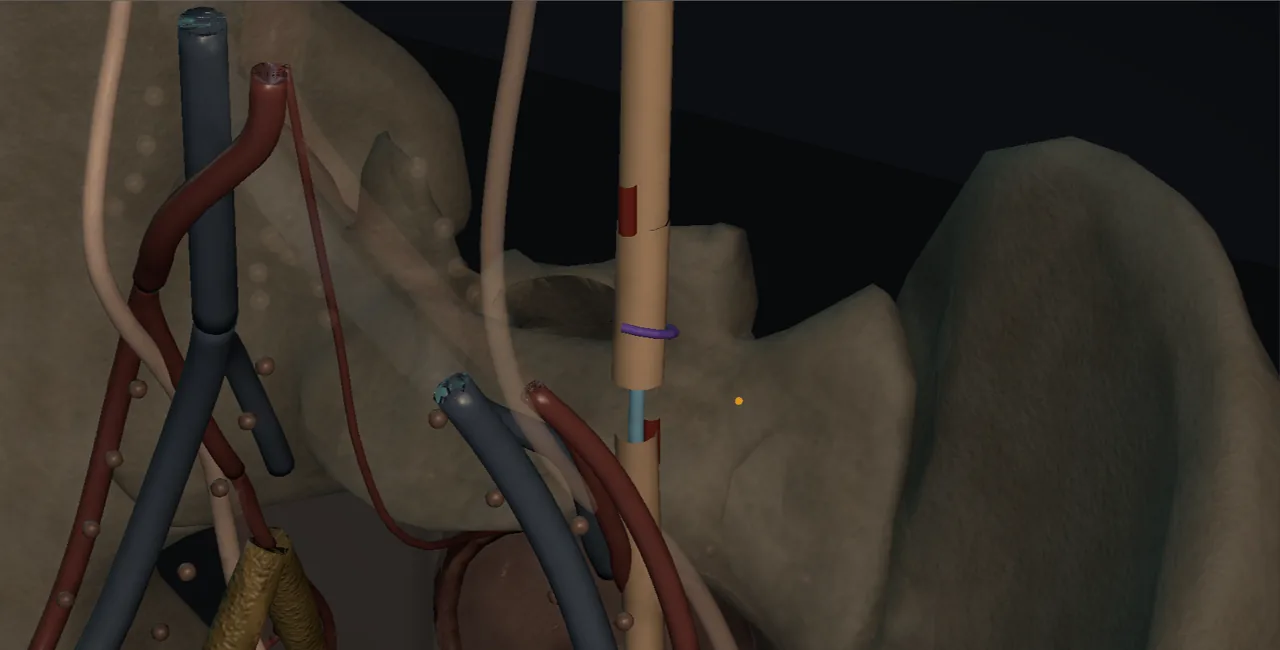 Interactive 3D Interactive ureteroureterostomy Open the 3D animation 3D Interactive transureteroureterostomy
Teaching catalogue only. This coverage record is not a patient pathway or operative instruction.
Typical place in practice
Selected traumatic, iatrogenic, benign stricturing, congenital or oncological ureteric defects with adequate length and viable tissue.
Alternatives and neighbouring procedures
Stenting, nephrostomy, ureteric reimplantation, graft ureteroplasty, ileal replacement, autotransplantation or nephrectomy according to defect and renal function.
Same procedure family, explicit technique branches
These are variations of this canonical operation. Complication modules below identify whether they apply to all branches or only to named approaches.
Open ipsilateral ureteroureterostomy
A short defect is excised and ends are re-anastomosed directly on the same side.
Laparoscopic ureteroureterostomy
Minimally invasive dissection and suturing reconstruct a selected short defect.
Robot-assisted ureteroureterostomy
Robotic suturing supports precise spatulation and anastomosis.
Transureteroureterostomy
The affected ureter is anastomosed to the contralateral ureter when ipsilateral distal reconstruction is unsuitable.
Ureteroureterostomy in duplex system
One duplex moiety ureter is joined to the other, with careful preservation of both blood supplies.
High-level sequence
Coverage outline only; not a step-by-step technical guide.
- Define defect length, cause, renal function and alternative options
- Mobilise only enough ureter to preserve segmental blood supply
- Excise non-viable or diseased tissue and confirm healthy lumen
- Spatulate and create a tension-free, watertight anastomosis over planned drainage
- Confirm perfusion and document stent, drain and imaging pathway
Operative notes
Concise operative notes covering the key steps, landmarks and watch points, in the order you encounter them.
Ureteric stricture - endoscopic cut
What it does: slit a narrow ureter from inside.
- Slippery Terumo wire across, into the kidney.
- Swap over a 5Fr catheter for a stiff wire.
- Suture-around-ureter cause? A stent alone may cure. 3 months. Then image at 4 weeks and 3 months.
- Else: balloon, or cut (cold knife, wire, laser).
- Cut full thickness, till fat is seen.
- Direction: side, in the middle ureter. EXCEPT over the iliac vessels: cut front-inner. (Vessels sit behind the ureter there.)
- Stent 4-6 weeks. Catheter a day.
- Watch: Balloon ~55% cure. Cut ~70%.
- Watch: Over 1 cm, or poor blood supply: poor results.
- Watch: Middle ureter worse than ends: 25% vs 80%.
From the UroRef Operative Quick Guide. Open the note page →
Every failure mode is its own module.
Timing and variation coverage are recorded for each module.
Urine leak or urinoma
Tension, ischaemia or an imperfect anastomosis can leak and cause collection or infection.
Applies to: Open ipsilateral ureteroureterostomy · Laparoscopic ureteroureterostomy · Robot-assisted ureteroureterostomy · Transureteroureterostomy · Ureteroureterostomy in duplex systemAnastomotic stricture or recurrent obstruction
Ischaemia, inadequate spatulation, residual disease or scar can narrow the repair.
Applies to: Open ipsilateral ureteroureterostomy · Laparoscopic ureteroureterostomy · Robot-assisted ureteroureterostomy · Transureteroureterostomy · Ureteroureterostomy in duplex systemUreteric devascularisation or extended defect
Over-mobilisation or thermal dissection can compromise segmental blood supply and make a direct repair fail.
Applies to: Open ipsilateral ureteroureterostomy · Laparoscopic ureteroureterostomy · Robot-assisted ureteroureterostomy · Transureteroureterostomy · Ureteroureterostomy in duplex systemInjury or obstruction of the healthy ureter
A shared drainage reconstruction can expose an otherwise healthy ureter or moiety to injury, reflux or bilateral/combined obstruction.
Applies to: Transureteroureterostomy · Ureteroureterostomy in duplex systemBleeding or vascular injury
Iliac, gonadal, mesenteric or small segmental vessels may be injured during exposure and tunnelling.
Applies to: Open ipsilateral ureteroureterostomy · Laparoscopic ureteroureterostomy · Robot-assisted ureteroureterostomy · Transureteroureterostomy · Ureteroureterostomy in duplex systemUrinary or wound infection
Obstruction, urine leak, stents and incisions create infection risk.
Applies to: Open ipsilateral ureteroureterostomy · Laparoscopic ureteroureterostomy · Robot-assisted ureteroureterostomy · Transureteroureterostomy · Ureteroureterostomy in duplex systemStent migration, blockage or retention
Internal drainage may fail or become a source of symptoms, infection or encrustation.
Applies to: Open ipsilateral ureteroureterostomy · Laparoscopic ureteroureterostomy · Robot-assisted ureteroureterostomy · Transureteroureterostomy · Ureteroureterostomy in duplex systemSources for this module
Renal, ureteric, bladder, urethral and genital trauma and reconstruction.
Accessed 2026-08-03 · opens source European Association of Urology EAU Guidelines on Paediatric UrologyCommon congenital, acute scrotal and paediatric reconstructive procedures.
Accessed 2026-08-03 · opens source European Association of Urology EAU Guidelines on Urological InfectionsInfection prevention, recognition and procedure-associated infection context.
Accessed 2026-08-03 · opens source British Association of Urological Surgeons Patient information leaflets by procedureUK patient-facing procedure, alternatives, recovery and complication framing.
Accessed 2026-08-03 · opens source