
Pyeloplasty and pelvi-ureteric junction reconstruction
Reconstruction of an obstructed pelvi-ureteric junction to create dependent, well-vascularised drainage from renal pelvis to ureter.
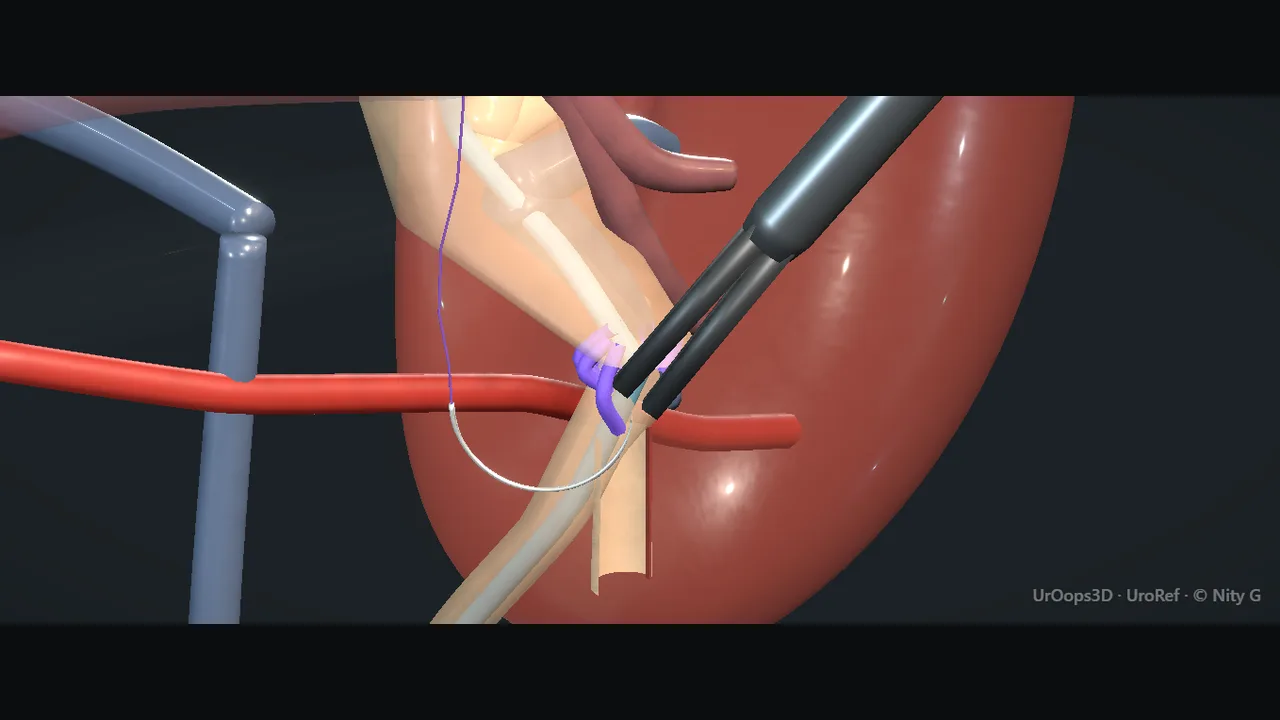 Interactive 3D Interactive operative model Open the 3D animation 3D Interactive ureterocalicostomy
Teaching catalogue only. This coverage record is not a patient pathway or operative instruction.
Typical place in practice
Symptomatic, function-threatening or otherwise clinically significant PUJ obstruction in adults or children.
Alternatives and neighbouring procedures
Observation, temporary drainage, endopyelotomy or nephrectomy in selected circumstances according to function, anatomy and previous treatment.
Same procedure family, explicit technique branches
These are variations of this canonical operation. Complication modules below identify whether they apply to all branches or only to named approaches.
Open dismembered pyeloplasty
The narrowed junction is excised and ureter spatulated before a dependent renal-pelvis anastomosis.
Laparoscopic dismembered pyeloplasty
Minimally invasive suturing reproduces an open dismembered repair.
Robot-assisted dismembered pyeloplasty
Robotic suturing supports reconstruction and management of crossing vessels.
Non-dismembered flap pyeloplasty
A renal-pelvis flap bridges selected long or complex narrow segments without complete transection.
Endopyelotomy
The narrowed junction is incised internally in selected anatomy without formal excision and re-anastomosis.
Redo pyeloplasty
Scarred recurrent obstruction is reconstructed with altered landmarks and vascularity.
High-level sequence
Coverage outline only; not a step-by-step technical guide.
- Confirm functional obstruction, side and vascular anatomy
- Expose renal pelvis, proximal ureter and any crossing vessel
- Excise or incise the obstruction according to the planned variant
- Create a dependent, tension-free, watertight lumen with preserved blood supply
- Confirm drainage and record stent, drain and follow-up imaging plans
Operative notes
Concise operative notes covering the key steps, landmarks and watch points, in the order you encounter them.
Endopyelotomy
What it does: slit a blocked PUJ from inside. (PUJ = where renal pelvis joins the ureter.)
- Wire into the kidney. 5Fr catheter over it.
- Scope over a 2nd wire. Look before cutting: a pulsing vessel crossing = do not cut there.
- Full-thickness SIDE cut, holmium 1-1.5 J.
- Balloon the PUJ to 24. Stent ~4 weeks.
- Acucise (cutting balloon): contrast in water or glycine, not saline. Markers astride the PUJ. Check with a side view. Balloon 2.2 mL + 75 W cut 3-5 s. Then tamponade.
- Percutaneous route (failed surgery, or stones): stones out FIRST. Cold knife hook, under vision. 14/7 endopyelotomy stent, wide end across the PUJ.
- 2026 update: Rarely first choice now. Lap or robotic pyeloplasty works better: 90-95% vs ~70%.
From the UroRef Operative Quick Guide. Open the note page →
Pyeloplasty (Anderson-Hynes)
What it does: cut out the blocked PUJ and rejoin, wide.
- Retroperitoneal cut under the 12th rib.
- Find the ureter on psoas. Follow up to the pelvis. Do not strip its wrapper. That is its blood.
- Stay stitch below the block. 2 stays on the pelvis.
- Cut out the blocked segment and spare pelvis.
- Spatulate the ureter's OUTER side (Potts scissors).
- Join: spatula tip to low pelvis. Inner ureter edge to upper pelvis.
- Water-tight 4/0 Vicryl.
- Crossing vessel? Move the join in front of it.
- Drain. Catheter out when dry.
- Stent out at 4 weeks. MAG3 scan at 3 months. (MAG3 = a kidney drainage nuclear scan.)
- Watch: In children: same steps. Smaller pelvis to trim. 3-4/0 or 5/0 stitches at the corners first.
From the UroRef Operative Quick Guide. Open the note page →
Every failure mode is its own module.
Timing and variation coverage are recorded for each module.
Urine leak or urinoma
Anastomotic failure, collecting-system injury or inadequate drainage can cause persistent extravasation and collection.
Applies to: Open dismembered pyeloplasty · Laparoscopic dismembered pyeloplasty · Robot-assisted dismembered pyeloplasty · Non-dismembered flap pyeloplasty · Endopyelotomy · Redo pyeloplastyRecurrent PUJ obstruction
Ischaemia, tension, missed crossing anatomy, inadequate incision or scar can lead to recurrent symptoms and impaired drainage.
Applies to: Open dismembered pyeloplasty · Laparoscopic dismembered pyeloplasty · Robot-assisted dismembered pyeloplasty · Non-dismembered flap pyeloplasty · Endopyelotomy · Redo pyeloplastyVascular injury or haemorrhage
Crossing and hilar vessels are close to the junction; internal incision has a specific risk when vascular anatomy is unfavourable.
Applies to: Open dismembered pyeloplasty · Laparoscopic dismembered pyeloplasty · Robot-assisted dismembered pyeloplasty · Non-dismembered flap pyeloplasty · Endopyelotomy · Redo pyeloplastyUreteric or collecting-system injury
Incorrect orientation, devascularisation or instrumentation can create a longer defect or compromise the remaining lumen.
Applies to: Open dismembered pyeloplasty · Laparoscopic dismembered pyeloplasty · Robot-assisted dismembered pyeloplasty · Non-dismembered flap pyeloplasty · Endopyelotomy · Redo pyeloplastyStent migration, blockage or retained stent
Internal drainage can fail, cause symptoms or remain beyond its planned removal date.
Applies to: Open dismembered pyeloplasty · Laparoscopic dismembered pyeloplasty · Robot-assisted dismembered pyeloplasty · Non-dismembered flap pyeloplasty · Endopyelotomy · Redo pyeloplastyUrinary or wound infection
Obstruction, urine leak, foreign material and access wounds can support infection.
Applies to: Open dismembered pyeloplasty · Laparoscopic dismembered pyeloplasty · Robot-assisted dismembered pyeloplasty · Non-dismembered flap pyeloplasty · Endopyelotomy · Redo pyeloplastyAdjacent-organ injury
Renal exposure and adhesiolysis may injure bowel, spleen, pancreas, liver or pleura.
Applies to: Open dismembered pyeloplasty · Laparoscopic dismembered pyeloplasty · Robot-assisted dismembered pyeloplasty · Non-dismembered flap pyeloplasty · Redo pyeloplastyPersistent pain despite patent drainage
Symptoms may persist even when postoperative imaging suggests an unobstructed repair, requiring reassessment of the original pain mechanism.
Applies to: Open dismembered pyeloplasty · Laparoscopic dismembered pyeloplasty · Robot-assisted dismembered pyeloplasty · Non-dismembered flap pyeloplasty · Endopyelotomy · Redo pyeloplastySources for this module
Common congenital, acute scrotal and paediatric reconstructive procedures.
Accessed 2026-08-03 · opens source European Association of Urology EAU Guidelines on Urological TraumaRenal, ureteric, bladder, urethral and genital trauma and reconstruction.
Accessed 2026-08-03 · opens source European Association of Urology EAU Guidelines on Urological InfectionsInfection prevention, recognition and procedure-associated infection context.
Accessed 2026-08-03 · opens source British Association of Urological Surgeons Patient information leaflets by procedureUK patient-facing procedure, alternatives, recovery and complication framing.
Accessed 2026-08-03 · opens source