Operative Dictations in Urologic Surgery
Armenakas NA, Fracchia JA, Golan R. Ureterocalicostomy. Chapter 53. Wiley, 2019
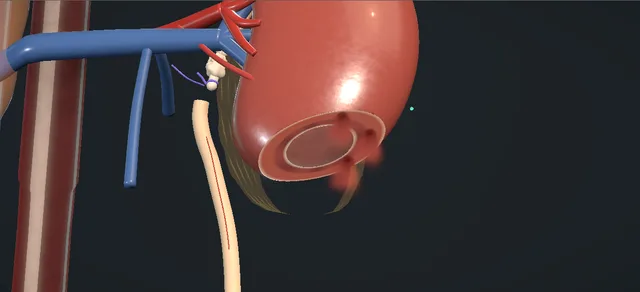
Indications, the essential steps, the template dictation (flank approach, division of the ureter with its adventitia kept, excision of the lower pole parenchyma, figure-of-eight haemostasis, lateral spatulation, interrupted mucosa-to-mucosa join begun posteriorly and finished over a stent, gelatin sponge bolster, loose capsular closure, infrarenal drain), the two variations (subcostal incision, nephropexy) and the complication list. Its figures are kept out of the lesson: a 2 cm spatulation, 4-0 chromic catgut for the join and for the haemostatic stitches, 2-0 polydioxanone on the capsule. It uses no clamp on the renal artery and no nephrostomy, and it gives no duration for the stent. It is silent on the junction stump and on how the parenchyma is divided: the absorbable tie on the stump, the diathermy score and the scalpel are authored for this module.
Open guideline
Journal of the Medical Association of Thailand
Kochakarn W, Viseshsindh V, Muangman V. Ureterocalicostomy for reconstruction of complicated ureteropelvic junction obstruction. J Med Assoc Thai 2002;85:351-5. PMID 12117025 (abstract read 13 October 2026)
Fifteen adults, 1985 to 2000: flank incision, lower pole excised, ureter to lower calyceal mucosa without tension over an internal stent, nephrostomy in all. Twelve successful at a mean of 2.5 years; three failures (one nephrectomy, two permanent nephrostomies in solitary kidneys). A single-centre retrospective series.
Open guideline
Urology
Osman T, Eltahawy I, Fawaz K, Shoeib M, Elshawaf H, El Halaby R. Ureterocalicostomy for treatment of complex cases of ureteropelvic junction obstruction in adults. Urology 2011;78:202-7. doi 10.1016/j.urology.2011.01.044 (abstract read 13 October 2026)
Twenty-two patients, 2002 to 2009; indications were an intrarenal pelvis, a calyx more dilated than the pelvis, recurrent obstruction and iatrogenic injury. Success in 16 at a mean of about 27 months; four failures (two nephrectomies, two long-term stents). Outcome judged by symptoms, ultrasound, radiography and diuretic renography.
Open guideline
World Journal of Urology
Spinos T, Kallidonis P, Tatanis V, et al. Robotic-assisted laparoscopic ureterocalicostomy (RALUC): a systematic review of its applications. World J Urol 2025;44:47. doi 10.1007/s00345-025-06046-w (read 13 October 2026)
Eight small studies, mostly case series, too heterogeneous to pool; failed pyeloplasty was the commonest indication; success ranged from 66.7 to 100 per cent. It quotes Casale et al. on generous excision of parenchyma and a tension-free join that avoids ischaemia and scar. It does not tabulate hilar clamping; one included series used a harmonic scalpel to avoid it. Its table gives stent removal at four to six weeks in most series.
Open guideline