
Distal ureteric reimplantation and reconstruction
Reimplantation of a viable ureter into the bladder, using bladder mobilisation or a flap to bridge longer distal defects and an anti-reflux tunnel where indicated.
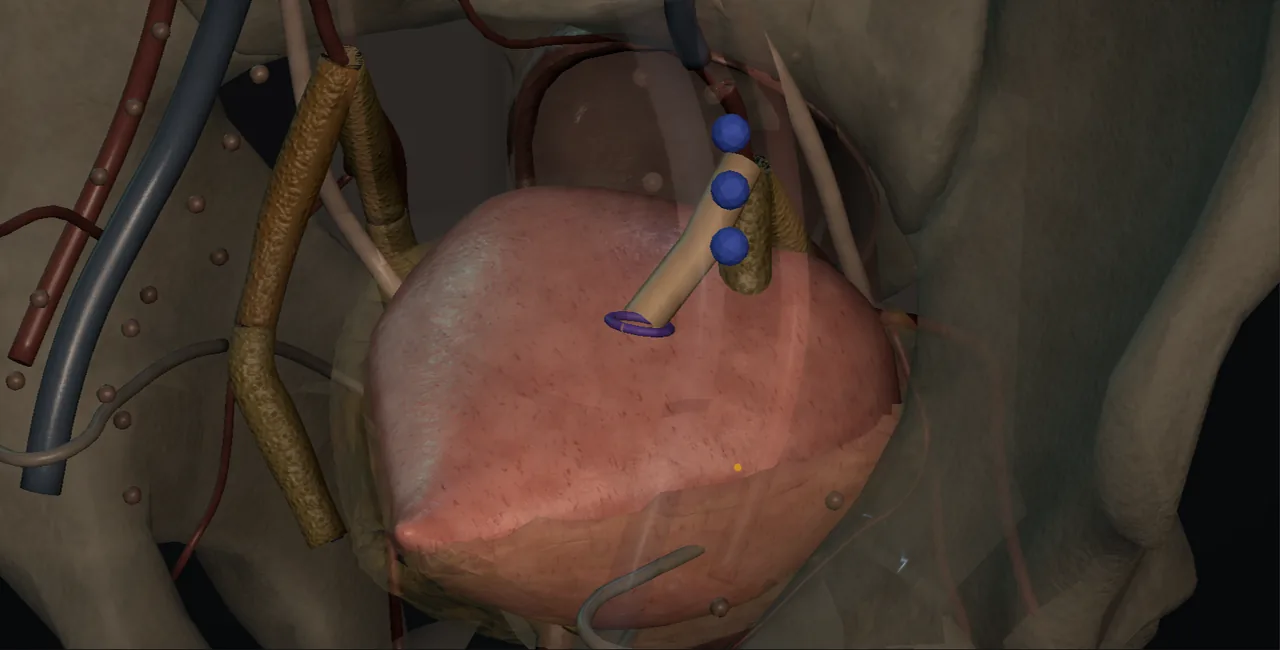 Interactive 3D Interactive psoas hitch, reimplant and Boari flap Open the 3D animation
Teaching catalogue only. This coverage record is not a patient pathway or operative instruction.
Typical place in practice
Distal ureteric injury, stricture, reflux or selected distal tumour excision when the kidney is worth preserving.
Alternatives and neighbouring procedures
Stenting, nephrostomy, ureteroureterostomy, transureteroureterostomy, bowel interposition, autotransplantation or nephrectomy.
Same procedure family, explicit technique branches
These are variations of this canonical operation. Complication modules below identify whether they apply to all branches or only to named approaches.
Direct ureteroneocystostomy
A short distal defect is bridged by direct tension-free ureter-to-bladder implantation.
Psoas-hitch ureteric reimplantation
The bladder is advanced and fixed cephalad to reach a longer ureteric defect.
Boari-flap ureteric reconstruction
A vascularised bladder flap is fashioned into a tube to bridge a longer distal or mid-ureteric gap.
Extravesical anti-reflux reimplantation
The ureter is placed in an extravesical detrusor tunnel, commonly for selected reflux pathways.
Cross-trigonal intravesical reimplantation
The ureter traverses a submucosal bladder tunnel to create an anti-reflux mechanism.
Redo ureteric reimplantation
Prior surgery, radiation or scar requires a revised reconstruction with altered bladder and ureteric blood supply.
High-level sequence
Coverage outline only; not a step-by-step technical guide.
- Define viable ureter, defect length and bladder capacity/mobility
- Mobilise ureter and bladder while preserving blood supply
- Choose direct reimplant, hitch, flap or anti-reflux configuration
- Create a tension-free, watertight anastomosis over planned drainage
- Test closure, avoid outlet distortion and document catheter/stent follow-up
Operative notes
Concise operative notes covering the key steps, landmarks and watch points, in the order you encounter them.
Ureteric rebuild - the ladder
What it does: 4 ways to bridge a missing ureter length.
1: reimplant, short low gaps
- Cut out the diseased end. Fill the bladder.
- Cut 3 cm through bladder muscle only.
- Open mucosa at the far end.
- Lay the spatulated ureter in.
- Close muscle over it. That tunnel stops reflux.
- Catheter 7-10 days.
2: psoas hitch, gains 5-8 cm
- Free the bladder: cut the OPPOSITE side umbilical artery, +/- superior vesical.
- Oblique cut across the bladder top.
- Finger inside pushes bladder up to psoas.
- 3-6 stitches, vertical, into psoas tendon. Vertical misses the nerve along psoas. Shallow misses the leg nerves.
- Hitch BEFORE joining, or the ureter kinks.
- Stent out 7-14 days.
3: Boari flap, gains 12-15 cm
- Bladder flap on a pedicle (superior vesical artery). Base 4 cm wide. Tip 3 cm. Length = gap + 3-4 cm.
- Fix tip to psoas.
- Ureter through the back of the flap. Spatulate.
- Join mucosa to mucosa, 4/0. No tension.
- Roll the flap closed over a catheter.
- Cystogram at 2 weeks. Then catheter out.
4: ileal ureter / kidney swap
- Know the concept only. Full-length gaps.
From the UroRef Operative Quick Guide. Open the note page →
Every failure mode is its own module.
Timing and variation coverage are recorded for each module.
Urine leak or pelvic urinoma
Anastomotic or bladder-closure failure can cause pelvic leakage, collection and infection.
Applies to: Direct ureteroneocystostomy · Psoas-hitch ureteric reimplantation · Boari-flap ureteric reconstruction · Extravesical anti-reflux reimplantation · Cross-trigonal intravesical reimplantation · Redo ureteric reimplantationAnastomotic stricture and recurrent obstruction
Ischaemia, tension, kinking or scar can impair upper-tract drainage.
Applies to: Direct ureteroneocystostomy · Psoas-hitch ureteric reimplantation · Boari-flap ureteric reconstruction · Extravesical anti-reflux reimplantation · Cross-trigonal intravesical reimplantation · Redo ureteric reimplantationVesicoureteric reflux or recurrent infection
A refluxing or ineffective tunnel may allow retrograde flow, though the clinical importance varies with indication and bladder function.
Applies to: Direct ureteroneocystostomy · Psoas-hitch ureteric reimplantation · Boari-flap ureteric reconstruction · Extravesical anti-reflux reimplantation · Cross-trigonal intravesical reimplantation · Redo ureteric reimplantationContralateral ureteric-orifice injury
Bladder incision, mobilisation or tunnel creation can compromise the opposite ureter.
Applies to: Psoas-hitch ureteric reimplantation · Boari-flap ureteric reconstruction · Cross-trigonal intravesical reimplantation · Redo ureteric reimplantationGenitofemoral nerve or psoas-related injury
Fixation too deep or lateral can trap the genitofemoral nerve or injure psoas and adjacent vessels.
Applies to: Psoas-hitch ureteric reimplantationFlap ischaemia, necrosis or reduced bladder capacity
A narrow, scarred or over-tensioned flap may fail, while extensive tubularisation can worsen storage function.
Applies to: Boari-flap ureteric reconstructionUrinary retention or bladder dysfunction
Bladder dissection, bilateral extravesical work, altered capacity or pre-existing dysfunction can impair emptying.
Applies to: Psoas-hitch ureteric reimplantation · Boari-flap ureteric reconstruction · Extravesical anti-reflux reimplantation · Cross-trigonal intravesical reimplantation · Redo ureteric reimplantationUrinary or wound infection
Stents, catheters, obstruction and urine leakage create infection risk.
Applies to: Direct ureteroneocystostomy · Psoas-hitch ureteric reimplantation · Boari-flap ureteric reconstruction · Extravesical anti-reflux reimplantation · Cross-trigonal intravesical reimplantation · Redo ureteric reimplantationStent migration, blockage or retention
A drainage device may fail, cause symptoms or be left beyond the intended removal date.
Applies to: Direct ureteroneocystostomy · Psoas-hitch ureteric reimplantation · Boari-flap ureteric reconstruction · Extravesical anti-reflux reimplantation · Cross-trigonal intravesical reimplantation · Redo ureteric reimplantationSources for this module
Renal, ureteric, bladder, urethral and genital trauma and reconstruction.
Accessed 2026-08-03 · opens source European Association of Urology EAU Guidelines on Paediatric UrologyCommon congenital, acute scrotal and paediatric reconstructive procedures.
Accessed 2026-08-03 · opens source European Association of Urology EAU Guidelines on Urological InfectionsInfection prevention, recognition and procedure-associated infection context.
Accessed 2026-08-03 · opens source British Association of Urological Surgeons Patient information leaflets by procedureUK patient-facing procedure, alternatives, recovery and complication framing.
Accessed 2026-08-03 · opens source