
Transurethral resection of bladder tumour
Endoscopic resection of visible bladder tumour for diagnosis, staging and local control, with deliberate specimen strategy and assessment of resection quality.
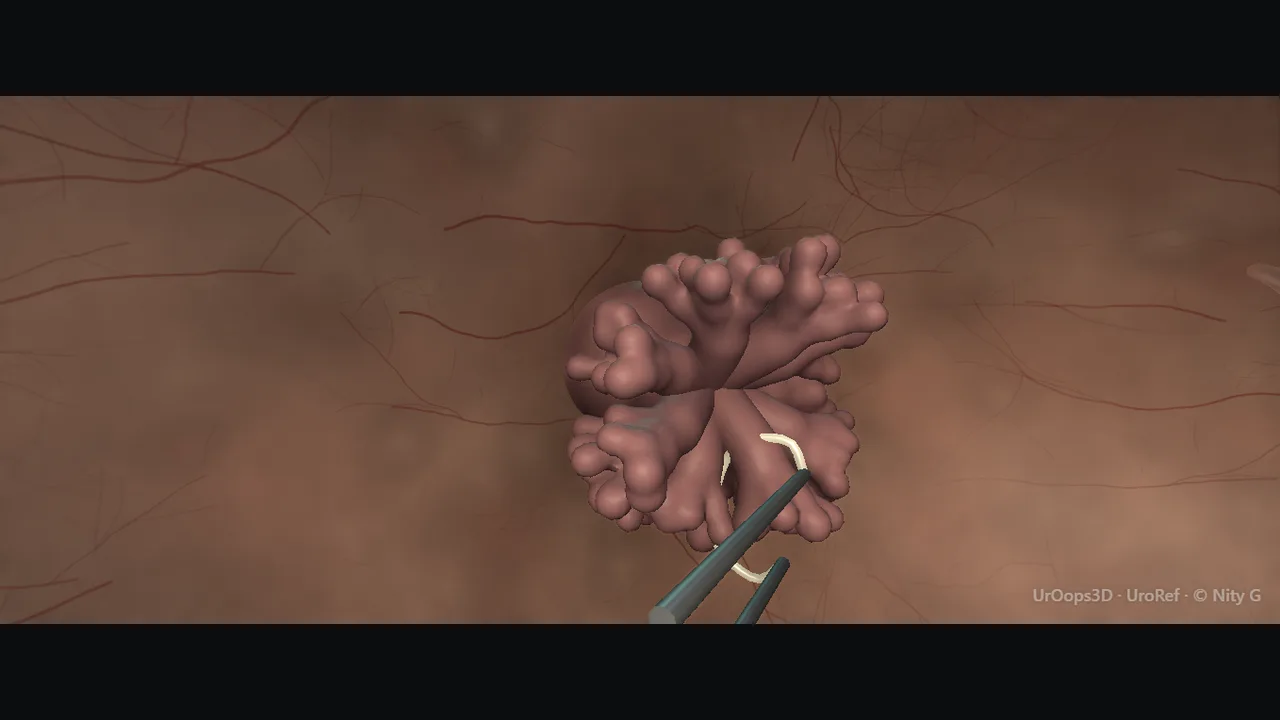 Interactive 3D Interactive operative model Open the 3D animation
Teaching catalogue only. This coverage record is not a patient pathway or operative instruction.
Typical place in practice
Initial or repeat management of suspected non-muscle-invasive bladder cancer and selected assessment of more advanced disease.
Alternatives and neighbouring procedures
Office fulguration for selected recurrences, bladder biopsy, surveillance or definitive bladder surgery according to disease context.
Same procedure family, explicit technique branches
These are variations of this canonical operation. Complication modules below identify whether they apply to all branches or only to named approaches.
Conventional piecemeal TURBT
Tumour is resected in fractions with separately orientated deep tissue where required.
En-bloc TURBT
A selected tumour is removed as one specimen to preserve architecture and orientation.
Enhanced-visualisation TURBT
An enhanced imaging mode supplements white-light inspection to identify additional mucosal disease.
Repeat resection TURBT
The prior site and bladder are reassessed to address residual disease or staging uncertainty.
High-level sequence
Coverage outline only; not a step-by-step technical guide.
- Map the bladder and document tumour number, site and morphology
- Plan specimen handling and energy before resection
- Resect visible disease while protecting bladder wall and orifices
- Obtain appropriate deep tissue without uncontrolled perforation
- Secure haemostasis and document completeness, perforation status and next pathway
Operative notes
Concise operative notes covering the key steps, landmarks and watch points, in the order you encounter them.
TURBT
What it does: resect a bladder tumour through the resectoscope.
- Examine with both hands, in and out. A fixed mass changes stage and plan.
- Survey the whole bladder first, half full. Same order every time: trigone and both orifices, posterior wall, left wall, dome (bubble), right wall, front wall (70 degree lens, press above the pubis), neck.
- Find both ureteric orifices before cutting near them.
- Resect in order: tumour, then base, then edge. Base in its own pot.
- Muscle must be in the specimen. No muscle = no stage. It is the quality standard. Deep enough: coarse muscle bundles. Yellow fat: too deep.
- Small tumour: cold cup or loop, base included.
- Lateral wall? Warn the anaesthetist. The obturator nerve fires a leg kick as you cut. Ask for a short paralysing dose. Fill less. Bipolar in saline, lowest current that cuts.
- Avoid perforation: half fill. Loop placed beyond the tumour, drawn back towards you: cut on the return, sheath still. Short swipes. Never push the loop into a thin wall.
- Suspect perforation (view deflates, fat, distension)? Stop. Catheter. Drain. Image.
- Clear the chips through the sheath. Last look for a breach before any chemo goes in.
- En-bloc (cut around, lift off) for small tumours.
- Kit: 24-26 Fr continuous-flow resectoscope. 30 and 70 degree lenses. Bipolar loop in saline; rollerball or button. Cold-cup forceps. Suction on the outflow. Separate labelled pots: tumour, base, each biopsy. 3-way 20-22 Fr catheter for a big resection. Owner-specified.
- Watch: Bimanual after, not just before.
- 2026 update: One dose of chemo in the bladder after resection. Within 2 h. Not if perforated or bleeding hard. Gemcitabine is now first choice in many units. (Mitomycin supply ran short.)
- 2026 update: Re-resect in 2-6 weeks for T1, G3, or no muscle.
From the UroRef Operative Quick Guide. Open the note page →
Every failure mode is its own module.
Timing and variation coverage are recorded for each module.
Obturator reflex with bladder injury
Lateral-wall energy can trigger sudden adductor contraction and drive the resection loop through the bladder.
Applies to: Conventional piecemeal TURBT · En-bloc TURBT · Enhanced-visualisation TURBT · Repeat resection TURBTExtraperitoneal or intraperitoneal perforation
Deep resection or mechanical injury can breach the bladder, with consequences determined by location, size and associated contamination or bleeding.
Applies to: Conventional piecemeal TURBT · En-bloc TURBT · Enhanced-visualisation TURBT · Repeat resection TURBTBleeding and clot retention
Tumour vessels and the resection bed may bleed immediately or after catheter removal and obstruct drainage.
Applies to: Conventional piecemeal TURBT · En-bloc TURBT · Enhanced-visualisation TURBT · Repeat resection TURBTUrinary infection or sepsis
Instrumentation, necrotic tumour, catheterisation and impaired drainage can contribute to infection.
Applies to: Conventional piecemeal TURBT · En-bloc TURBT · Enhanced-visualisation TURBT · Repeat resection TURBTUreteric-orifice injury or upper-tract obstruction
Resection or coagulation at an orifice can cause oedema, reflux or delayed stenosis.
Applies to: Conventional piecemeal TURBT · En-bloc TURBT · Enhanced-visualisation TURBT · Repeat resection TURBTInadequate staging specimen
Absent or uninterpretable detrusor, cautery artefact, fragmentation or poor labelling can prevent reliable staging.
Applies to: Conventional piecemeal TURBT · En-bloc TURBT · Enhanced-visualisation TURBT · Repeat resection TURBTResidual or missed tumour
Incomplete inspection or resection, occult flat disease and multifocal biology can leave clinically significant cancer.
Applies to: Conventional piecemeal TURBT · En-bloc TURBT · Enhanced-visualisation TURBT · Repeat resection TURBTUrethral stricture or bladder contracture
Repeated instrumentation and extensive mucosal treatment can cause delayed outlet narrowing or loss of bladder capacity.
Applies to: Conventional piecemeal TURBT · En-bloc TURBT · Enhanced-visualisation TURBT · Repeat resection TURBTSources for this module
TURBT quality, repeat resection and intravesical-treatment pathways.
Accessed 2026-08-03 · opens source European Association of Urology EAU Guidelines on Urological InfectionsInfection prevention, recognition and procedure-associated infection context.
Accessed 2026-08-03 · opens source British Association of Urological Surgeons Patient information leaflets by procedureUK patient-facing procedure, alternatives, recovery and complication framing.
Accessed 2026-08-03 · opens source