
The obturator kick
Teaching only · not for diagnosis or treatment decisions
The normal sequence
TURBT both diagnoses and treats a bladder tumour. The aim is a complete resection of visible tumour with detrusor muscle in the specimen, so the pathologist can stage depth of invasion. A clean, staged resection beats a deep, frightened one.
The lateral wall plan is made before the loop moves. Where a tumour sits over the obturator nerve, decide on the energy and the anaesthetic with the anaesthetist first: bipolar where available, and a clear agreement on neuromuscular blockade or an obturator block if needed.
Fill the bladder only enough to see, not to stretch it. A thin, overdistended wall is a thin margin to the structures behind it.
- Examine under anaesthetic: bimanual palpation for a mass and for fixity, recorded before and after resection.
- Pass the resectoscope under vision and perform a systematic cystoscopy of the whole bladder, noting every tumour, its site, size and configuration.
- Identify both ureteric orifices and the relation of each tumour to them before resecting, so an orifice is not undermined.
- Resect the exophytic tumour in layers, working from the surface down, keeping the bladder comfortably but not tightly filled.
- Take the tumour base separately and send it as a distinct specimen, resecting deep enough to include detrusor muscle for accurate staging.
- Obtain haemostasis as you go and inspect the resection bed, then any suspicious flat areas, with biopsies as indicated.
- Empty the bladder, confirm the wall is intact, and leave a catheter with irrigation as the case dictates.
- It is when the loop reaches the deep base of a lateral or inferolateral wall tumour, taking detrusor for staging, that monopolar current can stimulate the obturator nerve and provoke the kick.
Where the danger lives
This model needs WebGL, which is switched off on this device. The spatial relationship is written out in full in the caption below and in the mechanism, so nothing on this card depends on the model alone.
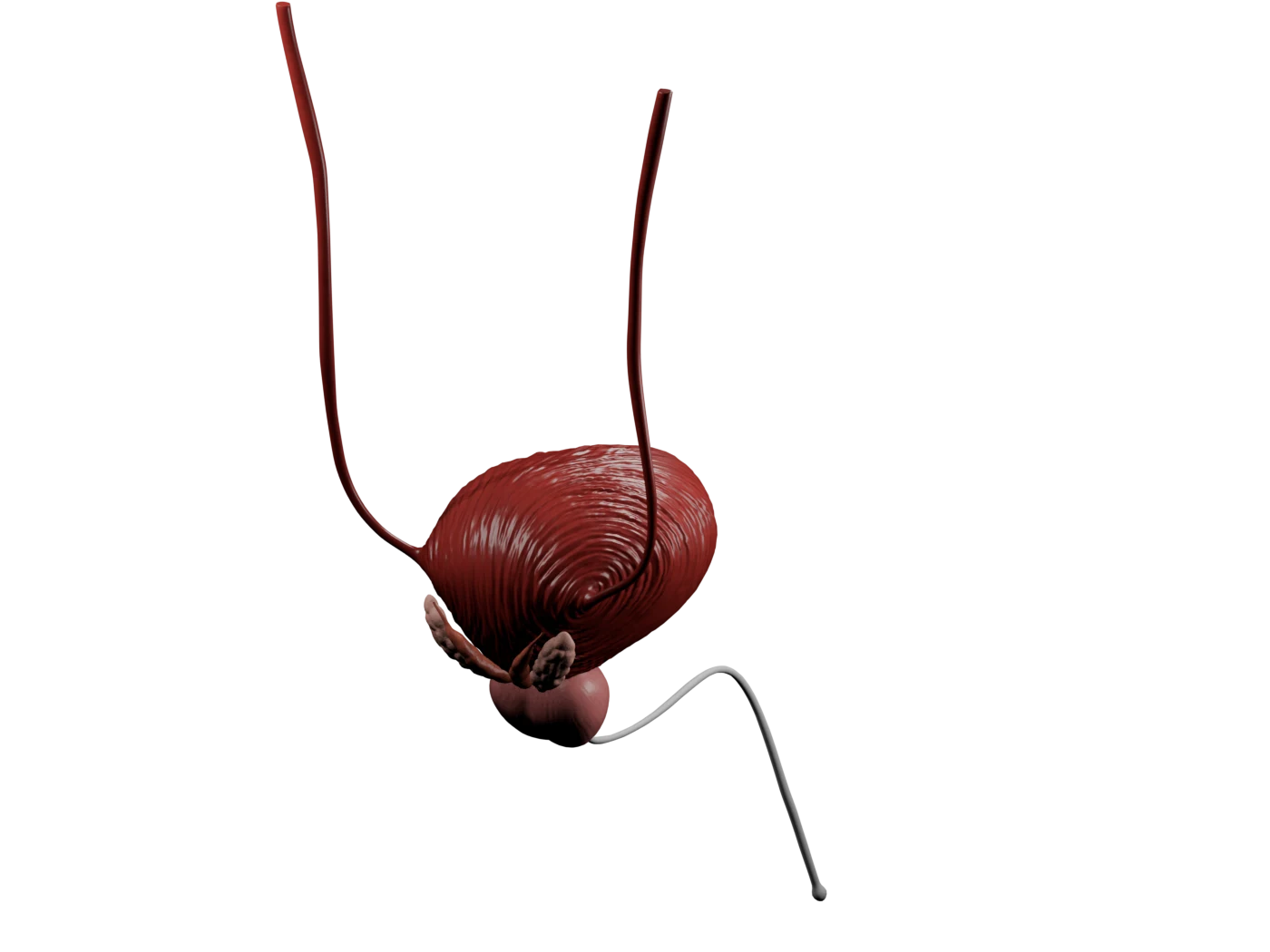 nerve danger corridor
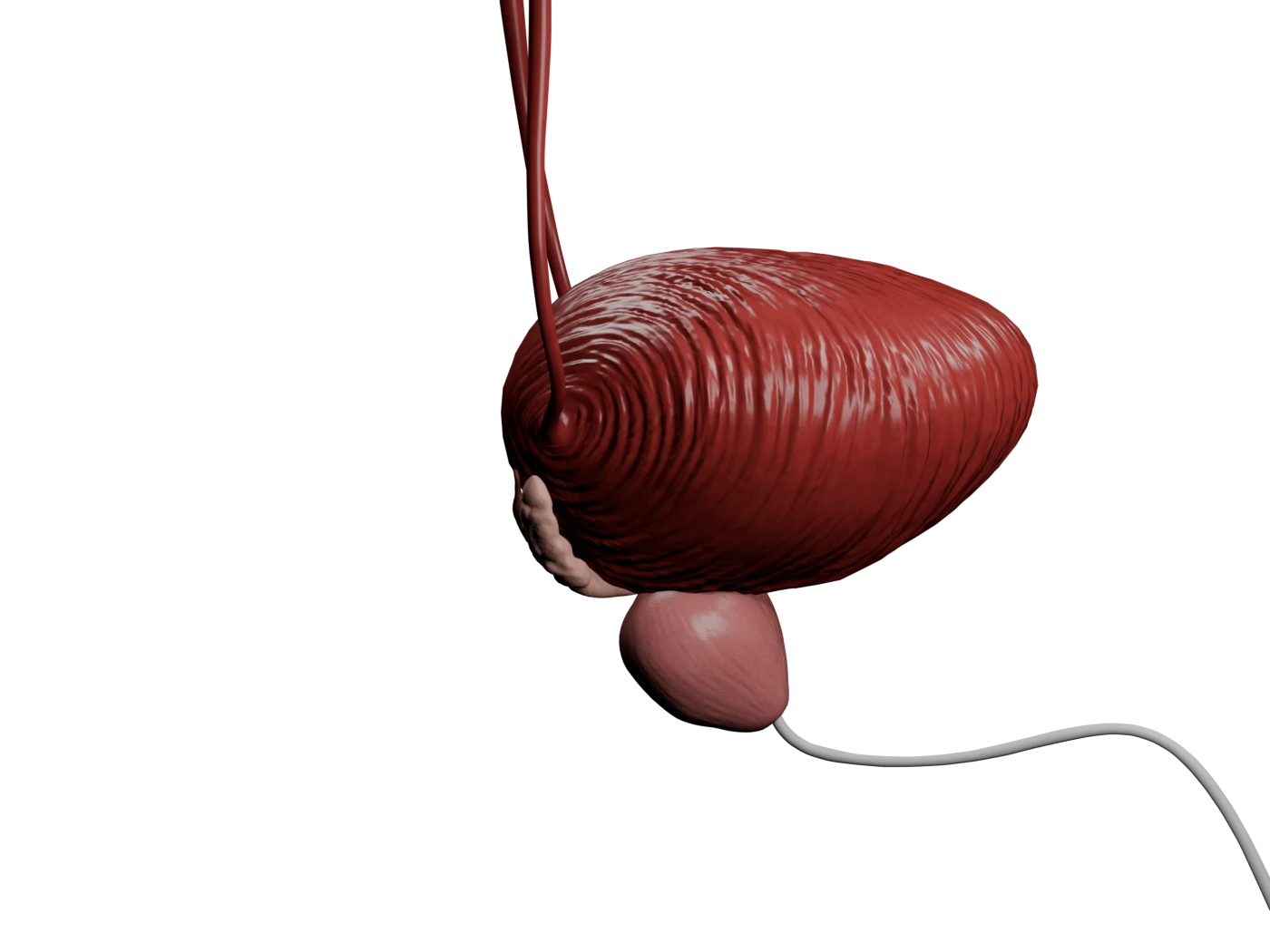 nerve danger corridor
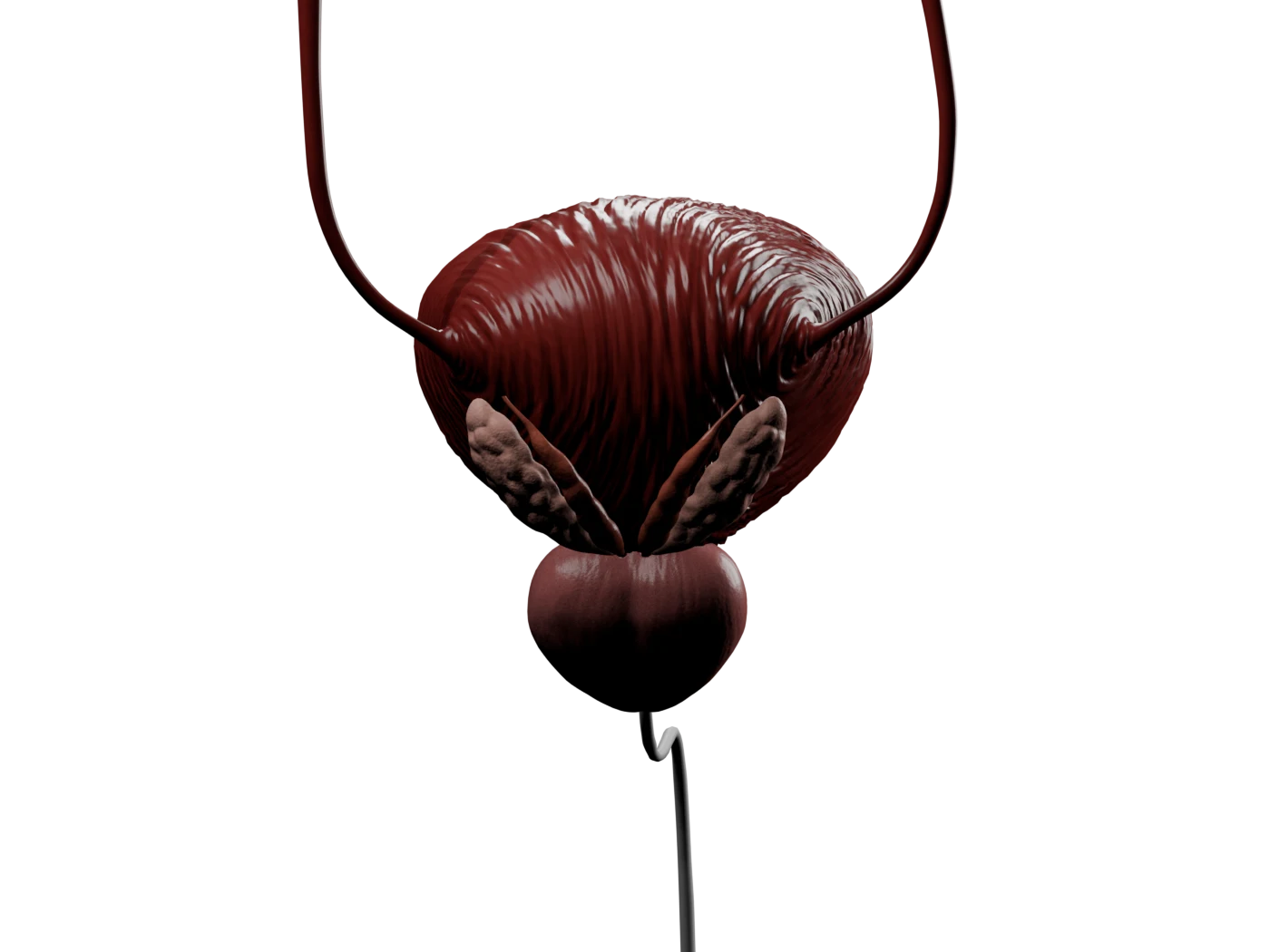 nerve danger corridor
- A tumour sits on the lateral bladder wall, the loop poised to resect it.
- The view is the surgeon's: down the resectoscope, into the filled bladder.
- Reveal the danger zone to see what lies just beyond the wall.
How it happens
- The obturator nerve runs along the pelvic side wall, immediately deep to the inferolateral bladder.
- It never has to be touched to fire.
- During resection of a lateral wall tumour, monopolar diathermy current spreads through the detrusor and stimulates the nerve directly.
- The thigh adductors contract in a single violent jerk - the kick - driving the resectoscope deeper than intended.
- The danger is not the cut you meant to make, but the one the leg makes for you: a deep muscle resection or a full-thickness perforation.
- lateral / inferolateral tumour
- overdistended thin bladder
- monopolar energy
- large tumour base
- Incidence. Reported reflex rates range from about 12% with bipolar energy to 40-63% with unblocked monopolar resection of lateral wall tumours, and a nerve block reduces but does not eliminate the reflex. Bladder perforation complicates around 1-10% of resections. [source traced]
- Obturator reflex: Abedi Yarandi V, Khatami F, Aghamir SMK. Urol J. 2020;18(6):688-92. PMID 32715449. Shubhankar G, Mittal A, Panwar VK, et al. Indian J Urol. 2025;41(2):111-16. PMID 40292369. Ozgur G, Genc YE, Ozdemiroglu C, et al. Actas Urol Esp. 2026. doi:10.1016/j.acuroe.2026.502007. PMID 42413613. Perforation: Osman Y, Elawdy M, Taha DE, et al. Int Urol Nephrol. 2023;55(9):2161-67. PMID 37318699.
- [source traced] Cho SY, Jung KT. Adductor muscle contraction under deep neuromuscular blockade during TURBT. Medicina (Kaunas). 2025;61(7):1207. PMID 40731836. Abedi Yarandi V, Khatami F, Aghamir SMK. Urol J. 2020;18(6):688-92. PMID 32715449. Ozgur G, Genc YE, Ozdemiroglu C, et al. Actas Urol Esp. 2026. doi:10.1016/j.acuroe.2026.502007. PMID 42413613. Osman Y, Elawdy M, Taha DE, et al. Int Urol Nephrol. 2023;55(9):2161-67. PMID 37318699.
The first moves
- Come off the pedal the instant a kick occurs or is anticipated. Stop resecting.
- Partially empty the bladder. A thicker, less distended wall puts distance between loop and nerve.
- Drop the cutting current and resect in short, tangential bursts rather than deep sweeps.
- If you are on bipolar, you are already on the safer energy. If on monopolar and the resection cannot wait, plan to complete the lateral wall on bipolar; it lowers but does not abolish the reflex.
- Ask anaesthetics to deepen neuromuscular blockade for continued lateral wall work. It usually prevents the kick but does not abolish it reliably: contraction has been recorded even at complete block, so plan an obturator nerve block for high-risk work.
- Request an obturator nerve block for a recurrent reflex or high-risk lateral wall work; it reduces the reflex more reliably than deep blockade alone.
- Inspect for perforation after any forceful kick. Extraperitoneal: catheter and observe. Intraperitoneal or large defect: this is your conversion trigger. Document the kick, the assessment, and the plan in the op note. escalation trigger
The viva answer
- The obturator reflex is a recognised hazard of resecting tumours on the lateral bladder wall.
- The obturator nerve lies on the pelvic side wall immediately adjacent to the bladder, and monopolar current passing through the detrusor stimulates it directly, producing a sudden adductor contraction that can drive the loop through the wall.
- My priorities are to anticipate it before resecting laterally, to recognise it, and to manage any consequent injury.
- I would reduce the risk by partially emptying the bladder to thicken the wall, by resecting with short tangential strokes at lower current, and by using bipolar in preference to monopolar where it is available.
- Bipolar lowers the reflex but does not reliably abolish it, and the comparative evidence is not unanimous, so I would not rely on it alone.
- For ongoing lateral wall work I would ask for deep neuromuscular blockade, which usually prevents the visible kick, but contraction has been recorded even at complete block, so I would not rely on paralysis alone: an obturator nerve block is the more reliable measure for high-risk lateral wall work and I would plan one alongside it.
- After any forceful kick I would inspect carefully for perforation.
- An extraperitoneal perforation is managed with catheter drainage and observation, whereas an intraperitoneal perforation, suggested by contrast outlining bowel, usually requires operative repair and is my trigger to call for senior help.
- If the nerve is still being stimulated, how does paralysis stop the kick?
- Neuromuscular blockade acts at the junction between nerve and muscle: the nerve still depolarises, but the muscle cannot respond.
- Depth matters, but even complete block does not guarantee abolition, since contraction has been recorded at train-of-four count zero.
- That is why I would add an obturator nerve block for high-risk lateral wall work.
- How do you distinguish extraperitoneal from intraperitoneal perforation?
- Cystographically and clinically.
- Extraperitoneal leaks show a flame-shaped blush around the bladder base and are managed with prolonged catheter drainage.
- Intraperitoneal leaks show contrast outlining bowel loops, often with peritonism, and usually need operative repair.
- Why might bipolar reduce the reflex compared with monopolar?
- In bipolar resection the current returns at the loop itself rather than passing through the patient to a distant return pad, so less spreads to the adjacent obturator nerve.
- The effect is a reduction, not abolition, and some series show no clear advantage, so it does not replace blockade for high-risk lateral wall work.
Anyone can say 'stop and put a catheter in'.
- The strong answer names deep neuromuscular blockade and an obturator nerve block as the preventions
- Explains why paralysis works despite continued nerve stimulation and why it is not absolute
- Separates extraperitoneal from intraperitoneal perforation in both diagnosis and management
Examiner note
Can you give it back without looking?
Allow about four minutes to order the save, answer the follow-ups and compare your viva response with the card. Your scores guide a suggested revision schedule in this browser.