
Simple nephrectomy for a non-functioning benign kidney
Removal of a poorly functioning or non-functioning kidney for benign disease, often in the presence of infection, stones, obstruction, pain or dense inflammation.
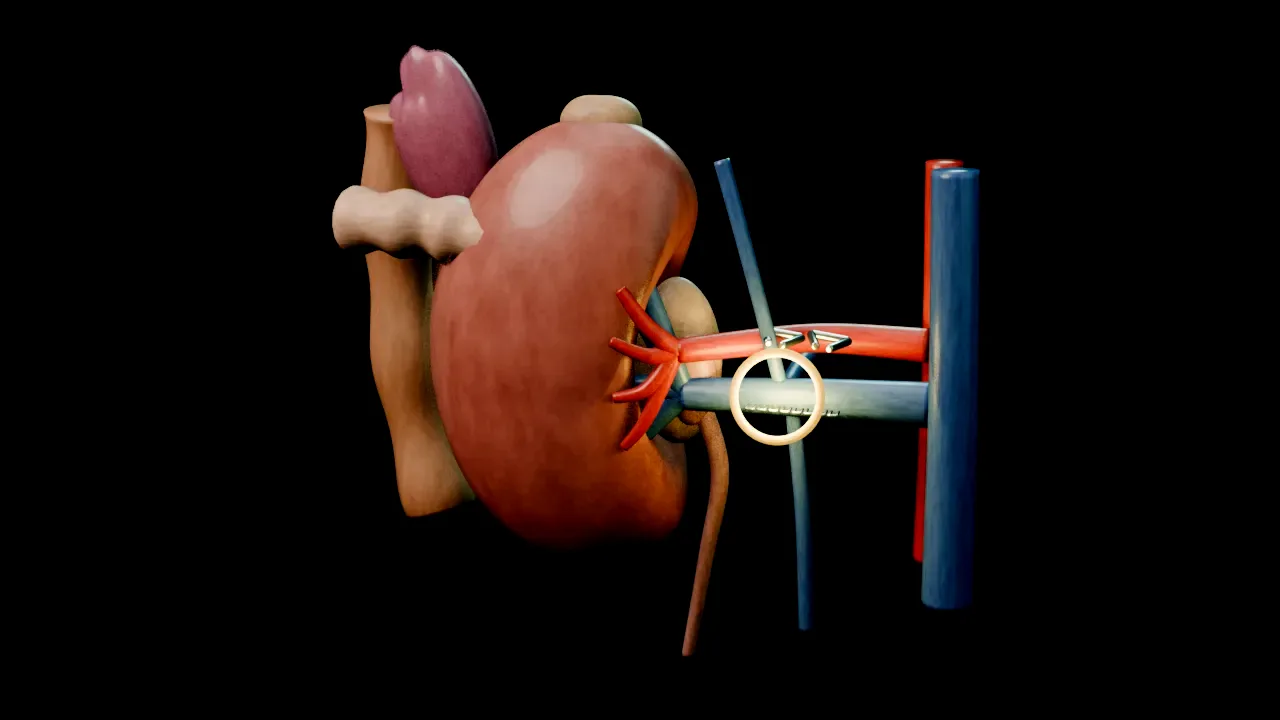 Interactive 3D Interactive operative model Open the 3D animation
Teaching catalogue only. This coverage record is not a patient pathway or operative instruction.
Typical place in practice
A symptomatic or harmful non-functioning renal unit when reconstruction, drainage or observation is not appropriate.
Alternatives and neighbouring procedures
Observation, drainage, stone treatment or reconstruction according to residual function, symptoms and infection risk.
Same procedure family, explicit technique branches
These are variations of this canonical operation. Complication modules below identify whether they apply to all branches or only to named approaches.
Laparoscopic simple nephrectomy
Minimally invasive dissection removes the kidney when inflammatory planes remain manageable.
Robot-assisted simple nephrectomy
Robotic access may assist selected complex benign dissection.
Open simple nephrectomy
Open exposure is used when sepsis, scarring, prior surgery or organ involvement makes minimally invasive dissection unsafe.
Subcapsular nephrectomy
Dissection within the renal capsule avoids densely adherent perinephric planes in selected inflammatory kidneys.
Nephrectomy for xanthogranulomatous or severely inflammatory disease
Extensive inflammatory adherence may require en-bloc organ repair or resection and a low threshold to change approach.
High-level sequence
Coverage outline only; not a step-by-step technical guide.
- Confirm negligible function, benign intent and contralateral reserve
- Review infection, stone and adjacent-organ anatomy
- Select the safest dissection plane and expose the hilum
- Control renal vessels and ureter without entering infected spaces unnecessarily
- Remove the kidney, manage any organ injury and confirm source control
Operative notes
Concise operative notes covering the key steps, landmarks and watch points, in the order you encounter them.
Open incisions to know
What it does: the standard cuts, and how to open each.
- Midline: skin, fat, linea alba. Find the midline via the urachus. (Urachus = fetal tube, bladder dome to umbilicus.) Finger in the wound top, pull up. A ridge rises. Cut on the ridge.
- Peritoneum: 2 clips, pinch, no bowel, cut between. Enlarge with scissors between 2 fingers.
- Pfannenstiel: curved cut 2 cm above the pubis. Open sheath in the same curve. Sweep sheath off both recti, up and down. Separate the recti in the middle. Do not cut them. Cut the recti off the pubis = Cherny. Rarely needed.
- Loin, over the 12th rib: cut onto the rib tip. 3 cm diathermy through latissimus dorsi. Then cut in front of the rib tip, through the obliques, onto Gerota's fascia. (Gerota's = the kidney's fascia wrapper.) Sweep the peritoneum inwards with a finger. Cut muscle along the rib, centrally. Avoid the pleura.
From the UroRef Operative Quick Guide. Open the note page →
Laparoscopic setup rules
What it does: safe ports and position, any lap case.
- Hasson first port: open cut-down. Safe. (Veress needle: ~4% problems.)
- Side lying. Break the table under the 12th rib.
- Axillary roll. Pillow between legs. Gel pads.
- Boots and warmer on.
- Ports under vision, camera inside.
- 2026 update: Antibiotics: 1 dose, local policy, allergy aware. The old fixed gent + cefuroxime recipe is gone.
From the UroRef Operative Quick Guide. Open the note page →
Every failure mode is its own module.
Timing and variation coverage are recorded for each module.
Hilar or major-vessel injury
Inflammation can obscure, shorten or fix renal vessels and make vascular control unexpectedly hazardous.
Applies to: Laparoscopic simple nephrectomy · Robot-assisted simple nephrectomy · Open simple nephrectomy · Subcapsular nephrectomy · Nephrectomy for xanthogranulomatous or severely inflammatory diseaseBowel, pancreas, spleen, liver or diaphragmatic injury
Loss of normal tissue planes may make adjacent-organ injury or planned en-bloc management unavoidable.
Applies to: Laparoscopic simple nephrectomy · Robot-assisted simple nephrectomy · Open simple nephrectomy · Subcapsular nephrectomy · Nephrectomy for xanthogranulomatous or severely inflammatory diseaseSepsis or infected residual collection
An infected kidney, stone burden or abscess may disseminate infection or leave a postoperative infected space.
Applies to: Laparoscopic simple nephrectomy · Robot-assisted simple nephrectomy · Open simple nephrectomy · Subcapsular nephrectomy · Nephrectomy for xanthogranulomatous or severely inflammatory diseaseConversion to open or more extensive surgery
Unsafe visualisation, bleeding or organ adherence may require open exposure or a different dissection plane.
Applies to: Laparoscopic simple nephrectomy · Robot-assisted simple nephrectomy · Subcapsular nephrectomyAcute kidney injury or chronic renal decline
Although the removed unit contributes little, sepsis and surgery can impair contralateral renal function.
Applies to: Laparoscopic simple nephrectomy · Robot-assisted simple nephrectomy · Open simple nephrectomy · Subcapsular nephrectomy · Nephrectomy for xanthogranulomatous or severely inflammatory diseaseWound infection, hernia or chronic flank pain
Contamination and open or extraction incisions can impair healing and cause long-term abdominal-wall symptoms.
Applies to: Laparoscopic simple nephrectomy · Robot-assisted simple nephrectomy · Open simple nephrectomy · Subcapsular nephrectomy · Nephrectomy for xanthogranulomatous or severely inflammatory diseaseUnexpected malignancy or incomplete pathology orientation
Occult cancer can be discovered in a presumed benign specimen, making intact removal and clear documentation important.
Applies to: Laparoscopic simple nephrectomy · Robot-assisted simple nephrectomy · Open simple nephrectomy · Subcapsular nephrectomy · Nephrectomy for xanthogranulomatous or severely inflammatory diseaseSources for this module
Infection prevention, recognition and procedure-associated infection context.
Accessed 2026-08-03 · opens source British Association of Urological Surgeons Patient information leaflets by procedureUK patient-facing procedure, alternatives, recovery and complication framing.
Accessed 2026-08-03 · opens source