
Radical prostatectomy and pelvic lymph-node dissection
Removal of the prostate and seminal vesicles with vesicourethral reconstruction, with pelvic lymph-node dissection and functional preservation tailored to cancer risk.
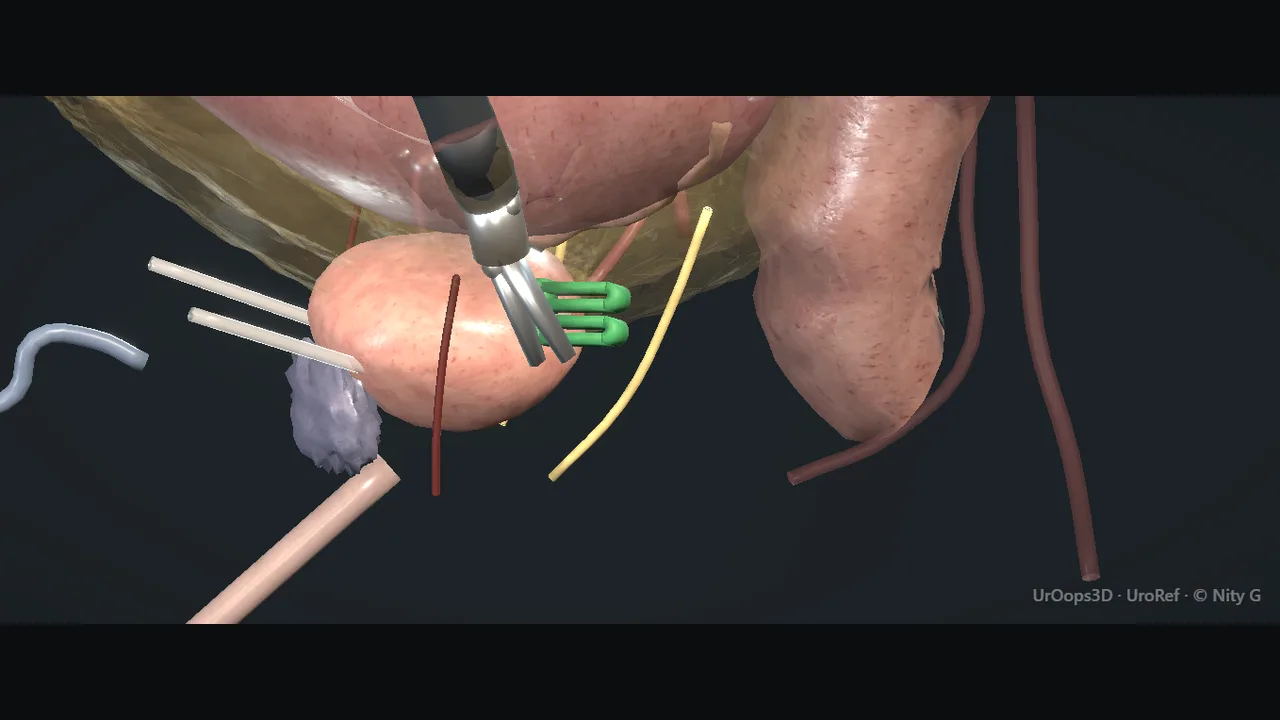 Interactive 3D Interactive operative model Open the 3D animation 3D Interactive rectourethral fistula repair
Teaching catalogue only. This coverage record is not a patient pathway or operative instruction.
Typical place in practice
Curative-intent local treatment of appropriately selected localised or locally advanced prostate cancer.
Alternatives and neighbouring procedures
Active surveillance, radiotherapy, focal treatment or systemic/palliative strategies according to disease and patient factors.
Same procedure family, explicit technique branches
These are variations of this canonical operation. Complication modules below identify whether they apply to all branches or only to named approaches.
Robot-assisted radical prostatectomy
Robotic dissection and suturing support prostate removal and vesicourethral anastomosis.
Open retropubic radical prostatectomy
The prostate is removed through an open pelvic approach with direct access to the retropubic space.
Laparoscopic radical prostatectomy
Laparoscopic instruments perform extirpation and intracorporeal anastomosis without robotic articulation.
Nerve-sparing radical prostatectomy
Neurovascular tissue is preserved to a degree compatible with tumour location and margin risk.
Radical prostatectomy with PLND
Nodal packets are removed according to the planned template for staging and possible therapeutic value.
Salvage radical prostatectomy
Surgery after radiation or focal treatment has altered tissue planes and greater reconstructive risk.
High-level sequence
Coverage outline only; not a step-by-step technical guide.
- Confirm staging, nerve-sparing and nodal plan
- Develop pelvic planes and control the dorsal venous complex and bladder neck
- Dissect seminal vesicles, pedicles and apex with oncological discipline
- Remove the specimen and complete planned lymphadenectomy
- Create a watertight, tension-free vesicourethral anastomosis and document functional preservation
Operative notes
Concise operative notes covering the key steps, landmarks and watch points, in the order you encounter them.
Radical prostatectomy, open
What it does: prostate, vesicles and vasa out for cure.
- Lower midline. Open the retropubic space.
- Node packet: open the sheath over the external iliac vein. Sweep nodes to the groin canal. Find the obturator nerve BEFORE dividing.
- Endopelvic fascia opened beside the prostate.
- Pubo-prostatic ligaments cut at their middle. Spare their urethral part.
- Dorsal vein complex stitched under, right to left. Anchor to pubic bone (Walsh) optional.
- Divide it under vision. Follow the prostate slope. The urethra appears at the apex.
- Running 3/0 on the prostate top for back-bleeding.
- Urethra: cut the front 2/3.
- 6 stitches, 3/0 Monocryl, round the urethral edge. They finish the join later.
- Back of the urethra cut between clamp and rectum.
- Nerve spare: lateral pelvic fascia cut on its inner reflection. Free the bundle from apex upwards, behind Denonvilliers'. Clips only. NO diathermy near the bundle.
- Bladder neck divided in front of the orifices. Vas clipped. Vesicle tip artery clipped. Out.
- Tennis-racket neck repair, to 1 finger wide. (Sparing the neck does not change continence.)
- Parachute join: 6 stitches through the neck. Catheter across. Bladder down. Knots: front first, back last.
- Drains beside, not on, the join.
- 2026 update: Robot is the UK default now. These open steps remain the exam anatomy.
Robot-assisted, as animated
- Camera and three 8 mm robotic arms in a line; assistant port separate. Steep head-down.
- Retzius dropped. Endopelvic fascia opened each side.
- Bladder neck opened at 12, at the prostate. Orifices stay with the bladder.
- Vasa clipped and cut. Third arm lifts the vesicles.
- Denonvilliers' opened below the vesicle tips. Stay on the fascia. Rectum is next.
- Prostatic pedicles clipped at the base. NO energy beside the bundle. Bundles peel off laterally.
- DVC controlled. Urethra cut at the apex, max length. Specimen into a bag.
- Join: posterior row first, neck parachuted down, new catheter, anterior row. Leak test. Drain.
- Bag out through the extended camera port.
From the UroRef Operative Quick Guide. Open the note page →
Every failure mode is its own module.
Timing and variation coverage are recorded for each module.
Major bleeding or vascular injury
The dorsal venous complex, prostatic pedicles or pelvic vessels may bleed and obscure oncological planes.
Applies to: Robot-assisted radical prostatectomy · Open retropubic radical prostatectomy · Laparoscopic radical prostatectomy · Nerve-sparing radical prostatectomy · Radical prostatectomy with PLND · Salvage radical prostatectomyRectal or ureteric injury
Posterior dissection and bladder-neck reconstruction can injure adjacent bowel or ureter, with greater risk in salvage planes.
Applies to: Robot-assisted radical prostatectomy · Open retropubic radical prostatectomy · Laparoscopic radical prostatectomy · Nerve-sparing radical prostatectomy · Radical prostatectomy with PLND · Salvage radical prostatectomyVesicourethral anastomotic leak
Tension, tissue quality or a non-watertight anastomosis can cause pelvic urine leakage and delayed catheter removal.
Applies to: Robot-assisted radical prostatectomy · Open retropubic radical prostatectomy · Laparoscopic radical prostatectomy · Nerve-sparing radical prostatectomy · Radical prostatectomy with PLND · Salvage radical prostatectomyUrinary infection, pelvic collection or wound infection
Catheterisation, urine leak, lymphatic collections and incisions create several infection routes.
Applies to: Robot-assisted radical prostatectomy · Open retropubic radical prostatectomy · Laparoscopic radical prostatectomy · Nerve-sparing radical prostatectomy · Radical prostatectomy with PLND · Salvage radical prostatectomyLymphocele or lymphatic leak
Pelvic lymphadenectomy can create collections that compress vessels or urinary structures or become infected.
Applies to: Radical prostatectomy with PLNDVenous thromboembolism or cardiopulmonary event
Cancer, pelvic surgery, positioning and reduced mobility contribute to systemic perioperative risk.
Applies to: Robot-assisted radical prostatectomy · Open retropubic radical prostatectomy · Laparoscopic radical prostatectomy · Nerve-sparing radical prostatectomy · Radical prostatectomy with PLND · Salvage radical prostatectomyUrinary incontinence
Sphincter, urethral-length, bladder and supporting-tissue factors influence stress leakage and recovery.
Applies to: Robot-assisted radical prostatectomy · Open retropubic radical prostatectomy · Laparoscopic radical prostatectomy · Nerve-sparing radical prostatectomy · Radical prostatectomy with PLND · Salvage radical prostatectomyErectile dysfunction, anejaculation and orgasmic change
Seminal removal and neurovascular injury alter ejaculation, erections and orgasm; nerve sparing reduces but does not eliminate erectile risk.
Applies to: Robot-assisted radical prostatectomy · Open retropubic radical prostatectomy · Laparoscopic radical prostatectomy · Nerve-sparing radical prostatectomy · Radical prostatectomy with PLND · Salvage radical prostatectomyBladder-neck contracture or anastomotic stricture
Ischaemia, leak, bleeding and healing can narrow the reconstructed outlet.
Applies to: Robot-assisted radical prostatectomy · Open retropubic radical prostatectomy · Laparoscopic radical prostatectomy · Nerve-sparing radical prostatectomy · Radical prostatectomy with PLND · Salvage radical prostatectomyPositive surgical margin or inadequate nodal staging
Tumour extent, preservation choices or specimen and template quality can compromise cancer-control information.
Applies to: Robot-assisted radical prostatectomy · Open retropubic radical prostatectomy · Laparoscopic radical prostatectomy · Nerve-sparing radical prostatectomy · Radical prostatectomy with PLND · Salvage radical prostatectomySources for this module
Radical prostatectomy, lymph-node dissection and selected focal-treatment context.
Accessed 2026-08-03 · opens source European Association of Urology EAU Guidelines on Urological InfectionsInfection prevention, recognition and procedure-associated infection context.
Accessed 2026-08-03 · opens source British Association of Urological Surgeons Patient information leaflets by procedureUK patient-facing procedure, alternatives, recovery and complication framing.
Accessed 2026-08-03 · opens source