
Radical nephroureterectomy with bladder cuff
Oncological removal of kidney, entire ureter and an intramural bladder cuff, with risk-adapted nodal surgery for upper-tract urothelial carcinoma.
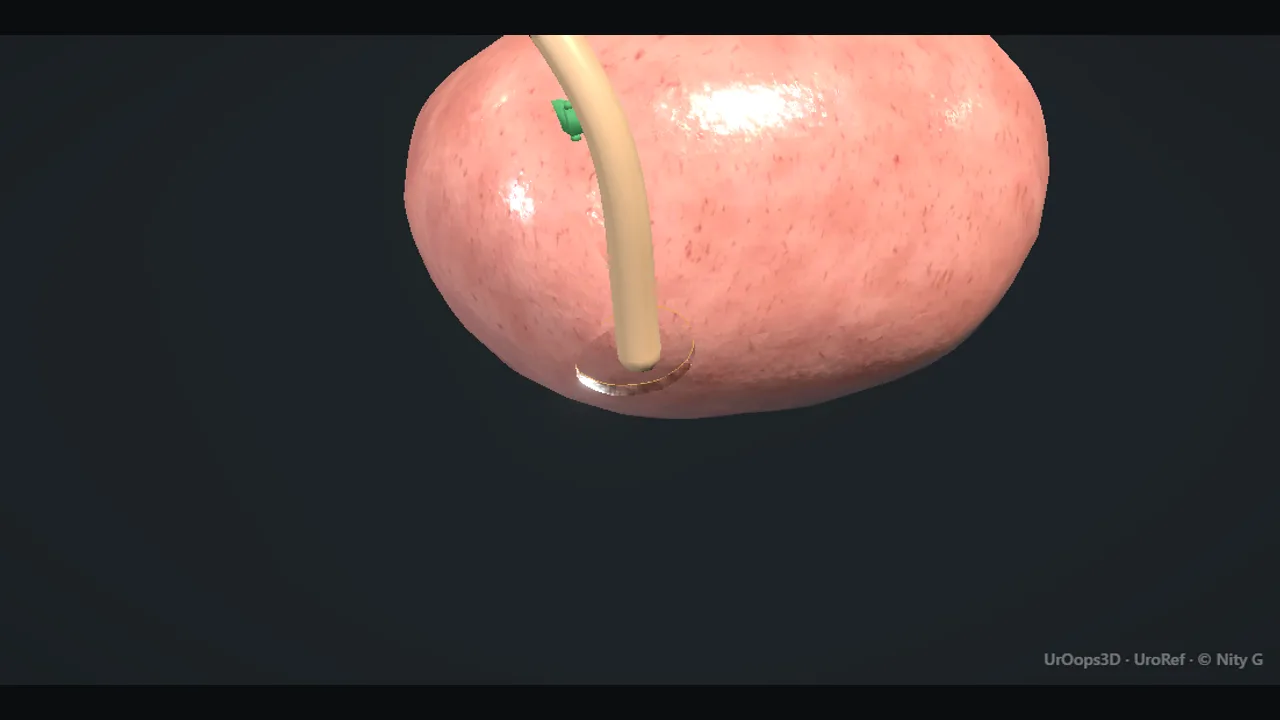 Interactive 3D Interactive operative model Open the 3D animation
Teaching catalogue only. This coverage record is not a patient pathway or operative instruction.
Typical place in practice
High-risk localised upper-tract urothelial carcinoma and selected non-functioning units with urothelial malignancy.
Alternatives and neighbouring procedures
Endoscopic ablation, segmental or distal ureterectomy, surveillance or systemic treatment for appropriately selected disease.
Same procedure family, explicit technique branches
These are variations of this canonical operation. Complication modules below identify whether they apply to all branches or only to named approaches.
Open radical nephroureterectomy
Kidney, ureter and cuff are removed through one or more open exposures.
Laparoscopic radical nephroureterectomy
Minimally invasive nephrectomy is combined with a planned bladder-cuff technique.
Robot-assisted radical nephroureterectomy
Robotic repositioning or port strategy supports both renal and distal ureteric phases.
Transvesical bladder-cuff excision
The intramural ureter is excised under direct bladder control and the defect closed.
Extravesical bladder-cuff excision
The ureter and cuff are mobilised externally while maintaining specimen continuity.
RNU with template lymphadenectomy
Regional nodes are removed using a tumour-location-specific plan.
High-level sequence
Coverage outline only; not a step-by-step technical guide.
- Confirm side, tumour location, bladder findings and nodal plan
- Control the renal hilum without entering the collecting system
- Mobilise kidney and ureter en bloc while minimising tumour manipulation
- Excise the intramural ureter and bladder cuff with a secure closure
- Orient the specimen, confirm watertight bladder repair and define surveillance
Every failure mode is its own module.
Timing and variation coverage are recorded for each module.
Major haemorrhage or vascular injury
Renal hilar and pelvic vascular dissection can cause major blood loss.
Applies to: Open radical nephroureterectomy · Laparoscopic radical nephroureterectomy · Robot-assisted radical nephroureterectomy · Transvesical bladder-cuff excision · Extravesical bladder-cuff excision · RNU with template lymphadenectomyBladder leak or pelvic urinoma
Failure of bladder-cuff closure can cause pelvic urine extravasation and infection.
Applies to: Transvesical bladder-cuff excision · Extravesical bladder-cuff excisionContralateral ureteric-orifice or bowel injury
Pelvic cuff dissection and bladder closure can injure the opposite orifice or adjacent bowel.
Applies to: Open radical nephroureterectomy · Laparoscopic radical nephroureterectomy · Robot-assisted radical nephroureterectomy · Transvesical bladder-cuff excision · Extravesical bladder-cuff excisionTumour spillage or incomplete distal ureter removal
Collecting-system entry, ureteric transection or retained intramural ureter can compromise oncological quality.
Applies to: Open radical nephroureterectomy · Laparoscopic radical nephroureterectomy · Robot-assisted radical nephroureterectomy · Transvesical bladder-cuff excision · Extravesical bladder-cuff excisionBladder or systemic urothelial recurrence
Urothelial field disease and tumour biology create recurrence risk despite technically complete surgery.
Applies to: Open radical nephroureterectomy · Laparoscopic radical nephroureterectomy · Robot-assisted radical nephroureterectomy · Transvesical bladder-cuff excision · Extravesical bladder-cuff excision · RNU with template lymphadenectomyAcute kidney injury or chronic renal decline
Loss of a renal unit reduces reserve and may affect eligibility for subsequent systemic treatment.
Applies to: Open radical nephroureterectomy · Laparoscopic radical nephroureterectomy · Robot-assisted radical nephroureterectomy · Transvesical bladder-cuff excision · Extravesical bladder-cuff excision · RNU with template lymphadenectomyUrinary, wound or intra-abdominal infection
Bladder opening, urine leak, collections and incisions can become infected.
Applies to: Open radical nephroureterectomy · Laparoscopic radical nephroureterectomy · Robot-assisted radical nephroureterectomy · Transvesical bladder-cuff excision · Extravesical bladder-cuff excision · RNU with template lymphadenectomyLymphocele or nerve injury
Retroperitoneal or pelvic lymphadenectomy can create lymphatic collections or damage nearby autonomic and somatic nerves.
Applies to: RNU with template lymphadenectomySources for this module
Kidney-sparing UTUC treatment, segmental surgery and nephroureterectomy.
Accessed 2026-08-03 · opens source European Association of Urology EAU Guidelines on Urological InfectionsInfection prevention, recognition and procedure-associated infection context.
Accessed 2026-08-03 · opens source British Association of Urological Surgeons Patient information leaflets by procedureUK patient-facing procedure, alternatives, recovery and complication framing.
Accessed 2026-08-03 · opens source