
Radical nephrectomy
Oncological removal of the kidney with perirenal tissue and risk-adapted management of adrenal, nodes or venous tumour extension.
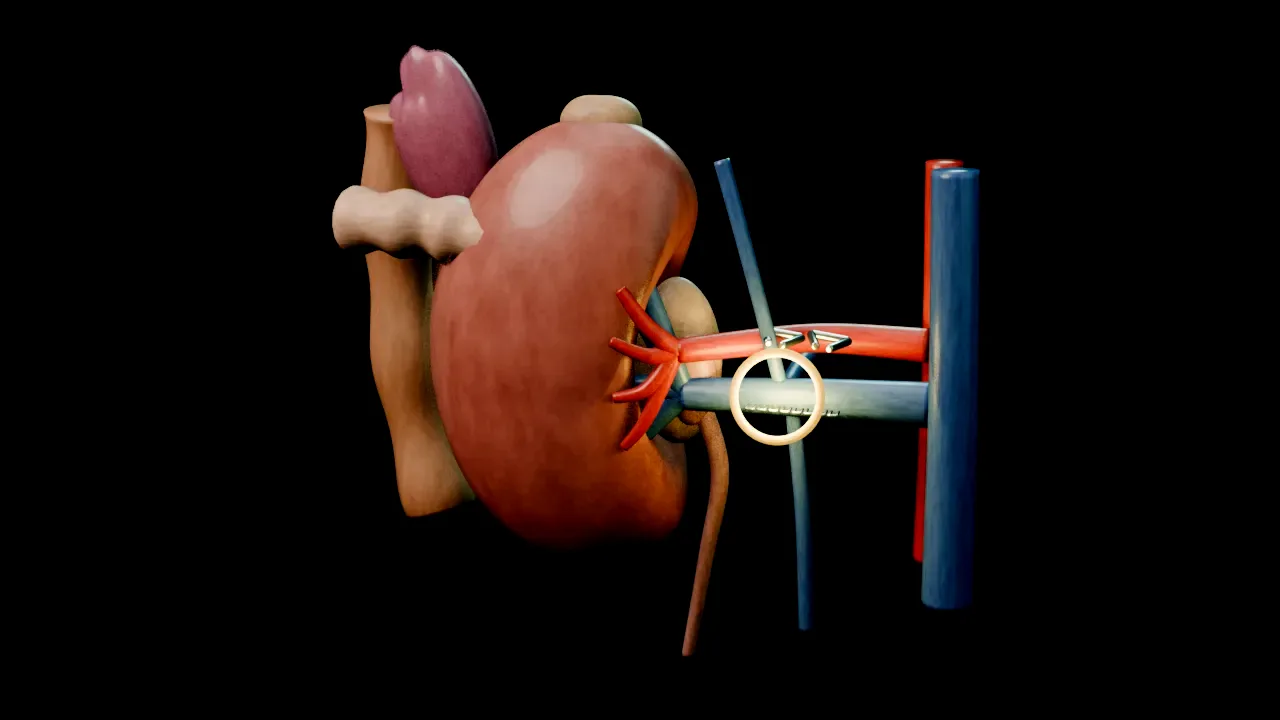 Interactive 3D Interactive operative model Open the 3D animation
Teaching catalogue only. This coverage record is not a patient pathway or operative instruction.
Typical place in practice
Renal malignancy not suitable for nephron-sparing treatment or where radical removal is otherwise oncologically indicated.
Alternatives and neighbouring procedures
Partial nephrectomy, surveillance, ablation or systemic treatment according to stage, tumour and patient factors.
Same procedure family, explicit technique branches
These are variations of this canonical operation. Complication modules below identify whether they apply to all branches or only to named approaches.
Laparoscopic radical nephrectomy
Minimally invasive hilar control and specimen extraction are used for suitable tumours.
Robot-assisted radical nephrectomy
Robotic dissection supports selected complex hilar or adjunctive steps.
Open radical nephrectomy
Open exposure is selected for tumour, thrombus, adjacent-organ or access complexity.
Radical nephrectomy with venous thrombectomy
Renal vein or caval tumour thrombus is removed with level-specific vascular control.
Radical nephrectomy with adrenal or nodal resection
Adjacent adrenal or lymphatic tissue is removed when imaging or intraoperative findings justify it.
High-level sequence
Coverage outline only; not a step-by-step technical guide.
- Confirm side, renal function, tumour extent and vascular anatomy
- Mobilise colon and adjacent organs to expose the kidney and hilum
- Control renal artery and vein with a plan for anomalous or tumour-bearing vessels
- Complete oncological mobilisation without tumour violation
- Extract and orient the specimen, confirm haemostasis and protect remaining renal function
Operative notes
Concise operative notes covering the key steps, landmarks and watch points, in the order you encounter them.
Laparoscopic nephrectomy
What it does: kidney out, keyhole. Simple or radical.
- Drop the colon off the white line of Toldt. (Toldt's = the peritoneal seam beside the colon.)
- Open the plane between bowel fat and Gerota's.
- Right side: Kocher the duodenum off the IVC. (Reflect it inwards.)
- Find the ureter below the lower pole.
- Follow it + the gonadal vein up to the pedicle. Gonadal vein: to IVC on the right. To renal vein on the left.
- Open Gerota's at the lower pole. Work upwards.
- Artery first, then vein, ureter last. Clips/staples.
- Radical: adrenal + whole Gerota wrapper stay on.
- 2026 update: Robot-assisted is the usual UK platform. Same steps.
- 2026 update: T1a/T1b tumour: partial nephrectomy is the default where feasible (EAU RCC).
From the UroRef Operative Quick Guide. Open the note page →
Open incisions to know
What it does: the standard cuts, and how to open each.
- Midline: skin, fat, linea alba. Find the midline via the urachus. (Urachus = fetal tube, bladder dome to umbilicus.) Finger in the wound top, pull up. A ridge rises. Cut on the ridge.
- Peritoneum: 2 clips, pinch, no bowel, cut between. Enlarge with scissors between 2 fingers.
- Pfannenstiel: curved cut 2 cm above the pubis. Open sheath in the same curve. Sweep sheath off both recti, up and down. Separate the recti in the middle. Do not cut them. Cut the recti off the pubis = Cherny. Rarely needed.
- Loin, over the 12th rib: cut onto the rib tip. 3 cm diathermy through latissimus dorsi. Then cut in front of the rib tip, through the obliques, onto Gerota's fascia. (Gerota's = the kidney's fascia wrapper.) Sweep the peritoneum inwards with a finger. Cut muscle along the rib, centrally. Avoid the pleura.
From the UroRef Operative Quick Guide. Open the note page →
Laparoscopic setup rules
What it does: safe ports and position, any lap case.
- Hasson first port: open cut-down. Safe. (Veress needle: ~4% problems.)
- Side lying. Break the table under the 12th rib.
- Axillary roll. Pillow between legs. Gel pads.
- Boots and warmer on.
- Ports under vision, camera inside.
- 2026 update: Antibiotics: 1 dose, local policy, allergy aware. The old fixed gent + cefuroxime recipe is gone.
From the UroRef Operative Quick Guide. Open the note page →
Every failure mode is its own module.
Timing and variation coverage are recorded for each module.
Hilar or major-vessel injury
Renal artery, renal vein, IVC or aortic injury can cause catastrophic haemorrhage and require immediate change of operative strategy.
Applies to: Laparoscopic radical nephrectomy · Robot-assisted radical nephrectomy · Open radical nephrectomy · Radical nephrectomy with venous thrombectomy · Radical nephrectomy with adrenal or nodal resectionAdjacent-organ injury
Colon, duodenum, pancreas, spleen, liver, pleura or diaphragm can be injured during mobilisation or tumour dissection.
Applies to: Laparoscopic radical nephrectomy · Robot-assisted radical nephrectomy · Open radical nephrectomy · Radical nephrectomy with venous thrombectomy · Radical nephrectomy with adrenal or nodal resectionVenous tumour embolisation or incomplete thrombus removal
Thrombus manipulation without secure control can dislodge tumour or leave residual venous disease.
Applies to: Radical nephrectomy with venous thrombectomyAcute kidney injury or chronic renal decline
Removal of renal mass and perioperative physiological stress can impair overall renal function, especially with limited contralateral reserve.
Applies to: Laparoscopic radical nephrectomy · Robot-assisted radical nephrectomy · Open radical nephrectomy · Radical nephrectomy with venous thrombectomy · Radical nephrectomy with adrenal or nodal resectionWound, urinary or intra-abdominal infection
Haematoma, organ injury and access wounds can become infected after major renal surgery.
Applies to: Laparoscopic radical nephrectomy · Robot-assisted radical nephrectomy · Open radical nephrectomy · Radical nephrectomy with venous thrombectomy · Radical nephrectomy with adrenal or nodal resectionVenous thromboembolism, cardiac or pulmonary complication
Cancer, major surgery, positioning and vascular manipulation contribute to cardiopulmonary and thrombotic risk.
Applies to: Laparoscopic radical nephrectomy · Robot-assisted radical nephrectomy · Open radical nephrectomy · Radical nephrectomy with venous thrombectomy · Radical nephrectomy with adrenal or nodal resectionPositive margin, tumour rupture or incomplete staging
Tumour invasion, plane selection or specimen disruption can compromise local control and pathological assessment.
Applies to: Laparoscopic radical nephrectomy · Robot-assisted radical nephrectomy · Open radical nephrectomy · Radical nephrectomy with venous thrombectomy · Radical nephrectomy with adrenal or nodal resectionIncisional hernia, bulge or chronic pain
Port, extraction, flank and thoracoabdominal incisions have distinct risks of denervation, hernia and persistent pain.
Applies to: Laparoscopic radical nephrectomy · Robot-assisted radical nephrectomy · Open radical nephrectomySources for this module
Partial and radical nephrectomy, approach selection and renal-tumour ablation.
Accessed 2026-08-03 · opens source European Association of Urology EAU Guidelines on Urological InfectionsInfection prevention, recognition and procedure-associated infection context.
Accessed 2026-08-03 · opens source British Association of Urological Surgeons Patient information leaflets by procedureUK patient-facing procedure, alternatives, recovery and complication framing.
Accessed 2026-08-03 · opens source