
Radical inguinal orchidectomy
Removal of a suspicious testis and spermatic cord through an inguinal approach without scrotal violation, providing diagnosis and local tumour control.
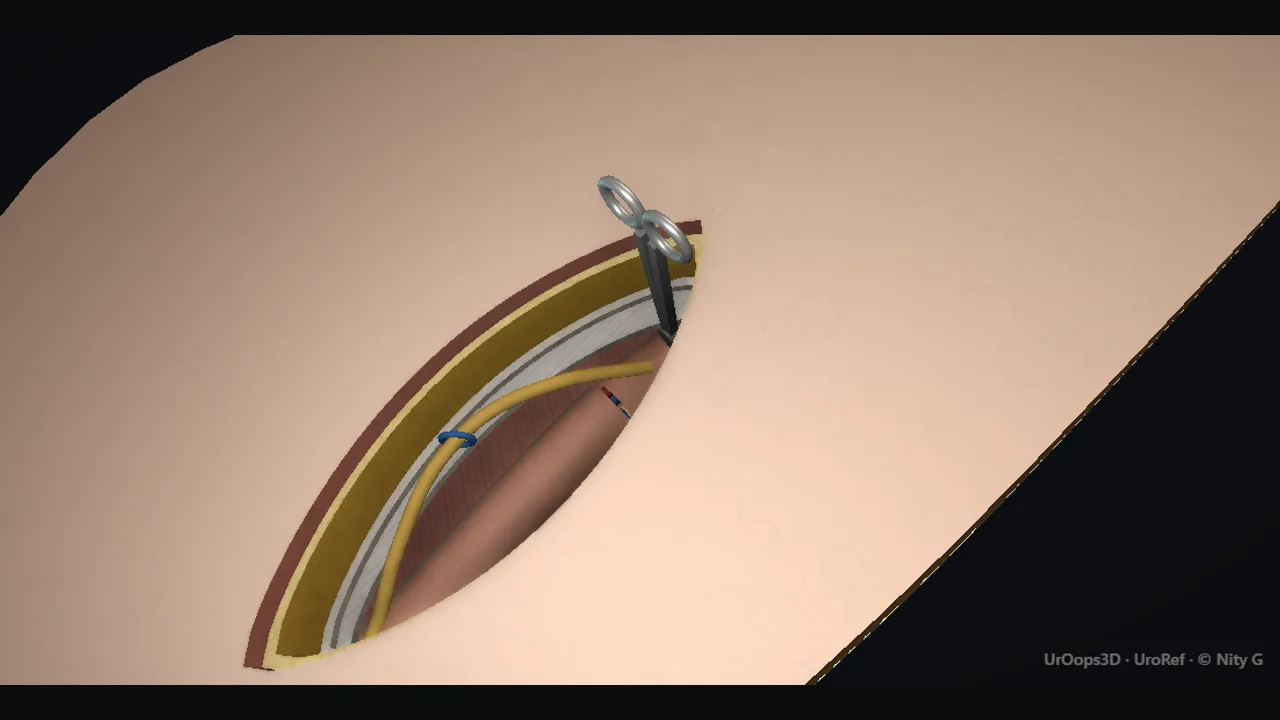 Interactive 3D Interactive operative model Open the 3D animation
Teaching catalogue only. This coverage record is not a patient pathway or operative instruction.
Typical place in practice
A testicular mass suspicious for germ-cell or other malignancy when radical removal is the appropriate diagnostic and therapeutic operation.
Alternatives and neighbouring procedures
Testis-sparing surgery with controlled sampling is reserved for selected lesions and clinical circumstances; surveillance alone is rarely appropriate for a suspicious solid mass.
Same procedure family, explicit technique branches
These are variations of this canonical operation. Complication modules below identify whether they apply to all branches or only to named approaches.
Standard radical inguinal orchidectomy
The cord is controlled at the internal-ring level and the testis delivered through the groin without opening scrotal skin.
Radical orchidectomy with prosthesis
A consented testicular prosthesis is inserted during the same operation after oncological removal.
Radical orchidectomy after prior scrotal violation
Prior trans-scrotal biopsy or surgery alters local staging and may require additional scar or hemiscrotal management.
Emergency radical orchidectomy
Urgent surgery addresses a complicated tumour presentation while preserving oncological planes where possible.
High-level sequence
Coverage outline only; not a step-by-step technical guide.
- Confirm side, imaging, markers, fertility discussion and prosthesis choice
- Open the inguinal canal and obtain early cord control
- Deliver the testis through the groin without scrotal breach
- Divide the cord at the planned level and orient the specimen
- Secure haemostasis, place any prosthesis safely and complete staging documentation
Operative notes
Concise operative notes covering the key steps, landmarks and watch points, in the order you encounter them.
Orchidectomy - 3 types
What it does: remove the testis. 3 ways, 3 reasons.
scrotal, simple
- Midline scrotal cut. Open the tunica. Deliver.
- Stitch-ligate the vessels (0). Tie the vas (2/0).
- Do not cut the tie till bone dry. A retracted cord is misery to find.
subcapsular, hormone shutdown
- Same exposure. Slit the tunica lengthways.
- Sweep the contents out with a swab.
- Diathermy bleeders. Close the tunica.
radical inguinal, suspected cancer
- NEVER take a tumour out through the scrotum.
- Landmarks: ASIS and pubic tubercle. About 5 cm cut between them, along the line of the canal.
- Skin. Camper's fat. Scarpa's fascia. Stop at the shiny external oblique.
- Open external oblique along its fibres, through the external ring. Isolate and protect the ilio-inguinal nerve.
- Clamp across the cord at the inner ring. Before the testis is touched.
- Evert the scrotum with a finger. Deliver testis in its coverings. Divide the gubernaculum.
- Second clamp. Divide above both clamps. Testis and cord are the specimen.
- Transfix (0 Vicryl) between the clamps. Slowly off with the top clamp.
- Transfix below the bottom clamp. Slowly off with it. Stump dry before it goes.
- Prosthesis if wanted: down the groin route. Never a scrotal cut.
- Close: external oblique 2-0 Vicryl continuous, nerve clear. Scarpa's 3-0 Vicryl interrupted. Skin 4-0 Monocryl subcuticular.
- 2026 update: Stage 1 seminoma: watch, or 1 dose carboplatin. (AUC 7.)
- 2026 update: Stage 1 NSGCT: watch if low risk. 1 cycle BEP if high risk (vessels invaded).
- 2026 update: RPLND now mostly for post-chemo lumps.
From the UroRef Operative Quick Guide. Open the note page →
Every failure mode is its own module.
Timing and variation coverage are recorded for each module.
Groin or scrotal haematoma
Cord, canal or scrotal bleeding can create painful swelling and obscure wound assessment.
Applies to: Standard radical inguinal orchidectomy · Radical orchidectomy with prosthesis · Radical orchidectomy after prior scrotal violation · Emergency radical orchidectomyWound or prosthesis infection
Groin wounds can become infected; an implant adds biofilm and explantation risk.
Applies to: Standard radical inguinal orchidectomy · Radical orchidectomy with prosthesis · Radical orchidectomy after prior scrotal violation · Emergency radical orchidectomyIlioinguinal or genitofemoral nerve injury and chronic pain
Nerve traction, division or scar can cause numbness, neuralgia or persistent groin discomfort.
Applies to: Standard radical inguinal orchidectomy · Radical orchidectomy with prosthesis · Radical orchidectomy after prior scrotal violation · Emergency radical orchidectomyScrotal violation or tumour spillage
Breach of tumour or scrotal planes can alter lymphatic dissemination risk and subsequent management.
Applies to: Standard radical inguinal orchidectomy · Radical orchidectomy with prosthesis · Radical orchidectomy after prior scrotal violation · Emergency radical orchidectomyInadequate cord length or specimen orientation
Low cord division or poor orientation can limit pathological assessment and local-control confidence.
Applies to: Standard radical inguinal orchidectomy · Radical orchidectomy with prosthesis · Radical orchidectomy after prior scrotal violation · Emergency radical orchidectomyProsthesis malposition, extrusion or dissatisfaction
An implant can sit too high or low, become painful, erode or fail to meet cosmetic expectations.
Applies to: Radical orchidectomy with prosthesisHypogonadism, fertility or body-image effects
Loss of a testis may affect endocrine reserve, fertility and psychological wellbeing, particularly with contralateral abnormality or further treatment.
Applies to: Standard radical inguinal orchidectomy · Radical orchidectomy with prosthesis · Radical orchidectomy after prior scrotal violation · Emergency radical orchidectomySources for this module
Radical inguinal orchidectomy and retroperitoneal lymph-node dissection.
Accessed 2026-08-03 · opens source British Association of Urological Surgeons Patient information leaflets by procedureUK patient-facing procedure, alternatives, recovery and complication framing.
Accessed 2026-08-03 · opens source