
Radical cystectomy and pelvic lymph-node dissection
Extirpation of the urinary bladder with sex- and disease-appropriate adjacent organs and pelvic lymph-node dissection, followed by a separately planned urinary diversion.
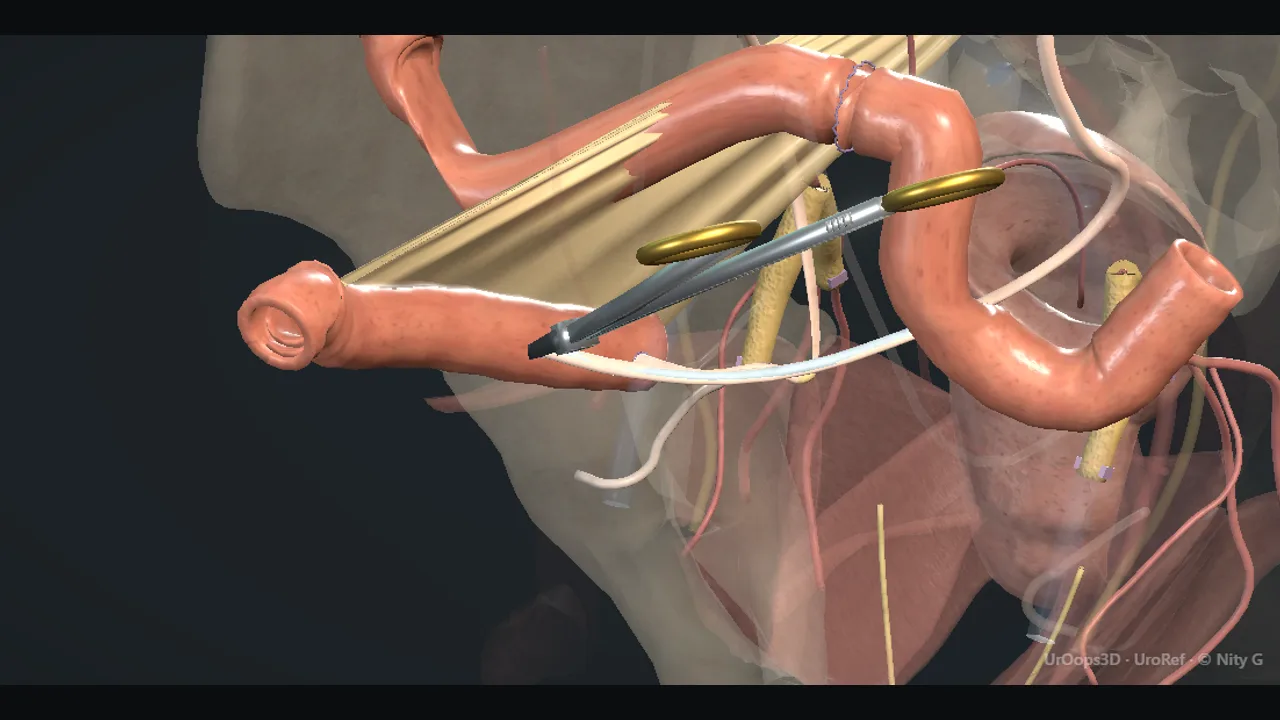 Interactive 3D Interactive operative model Open the 3D animation 3D Interactive urethrectomy after cystectomy 3D Interactive pelvic atlas: cystectomy + PLND
Teaching catalogue only. This coverage record is not a patient pathway or operative instruction.
Typical place in practice
Curative-intent treatment of muscle-invasive and selected very-high-risk non-muscle-invasive bladder cancer, or palliation in carefully selected circumstances.
Alternatives and neighbouring procedures
Bladder-preserving multimodal treatment, endoscopic/intravesical pathways or non-operative palliation according to disease and fitness.
Same procedure family, explicit technique branches
These are variations of this canonical operation. Complication modules below identify whether they apply to all branches or only to named approaches.
Open radical cystectomy
The bladder, planned adjacent organs and nodal packets are removed through an open approach.
Robot-assisted radical cystectomy
Robotic dissection performs extirpation and lymphadenectomy, with diversion constructed intracorporeally or extracorporeally.
Organ-sparing radical cystectomy
Selected reproductive, sexual or continence-related structures are preserved only when oncologically appropriate.
Salvage radical cystectomy
Cystectomy after radiation or other major treatment faces altered planes, healing and fistula risk.
High-level sequence
Coverage outline only; not a step-by-step technical guide.
- Confirm staging, diversion plan and ureteric/vascular anatomy
- Mobilise ureters with oncological and vascular discipline
- Control bladder pedicles and separate adjacent organs in the correct plane
- Complete planned pelvic lymph-node dissection and specimen orientation
- Reconfirm haemostasis, bowel and nerve integrity before diversion and closure
Operative notes
Concise operative notes covering the key steps, landmarks and watch points, in the order you encounter them.
Cystoprostatectomy, keyhole - 10 steps
What it does: bladder and prostate out, keyhole. Diversion after.
- Ureters divided near the bladder, with a cuff. Frozen section the ends. Do not strip ureter fat. Scarring follows.
- Peritoneum opened between the ureter stumps. Vasa + vesicles stay with the specimen. Denonvilliers' fascia cut across, into pale fat. (That fascia = the sheet between bladder and rectum.)
- Bladder pedicles divided (stapler or harmonic) along the inner side of the external iliac vein. Find the obturator nerve first.
- Bladder dropped off the wall. Urachus with it.
- Endopelvic fascia opened. Dorsal vein complex stitched, right to left.
- Urethra divided. Catheter out. Clip the proximal urethra (no spill). Nerve bundles kept or taken.
- Specimen bagged, sealed.
- Drop the gas to 5 mmHg. Haemostasis check.
- Node dissection both sides. Bagged, labelled.
- Left ureter routed under the colon mesentery. Diversion built outside, via the port site.
- 2026 update: Robotic with internal diversion is standard in big centres. Open still fine. Steps translate.
- 2026 update: ERAS now: no bowel washout, early food.
From the UroRef Operative Quick Guide. Open the note page →
Open incisions to know
What it does: the standard cuts, and how to open each.
- Midline: skin, fat, linea alba. Find the midline via the urachus. (Urachus = fetal tube, bladder dome to umbilicus.) Finger in the wound top, pull up. A ridge rises. Cut on the ridge.
- Peritoneum: 2 clips, pinch, no bowel, cut between. Enlarge with scissors between 2 fingers.
- Pfannenstiel: curved cut 2 cm above the pubis. Open sheath in the same curve. Sweep sheath off both recti, up and down. Separate the recti in the middle. Do not cut them. Cut the recti off the pubis = Cherny. Rarely needed.
- Loin, over the 12th rib: cut onto the rib tip. 3 cm diathermy through latissimus dorsi. Then cut in front of the rib tip, through the obliques, onto Gerota's fascia. (Gerota's = the kidney's fascia wrapper.) Sweep the peritoneum inwards with a finger. Cut muscle along the rib, centrally. Avoid the pleura.
From the UroRef Operative Quick Guide. Open the note page →
Every failure mode is its own module.
Timing and variation coverage are recorded for each module.
Major haemorrhage or vascular injury
Pelvic sidewall, venous plexus and major-vessel injury can cause rapid blood loss and compromise oncological dissection.
Applies to: Open radical cystectomy · Robot-assisted radical cystectomy · Organ-sparing radical cystectomy · Salvage radical cystectomyRectal or bowel injury
Posterior dissection, adhesions and prior radiation can injure bowel and lead to contamination, leak or fistula.
Applies to: Open radical cystectomy · Robot-assisted radical cystectomy · Organ-sparing radical cystectomy · Salvage radical cystectomyObturator, autonomic or other nerve injury
Lymphadenectomy and deep pelvic dissection can affect leg function, sexual function and visceral autonomic control.
Applies to: Open radical cystectomy · Robot-assisted radical cystectomy · Organ-sparing radical cystectomy · Salvage radical cystectomyIleus or bowel obstruction
Major pelvic surgery and bowel handling can delay gastrointestinal recovery or produce early or late obstruction.
Applies to: Open radical cystectomy · Robot-assisted radical cystectomy · Organ-sparing radical cystectomy · Salvage radical cystectomyPelvic, urinary or wound infection
Urinary and bowel reconstruction, dead space and wounds create multiple infection routes.
Applies to: Open radical cystectomy · Robot-assisted radical cystectomy · Organ-sparing radical cystectomy · Salvage radical cystectomyVenous thromboembolism or cardiopulmonary event
Cancer, major pelvic surgery, immobility and physiological stress create substantial systemic risk.
Applies to: Open radical cystectomy · Robot-assisted radical cystectomy · Organ-sparing radical cystectomy · Salvage radical cystectomyLymphocele or lymphatic leak
Pelvic lymph-node dissection can leave symptomatic collections or persistent lymph drainage.
Applies to: Open radical cystectomy · Robot-assisted radical cystectomy · Organ-sparing radical cystectomy · Salvage radical cystectomyPositive margin or inadequate nodal staging
Plane selection, tumour extent or incomplete nodal/specimen handling can compromise staging or local control.
Applies to: Open radical cystectomy · Robot-assisted radical cystectomy · Organ-sparing radical cystectomy · Salvage radical cystectomySexual and reproductive dysfunction
Removal or denervation of pelvic organs can affect erections, ejaculation, vaginal function, fertility and body image; sparing reduces but does not remove risk.
Applies to: Open radical cystectomy · Robot-assisted radical cystectomy · Organ-sparing radical cystectomy · Salvage radical cystectomySources for this module
Radical cystectomy, lymph-node dissection and urinary diversion.
Accessed 2026-08-03 · opens source European Association of Urology EAU Guidelines on Urological InfectionsInfection prevention, recognition and procedure-associated infection context.
Accessed 2026-08-03 · opens source British Association of Urological Surgeons Patient information leaflets by procedureUK patient-facing procedure, alternatives, recovery and complication framing.
Accessed 2026-08-03 · opens source