
Partial nephrectomy
Excision of a renal tumour or selected lesion while preserving the remaining kidney, with control of haemorrhage and collecting-system entry.
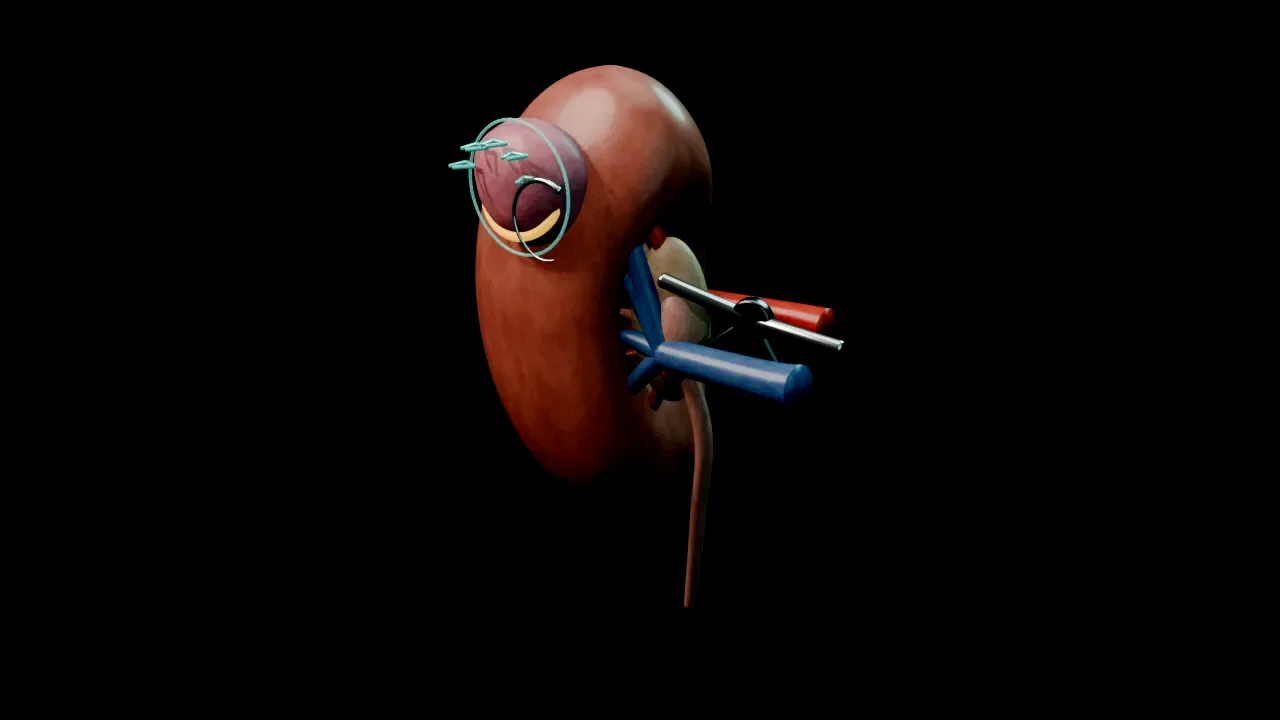 Interactive 3D Interactive operative model Open the 3D animation
Teaching catalogue only. This coverage record is not a patient pathway or operative instruction.
Typical place in practice
Localised renal masses where nephron preservation is oncologically and technically appropriate, especially when renal reserve matters.
Alternatives and neighbouring procedures
Surveillance, biopsy, thermal ablation or radical nephrectomy according to tumour and patient factors.
Same procedure family, explicit technique branches
These are variations of this canonical operation. Complication modules below identify whether they apply to all branches or only to named approaches.
Robot-assisted partial nephrectomy
Robotic excision and renorrhaphy allow minimally invasive nephron-sparing surgery.
Laparoscopic partial nephrectomy
Laparoscopic instruments perform tumour excision and renal reconstruction.
Open partial nephrectomy
Open exposure permits direct renal control and reconstruction for selected complex tumours.
Clamped partial nephrectomy
Temporary arterial control creates a lower-blood field with an ischaemia trade-off.
Off-clamp partial nephrectomy
Renal perfusion continues during excision, changing bleeding and visualisation demands.
Enucleation or enucleoresection
Dissection follows the lesion interface to preserve parenchyma where oncologically suitable.
High-level sequence
Coverage outline only; not a step-by-step technical guide.
- Define tumour depth, vessels and collecting-system relationship
- Expose kidney and obtain the planned level of vascular control
- Excise the lesion with an oncologically sound plane
- Close collecting-system and vascular defects as required
- Reconstruct the kidney, release control safely and confirm haemostasis and perfusion
Operative notes
Concise operative notes covering the key steps, landmarks and watch points, in the order you encounter them.
Partial nephrectomy, open
What it does: cut the tumour out, keep the kidney.
- Wedge, cone, polar, or half. Plan first.
- Clamp the artery. Warm ischaemia, short. (Under 25 min. Go cold if longer.)
- Sharp cut. Sucker in the field.
- Fine prolene on vessels as you meet them.
- Frozen section from the bed.
- Keep a strip of capsule if you can. Helps closure.
- Sew the collecting system, 3/0, over a stent. Test with blue dye.
- Bolster (Surgicel) sewn into the defect.
- FloSeal paste. Drain.
- Watch: Never shave the margin to save the kidney.
- Watch: Leak or bleed more than after full removal.
- Watch: Drain fluid: send creatinine if it persists.
From the UroRef Operative Quick Guide. Open the note page →
Laparoscopic setup rules
What it does: safe ports and position, any lap case.
- Hasson first port: open cut-down. Safe. (Veress needle: ~4% problems.)
- Side lying. Break the table under the 12th rib.
- Axillary roll. Pillow between legs. Gel pads.
- Boots and warmer on.
- Ports under vision, camera inside.
- 2026 update: Antibiotics: 1 dose, local policy, allergy aware. The old fixed gent + cefuroxime recipe is gone.
From the UroRef Operative Quick Guide. Open the note page →
Every failure mode is its own module.
Timing and variation coverage are recorded for each module.
Haemorrhage or conversion to radical nephrectomy
Hilar, segmental or tumour-bed bleeding can obscure the plane and threaten kidney preservation or patient stability.
Applies to: Robot-assisted partial nephrectomy · Laparoscopic partial nephrectomy · Open partial nephrectomy · Clamped partial nephrectomy · Off-clamp partial nephrectomy · Enucleation or enucleoresectionDelayed pseudoaneurysm or arteriovenous fistula
A partially controlled intrarenal vessel can present later with haematuria, pain or haemodynamic compromise.
Applies to: Robot-assisted partial nephrectomy · Laparoscopic partial nephrectomy · Open partial nephrectomy · Clamped partial nephrectomy · Off-clamp partial nephrectomy · Enucleation or enucleoresectionUrine leak or urinoma
Unrecognised or inadequately closed collecting-system entry can cause persistent drainage and collection.
Applies to: Robot-assisted partial nephrectomy · Laparoscopic partial nephrectomy · Open partial nephrectomy · Clamped partial nephrectomy · Off-clamp partial nephrectomy · Enucleation or enucleoresectionRenal ischaemic injury or loss of function
Vascular occlusion, parenchymal loss and reconstruction can reduce function in the operated kidney.
Applies to: Robot-assisted partial nephrectomy · Laparoscopic partial nephrectomy · Open partial nephrectomy · Clamped partial nephrectomyAdjacent-organ injury
Renal mobilisation and tumour location may place bowel, spleen, pancreas, liver, pleura or diaphragm at risk.
Applies to: Robot-assisted partial nephrectomy · Laparoscopic partial nephrectomy · Open partial nephrectomy · Clamped partial nephrectomy · Off-clamp partial nephrectomy · Enucleation or enucleoresectionUrinary, wound or intra-abdominal infection
Urine leak, haematoma and access wounds may become infected.
Applies to: Robot-assisted partial nephrectomy · Laparoscopic partial nephrectomy · Open partial nephrectomy · Clamped partial nephrectomy · Off-clamp partial nephrectomy · Enucleation or enucleoresectionPositive margin or tumour violation
Plane selection or lesion entry can compromise pathological interpretation and cancer-control confidence.
Applies to: Robot-assisted partial nephrectomy · Laparoscopic partial nephrectomy · Open partial nephrectomy · Clamped partial nephrectomy · Off-clamp partial nephrectomy · Enucleation or enucleoresectionIncisional hernia, port-site problem or chronic pain
Open, extraction and port wounds have different long-term abdominal-wall and pain profiles.
Applies to: Robot-assisted partial nephrectomy · Laparoscopic partial nephrectomy · Open partial nephrectomySources for this module
Partial and radical nephrectomy, approach selection and renal-tumour ablation.
Accessed 2026-08-03 · opens source European Association of Urology EAU Guidelines on Urological InfectionsInfection prevention, recognition and procedure-associated infection context.
Accessed 2026-08-03 · opens source British Association of Urological Surgeons Patient information leaflets by procedureUK patient-facing procedure, alternatives, recovery and complication framing.
Accessed 2026-08-03 · opens source