
Orthotopic neobladder reconstruction
A low-pressure bowel reservoir connected to the urethra and ureters after cystectomy, intended to provide per-urethral storage and emptying.
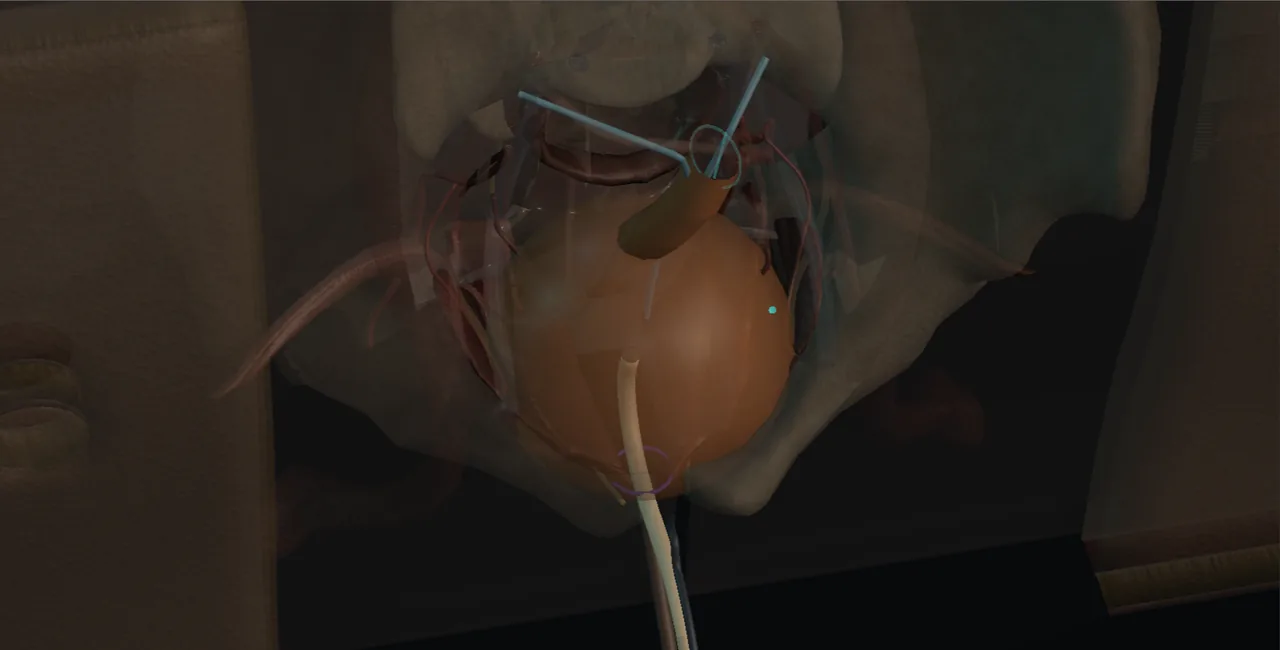 Interactive 3D Interactive Studer neobladder construction Open the 3D animation
Teaching catalogue only. This coverage record is not a patient pathway or operative instruction.
Typical place in practice
Highly selected patients undergoing cystectomy who meet oncological, anatomical, renal, functional and self-management requirements.
Alternatives and neighbouring procedures
Ileal conduit, continent cutaneous diversion, ureterostomy or other urinary drainage according to suitability and preference.
Same procedure family, explicit technique branches
These are variations of this canonical operation. Complication modules below identify whether they apply to all branches or only to named approaches.
Studer-type ileal neobladder
A detubularised ileal reservoir includes an afferent limb for ureteric implantation.
Spherical ileal neobladder
Bowel is folded into a low-pressure spherical substitute with direct or configured ureteric implantation.
Male orthotopic neobladder
The reservoir is anastomosed to a preserved urethral stump with attention to sphincter and oncological margins.
Female orthotopic neobladder
Selection and dissection preserve a suitable urethra and continence support while avoiding oncological compromise.
Intracorporeal neobladder
Bowel isolation, folding and urinary anastomoses are constructed within the abdomen.
High-level sequence
Coverage outline only; not a step-by-step technical guide.
- Confirm selection, urethral margin and bowel/renal suitability
- Isolate and detubularise a well-vascularised bowel segment
- Fold a compliant reservoir without narrowing its lumen
- Construct urethral and ureteric anastomoses without tension
- Test integrity and establish a structured drainage, irrigation and training pathway
Every failure mode is its own module.
Timing and variation coverage are recorded for each module.
Neobladder or ureteroenteric leak
Reservoir closure or a urinary anastomosis can leak, causing pelvic or abdominal collections and infection.
Applies to: Studer-type ileal neobladder · Spherical ileal neobladder · Male orthotopic neobladder · Female orthotopic neobladder · Intracorporeal neobladderBowel leak, ileus or obstruction
Bowel isolation and reconstruction can produce anastomotic failure, delayed recovery or later adhesive obstruction.
Applies to: Studer-type ileal neobladder · Spherical ileal neobladder · Male orthotopic neobladder · Female orthotopic neobladder · Intracorporeal neobladderUrinary infection or pyelonephritis
Mucus, residual urine, reflux and catheterisation can support recurrent lower- or upper-tract infection.
Applies to: Studer-type ileal neobladder · Spherical ileal neobladder · Male orthotopic neobladder · Female orthotopic neobladder · Intracorporeal neobladderDaytime or nocturnal incontinence
Reservoir pressure, sphincter function, sensation and adherence to timed emptying influence continence, especially at night.
Applies to: Studer-type ileal neobladder · Spherical ileal neobladder · Male orthotopic neobladder · Female orthotopic neobladder · Intracorporeal neobladderHypercontinence, retention or need for intermittent catheterisation
Outlet angulation, weak emptying mechanics or dysfunctional coordination can prevent complete emptying.
Applies to: Studer-type ileal neobladder · Spherical ileal neobladder · Male orthotopic neobladder · Female orthotopic neobladder · Intracorporeal neobladderUrethral or ureteroenteric stricture
Ischaemia and scar can narrow the reservoir outlet or upper-tract anastomoses.
Applies to: Studer-type ileal neobladder · Spherical ileal neobladder · Male orthotopic neobladder · Female orthotopic neobladder · Intracorporeal neobladderMetabolic, renal or nutritional consequences
Urine–bowel exchange, dehydration, impaired drainage and bowel resection can affect acid-base balance, renal function and nutrition.
Applies to: Studer-type ileal neobladder · Spherical ileal neobladder · Male orthotopic neobladder · Female orthotopic neobladder · Intracorporeal neobladderMucus retention or reservoir stone
Bowel mucus, foreign material, infection and incomplete emptying can block drainage or form stones.
Applies to: Studer-type ileal neobladder · Spherical ileal neobladder · Male orthotopic neobladder · Female orthotopic neobladder · Intracorporeal neobladderUrethral or upper-tract tumour recurrence
Preserved urothelium requires oncological selection and surveillance; diversion anatomy can complicate detection and access.
Applies to: Studer-type ileal neobladder · Spherical ileal neobladder · Male orthotopic neobladder · Female orthotopic neobladder · Intracorporeal neobladderSources for this module
Radical cystectomy, lymph-node dissection and urinary diversion.
Accessed 2026-08-03 · opens source European Association of Urology EAU Guidelines on Urological InfectionsInfection prevention, recognition and procedure-associated infection context.
Accessed 2026-08-03 · opens source British Association of Urological Surgeons Patient information leaflets by procedureUK patient-facing procedure, alternatives, recovery and complication framing.
Accessed 2026-08-03 · opens source