UrOops3D, danger-zone atlas

Schematic model.

Operative animation, Male urethrectomy

Male urethrectomy: the whole urethra through the perineum

Removal of the whole urethra in a man who has already had a cystectomy and a conduit and now has a recurrence in the urethra he kept.

The urethra comes out through a midline perineal incision as one specimen, from the blind stump at the pelvic floor to the meatus with a cuff of glans. The corpora cavernosa, the glans and the penile skin stay.

The lesson is the plane on the tunica of the corpora, the arteries to the bulb, and the bowel that may lie on the stump after cystectomy.

Advanced tier FRCS oncology, bladder cancer, urethral cancer Interactive 3D

Operative visualisation

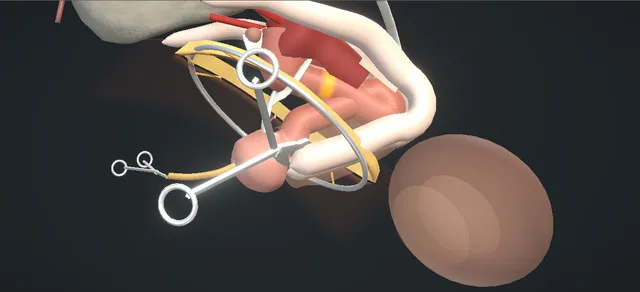
Schematic scene preview: Male urethrectomy
Preparing the 3D anatomy…

UrOops3D · UroRef · © Nity G

How to use this module. Play through the nine steps, or use Back and Next. Watch the drain go round the bulb, the urethra lift off the corpora, the shaft fold into the wound, the meatus cored out and the urethra leave whole. The triggers show a bleeding artery, an opened bowel loop and a perineal abscess.

Click me next Section 2 of 8 Anatomy The structures this operation works between, and the one it must not cross.

The structures in the scene

Male urethrectomy: how the structures relateThe urethra from the blind stump to the meatus, and what it is taken off. Urethra in its spongiosum: the specimen: lifted off their tunica, which is not perforated Corpora cavernosa and their tunica (danger). Urethra in its spongiosum: the specimen: ends at the meatus; leaves with a cuff of glans Glans: cored out, then closed. Urethra in its spongiosum: the specimen: enter the proximal bulb; tied, then divided Bulbar arteries, one each side (danger). Urethra in its spongiosum: the specimen: cover and hold the bulb; divided to free it Central tendon and bulbospongiosus. Urethra in its spongiosum: the specimen: lies behind it; very little diathermy Rectum, behind the membranous urethra (danger). Urethra in its spongiosum: the specimen: may be adherent after cystectomy Small bowel on the blind stump (danger).Urethra in itsspongiosum: thespecimen!Corpora cavernosaand their tunicaGlans: cored out,then closed!Bulbar arteries, oneeach sideCentral tendon andbulbospongiosus!Rectum, behind themembranous urethra!Small bowel on theblind stumplifted off theirtunica, which isnot perforatedends at the meatus;leaves with a cuffof glansenter the proximalbulb; tied, thendividedcover and hold thebulb; divided tofree itlies behind it;very littlediathermymay be adherentafter cystectomyTargetDangerLandmarkContext
The urethra from the blind stump to the meatus, and what it is taken off. Schematic, not to scale; relationships only.
  • From the foot of the table in lithotomy, the bulb lies under bulbospongiosus in the midline, between the crura.
  • The urethra in its spongiosum runs on the ventral face of the corpora cavernosa from the bulb to the glans, and is lifted off their tunica albuginea in one plane.
  • Proximally the bulbar arteries enter the bulb and the central tendon holds it; the membranous urethra then passes up through the pelvic floor with the rectum behind it.
  • After cystectomy its blind stump may lie directly under small bowel.
  • ›Urethral stump - the blind end left at the pelvic floor by the cystoprostatectomy; the proximal limit of what is removed.
  • ›Membranous urethra - passes through the pelvic floor; freed all round by sharp and blunt dissection with very little diathermy.
  • ›Bulb and corpus spongiosum - the urethra and its spongiosum come out together.
  • ›Bulbospongiosus - divided in the midline, dissected off the spongiosum, and approximated at the end.
  • ›Corpora cavernosa and crura - kept; the urethra is released from their tunica albuginea, which is not perforated.
  • ›Suspensory ligament - how far the bulbar urethra is mobilised before the penis is invaginated.
  • ›Glans and meatus - the meatus goes with a cuff of glans skin; the glans stays and is closed in two layers.
  • ›Bulbar arteries - paired, met at the proximal bulb; ligated and divided.
  • ›Central tendon - holds the proximal bulb ventrally; divided to free it.
  • ›Rectum - behind the membranous urethra; the reason diathermy is used sparingly there.
  • ›Small bowel - lies on the pelvic floor after cystectomy and may be adherent to the stump.
Click me next Section 3 of 8 Steps The operation in order, with the landmark that guards each move.

Operative steps

  1. The retained urethra A man with an ileal conduit after radical cystectomy has a recurrence in the retained urethra and no disease elsewhere. The pelvis holds no bladder or prostate: small bowel lies on the pelvic floor and the urethral stump ends blind beneath it. The specimen is the whole urethra in its spongiosum, from that stump to the meatus. Antibiotics, then high lithotomy on padded stirrups with a bolster under the buttocks; the genitalia, the perineum and the lower abdomen are prepared.
    where it bites: the proximal end of this operation lies under bowel; that is known before the first incision.
  2. Perineal exposure A vertical midline perineal incision runs from the base of the scrotum to just above the anus. Colles fascia and the subcutaneous tissue are divided with diathermy to expose bulbospongiosus. The muscle is divided sharply in the midline and dissected off the underlying corpus spongiosum. A self-retaining retractor is placed.
    where it bites: the spongiosum under the muscle is the specimen; the muscle is taken off it without cutting into it.
  3. Encircle the bulb A urethral catheter is passed gently until it stops at the stump, and clamped; it makes the urethra easy to feel. The mid-bulbar urethra is dissected circumferentially and freed dorsally from the corporal bodies. A Penrose drain is passed round the urethra at this level for traction.
    where it bites: the plane is on the tunica of the corpora; a cut into the spongiosum bleeds and opens the specimen.
  4. Distal mobilisation With traction on the drain, sharp and blunt dissection mobilises the bulbar urethra distally as far as the suspensory ligament of the penis, releasing it from the tunica albuginea of the corpora cavernosa.
    where it bites: the tunica albuginea is the plane and the limit; the dissection stays on it and does not go through it.
  5. Invert the penis The penis is invaginated into the perineal wound, which exposes the penile urethra. It is dissected off the tunica albuginea in the same way, as far as the base of the glans. The tunica of the corpora cavernosa is not perforated.
    where it bites: a perforation here opens a corpus cavernosum that is meant to be left whole.
  6. Meatus and glans The penis is returned to its normal position. A circumscribing incision is made round the meatus, taking a cuff of glans skin, and is carried down through the whole glans until the terminal urethra is free. The freed anterior urethra is tunnelled down through the perineal incision. The defect in the glans is closed in two layers of interrupted absorbable sutures.
    where it bites: the glans bleeds and the field is small; a tourniquet at the base of the penis may limit it.
  7. Bulbar arteries Attention turns proximally. The proximal bulbar urethra is freed from its posterior midline attachment and from the central tendon. The paired bulbar arteries are met at this level; each is ligated and then divided.
    where it bites: an artery to the bulb cut before it is tied draws back and bleeds briskly into a deep wound.
  8. Membranous urethra and delivery The dissection continues proximally through the deep perineal space, and the membranous urethra is freed circumferentially from the pelvic floor by sharp and blunt dissection. Diathermy is used very sparingly at this level to avoid thermal injury to the rectum behind. After cystectomy, bowel may be adherent to the stump, so this part is done slowly with limited coagulation. The urethra is removed en bloc, the wound is irrigated and haemostasis is checked.
    where it bites: beyond the stump the next structure may be small bowel; heat and blind traction are how it is injured.
  9. Closure The retractor is removed. Bulbospongiosus is approximated with a running absorbable suture, then the subcutaneous tissue and Colles fascia as two further running layers, separately, to close the dead space; the skin is closed with interrupted sutures. A drain is optional. The penis is wrapped in a self-adherent dressing, the perineal wound is dressed and a scrotal support is applied. Urine drains by the conduit as before.
    where it bites: the bed of the urethra is a space; left open it fills and can become an abscess.
Click me next Section 4 of 8 Danger zones Where this operation bites, and why it bites there.
Critical relationship

Danger zones

The spatial relationships the animation is built to make automatic. Before you read each one, ask yourself: at this point in the operation, what is about to go wrong, and what is my first move? The save for each sits in the Complications tab.

  • RiskTunica albuginea of the corpora - the plane of the whole distal dissection; the urethra comes off it and it is not perforated.
  • RiskBulbar arteries - paired, at the proximal bulb; tied before they are divided.
  • RiskThe stump and adherent bowel - after cystectomy bowel may be stuck to the stump; slow sharp dissection with limited coagulation.
  • RiskRectum behind the membranous urethra - thermal injury is the risk; diathermy is used very sparingly at this level.
  • RiskDead space in the perineum - closed in separate layers so no space is left under the skin.
Practise it Take me into the scene Opens the animation at a danger moment and asks you to predict the mechanism and your first move before it reveals.
Click me next Section 5 of 8 Complications The save for each one: the first move, the escalation trigger, the op-note line.

Complications and immediate saves

Trigger each of these live in the Animation tab, then read the save: the first move, the escalation trigger, and the line that goes in the op note.

Bulbar artery bleeding

  • brisk bleeding at the proximal bulb from an artery divided before it was tied; bleeding is a listed complication of this operation.
The save
  1. Pressure with a swab on the proximal bulb, and suction so the wound can be seen. first move
  2. Lift the swab from one edge, find the cut end and tie or under-run it under vision; the artery of the other side is tied before it is touched.
  3. A field that cannot be kept dry needs senior help in theatre while pressure is held. escalation trigger
  4. No blind diathermy at this depth: the rectum is behind and bowel may lie on the stump.
  5. Op note: which vessel bled, how it was controlled and the measured loss. document

Bowel injury at the stump

  • a loop of small bowel adherent to the urethral stump is opened during the membranous dissection; bowel injury is a listed complication of this operation.
The save
  1. Stop dissecting and pack the wound, so the hole is not made larger and the field is not soiled further. first move
  2. Find the edges of the hole under vision; no diathermy on bowel wall.
  3. Call a general surgical colleague to theatre for the repair; it is not left for later. escalation trigger
  4. Irrigate, and decide with that colleague about a drain and antibiotics before closing.
  5. Op note: where the injury was, its size, the repair and who did it; the patient is told afterwards. document

Perineal abscess

  • infection in the space the urethra left; infection and abscess are both listed complications, and the layered closure is there to close that space.
The save
  1. Examine the wound: a tense, red, tender swelling under the suture line with fever is a collection until shown otherwise. first move
  2. Open the wound over the swelling and drain it, with pus sent for culture; antibiotics follow the local policy.
  3. Spreading redness, crepitus, skin change or sepsis is a necrotising infection until excluded: senior review now and urgent examination under anaesthesia. escalation trigger
  4. The opened wound is packed lightly and left to heal from its base.
  5. Notes: the findings, what was drained, the culture sent and the plan for dressings and review. document
Click me next Section 6 of 8 Troubleshooting When the case turns: the problem, then the next move.

Intra-operative troubleshooting

When the case turns: the problem, then the next move.

  • ActionBleeding from the glans obscures the meatal dissection - a tourniquet at the base of the penis is the described way to limit bleeding while the glanular urethra is dissected.
  • ActionA straight midline incision does not expose the bulb well enough - an inverted-U or inverted-Y incision, also called a lambda incision, is the described alternative for exposing the bulbar urethra.
  • ActionThe stump will not come down and its upper end cannot be seen - stop pulling. After cystectomy the stump may be held by scar or by adherent bowel. Dissect sharply under vision with little coagulation; if the plane cannot be seen, ask for help before going further.
  • ActionThe urethra is known to be involved before the cystectomy - the urethrectomy is then often done en bloc with the cystectomy. The European guideline says an invasive urethral tumour found before cystectomy leads to urethrectomy and rules out an orthotopic neobladder.
  • ActionThe biopsy shows carcinoma in situ only - the European guideline points to BCG instillation for urethral carcinoma in situ, on a series of men with an orthotopic bladder substitute in which five of six stayed free of recurrence. That series does not transfer directly to a man with a conduit, whose urethra carries no urine; the operative text lists positive urethral washings among its indications for total urethrectomy.
  • ActionSpace remains under the skin after the muscle is closed - the subcutaneous tissue and Colles fascia are closed as separate layers to obliterate it; a drain is optional.
Click me next Section 7 of 8 FRCS viva Say it out loud, then mark yourself against the model answer.

FRCS viva questions

The examiner stems this scene prepares you for. Try to answer out loud first, then reveal, and learn the discriminator, the detail that turns a pass into a strong pass.

QA man with an ileal conduit after cystectomy has a recurrence in his urethra. What do you offer him?reveal answer
  • I would first establish what the recurrence is and whether the urethra is the only site.
  • The European guideline on muscle-invasive bladder cancer says a secondary urethral tumour should be staged and treated as a primary urethral tumour, and that treatment depends on the local stage and grade.
  • For carcinoma in situ it points to BCG instillation;
  • the figure behind that is small, five of six men in a series from Bern, all of whom had an orthotopic bladder substitute, so I would not quote it to a man with a conduit as his own odds.
  • For invasive disease it says urethrectomy should be performed if the urethra is the only site of disease, and for distant disease it points to systemic chemotherapy.
  • In a man with a conduit the urethra carries no urine, so I would offer total urethrectomy for invasive disease confined to it, and I would discuss it for carcinoma in situ as well, because the instillation evidence comes from men whose urethra was their outlet.
  • The operation takes the whole urethra from the stump to the meatus through a perineal incision and keeps the corpora, the glans and the penile skin.
  • I would tell him the complications the operative text lists: bleeding, infection, abscess, bowel injury and erectile dysfunction.
Strong pass

Treating by stage, and knowing that the instillation figure for carcinoma in situ comes from men who needed their urethra: urethrectomy for invasive disease confined to the urethra, systemic treatment when it is not.

QTalk me through a total urethrectomy in this man.reveal answer
  • Antibiotics, high lithotomy on padded stirrups with a bolster under the buttocks.
  • I make a vertical midline perineal incision from the base of the scrotum to just above the anus, divide Colles fascia and the fat with diathermy, divide bulbospongiosus sharply in the midline and take it off the spongiosum, and place a self-retaining retractor.
  • I pass a catheter and clamp it so that I can feel the urethra.
  • I free the mid-bulbar urethra all round, dorsally off the corpora, and pass a Penrose drain round it for traction.
  • I mobilise the bulbar urethra distally to the suspensory ligament, releasing it from the tunica albuginea.
  • I then invaginate the penis into the wound and dissect the penile urethra off the tunica to the base of the glans without perforating it.
  • With the penis returned, I circumscribe the meatus with a cuff of glans skin, take that cut down through the whole glans, tunnel the freed urethra down through the perineal incision and close the glans in two layers.
  • Proximally I free the bulb from its posterior midline attachment and the central tendon, tie and divide both bulbar arteries, and free the membranous urethra from the pelvic floor with sharp and blunt dissection and very little diathermy.
  • The urethra comes out en bloc.
  • I irrigate, secure haemostasis and close bulbospongiosus, then the fat and Colles fascia separately, then skin.
Strong pass

Say all four

  • The order: bulb first
  • Distal urethra and glans next
  • The arteries and the membranous urethra last
  • Where the bowel and the rectum are
Examiner note
The order: bulb first, distal urethra and glans next, the arteries and the membranous urethra last, where the bowel and the rectum are.
QHow common is urethral recurrence after cystectomy, and who is at risk?reveal answer
  • The figure I would quote is from the systematic review by Fahmy and colleagues, which is the review the European guideline cites: an incidence of 4.4 per cent, with a range across studies of 1.3 to 13.7 per cent, pooled from 14 retrospective studies and 6,169 patients.
  • In that review the risk was lower with an orthotopic neobladder than without, with an odds ratio of 0.44.
  • The guideline names tumour in the prostatic urethra or prostate as the risk factor in men.
  • I would add that the two meta-analyses differ on this: Fahmy and colleagues did not find prostatic involvement significant, whereas the later analysis by Laukhtina and colleagues, of 21 studies and 9,435 patients, found prostatic urethral or stromal involvement and multifocal tumour associated with recurrence, and a higher risk in men than in women.
  • On follow-up, the guideline says the evidence is limited, but that men whose recurrence was found before symptoms did better than those found with symptoms, so the male urethra is followed in patients at risk.
  • It also says prophylactic urethrectomy shows no survival benefit.
  • Across all cystectomy patients the guideline finds death from urethral recurrence rare, which is its case against prophylactic urethrectomy;
  • in those who do recur, Laukhtina and colleagues report five-year cancer-specific survival of 47 to 63 per cent.
Strong pass

Say all three

  • Knowing that recurrence is less frequent after a neobladder
  • An association in selected patients
  • That the guideline does not support removing the urethra prophylactically
Examiner note
Knowing that recurrence is less frequent after a neobladder, an association in selected patients, and that the guideline does not support removing the urethra prophylactically.
QWhat is dangerous about the proximal end of this dissection, and what do you do if bowel is opened?reveal answer
  • Three things lie at the proximal end.
  • The paired bulbar arteries are met there, and I tie each before dividing it.
  • The rectum lies behind the membranous urethra, which is why the operative text asks for diathermy to be used very sparingly at that level.
  • And in a man who has had a cystectomy, bowel may be adherent to the stump, so I free the membranous urethra slowly by sharp and blunt dissection with limited coagulation and I do not pull the stump down blind.
  • If I opened bowel I would stop, pack the wound, find the edges of the hole under vision and call a general surgical colleague to repair it at once.
  • I would irrigate, agree a drain and antibiotics with that colleague, record the site, the size and the repair in the note, and tell the patient afterwards.
Strong pass

Say both

  • Naming adherent bowel as the hazard particular to urethrectomy after cystectomy
  • With the rectum and the arteries as the other two
Examiner note
Naming adherent bowel as the hazard particular to urethrectomy after cystectomy, with the rectum and the arteries as the other two.
Click me next Section 8 of 8 Evidence The guidance each of these answers is built on.

Evidence and guidance

Operative Dictations in Urologic Surgery
Armenakas NA, Fracchia JA, Golan R. Urethrectomy (male). Chapter 67. Wiley, 2019
The indications, the six essential steps and their order, the template dictation followed step by step here, the variations (en bloc with cystectomy, an inverted-U or inverted-Y incision, a tourniquet at the base of the penis, an optional drain) and the complication list: bleeding, infection, abscess, bowel injury, erectile dysfunction. The chapter passes the catheter to the bladder; in this scenario there is no bladder, so it is shown passing to the blind stump. The scene is schematic: the invagination is drawn as the shaft folded into the wound with its skin as a faint sleeve, and the conduit is named but not drawn. The chapter lists complications without their management. The first, escalate and document steps, the troubleshooting line on a stump that will not come down, and the danger lines not traceable to the dictation are general surgical practice.
Open guideline
EAU Guidelines
Muscle-invasive and Metastatic Bladder Cancer, 2026: Recurrent disease, sections 8.4 Urethral recurrence and 8.6, read 13 October 2026
Urethral recurrence-related death is rare and prophylactic urethrectomy shows no survival benefit; a systematic review incidence of 4.4% (1.3 to 13.7%); prostatic urethra or prostate involvement as the risk factor in men; lower risk with an orthotopic neobladder (odds ratio 0.44); limited data on urethral follow-up, with a survival advantage in men diagnosed before symptoms; BCG for urethral carcinoma in situ, citing the Varol series listed below; urethrectomy for invasive disease if the urethra is the only site; a secondary urethral tumour staged and treated as a primary one (strong).
Open guideline
EAU Guidelines
Muscle-invasive and Metastatic Bladder Cancer, 2026: Disease management, sections 6.7.5.b and 6.7.5.d, read 13 October 2026
An invasive urethral tumour diagnosed before cystectomy leads to urethrectomy and is a contraindication to a neobladder; do not offer an orthotopic bladder substitute to patients with an invasive tumour in the urethra or at the level of urethral dissection (strong).
Open guideline
EAU Guidelines
Primary Urethral Carcinoma, 2026: Disease management, sections 7.1 and 7.4, read 13 October 2026
Background for the other two indications the chapter lists. For localised distal tumours in men, distal urethrectomy is offered as an alternative to penile amputation if negative margins can be achieved (weak), with complete circumferential assessment of the proximal urethral margin (strong). For non-invasive carcinoma of the prostatic urethra, a urethra-sparing approach with resection and BCG (strong). Not used for any statement about technique.
Open guideline
Urologic Oncology
Fahmy O et al. Urethral recurrence after radical cystectomy for urothelial carcinoma: a systematic review and meta-analysis. Urol Oncol 2018;36:54-59
Abstract read 13 October 2026. Fourteen retrospective studies, 6,169 patients: incidence 4.4% (1.3 to 13.7%); lower with neobladder diversion (odds ratio 0.44, 95% CI 0.24 to 0.79); muscle invasion, carcinoma in situ and prostatic stromal or urethral involvement not significant. This is the review the guideline figure comes from.
Open guideline
The Journal of Urology
Varol C, Thalmann GN, Burkhard FC, Studer UE. Treatment of urethral recurrence following radical cystectomy and ileal bladder substitution. J Urol 2004;172:937-942
Abstract read 13 October 2026. Fifteen of 371 men with an orthotopic bladder substitute had a urethral recurrence. Five of six with carcinoma in situ stayed free of recurrence after intraurethral BCG; it failed in four with papillary or invasive disease, and the authors advise urethrectomy for those. This is the source of the guideline figure of 83%; the men had a neobladder, so the figure does not transfer directly to a man with a conduit.
Open guideline
Urologic Oncology
Laukhtina E et al. Incidence, risk factors and outcomes of urethral recurrence after radical cystectomy for bladder cancer: a systematic review and meta-analysis. Urol Oncol 2021;39:806-815
Abstract read 13 October 2026. Twenty-one studies, 9,435 patients: lower odds with an orthotopic neobladder (pooled odds ratio 0.44), higher in men than women (3.16); prostatic urethral involvement (hazard ratio 5.44), prostatic stromal involvement (5.90) and multifocality (2.97) associated with urethral recurrence; five-year cancer-specific survival of 47% to 63% in patients with urethral recurrence, which did not appear related to worse survival.
Open guideline

Curriculum. Supports learning relevant to the ISCP Urology Curriculum syllabus topic Bladder cancer. Not a workplace-based assessment and not evidence of competence.

Two minutes

Close the lap: recall it before you leave.

Say it aloud, then reveal. Reading is not remembering.

  1. 01 The relationship Say the critical spatial relationship out loud, then reveal. reveal
    Memory frame

    From the foot of the table in lithotomy, the bulb lies under bulbospongiosus in the midline, between the crura.

    Why?
    The urethra in its spongiosum runs on the ventral face of the corpora cavernosa from the bulb to the glans, and is lifted off their tunica albuginea in one plane. Proximally the bulbar arteries enter the bulb and the central tendon holds it; the membranous urethra then passes up through the pelvic floor with the rectum behind it. After cystectomy its blind stump may lie directly under small bowel.
  2. 02 The first move Bulbar artery bleeding. Your first move? reveal
    First move

    Pressure with a swab on the proximal bulb, and suction so the wound can be seen.

  3. 03 The escalation trigger Bulbar artery bleeding. What makes you call for help? reveal
    Escalate when

    A field that cannot be kept dry needs senior help in theatre while pressure is held.

  4. 04 The discriminator What turns a pass into a strong pass? reveal
    Strong pass

    Treating by stage, and knowing that the instillation figure for carcinoma in situ comes from men who needed their urethra: urethrectomy for invasive disease confined to the urethra, systemic treatment when it is not.

  5. 05 The pitfall Where does this operation bite first? reveal
    Pitfall

    Tunica albuginea of the corpora

    Why?
    the plane of the whole distal dissection; the urethra comes off it and it is not perforated.

Revision practice with self-marked answers, not an assessment of clinical competence. Kept in this browser only; it does not sync between devices.