
Revision sheet
Continent cutaneous diversion
9 steps, each one the authored title and caption from the interactive animation, with the frame captured from that step. Read it before the case, or print it and work through the steps in order.
Teaching only, not for diagnosis or treatment decisions. The text on this sheet is the animation's own step copy, reproduced verbatim.
UrOops3D · UroRef · © Nity G
- 01
Who
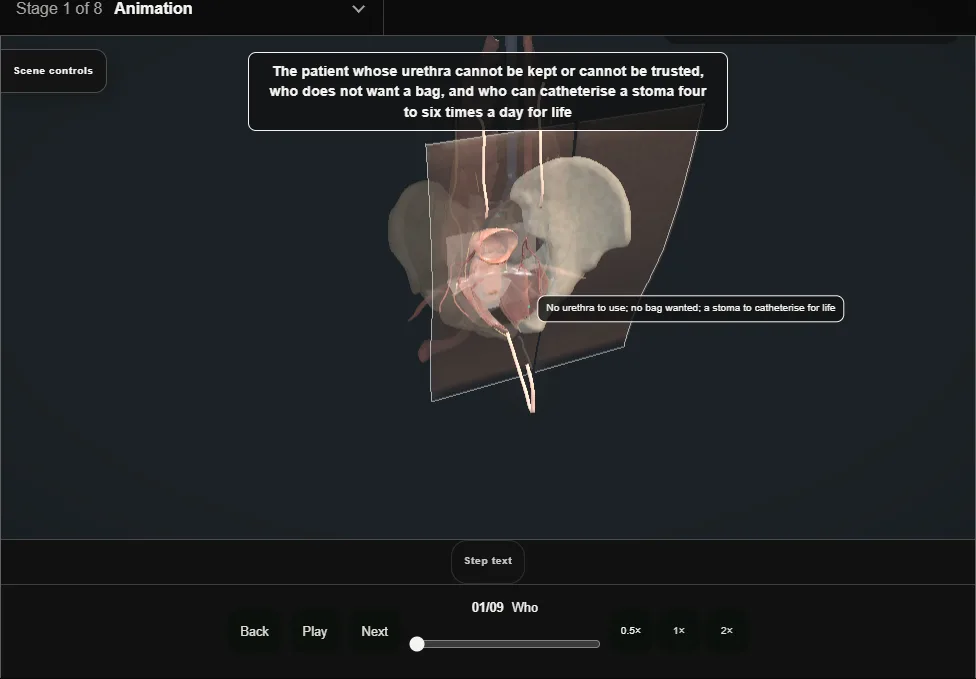
- The patient whose urethra cannot be kept or trusted, who does not want a bag, and who can catheterise a stoma four to six times a day for life.
- Kidneys that can take the reabsorption; no colonic disease; hands that work.
- 02
The right colon and terminal ileum
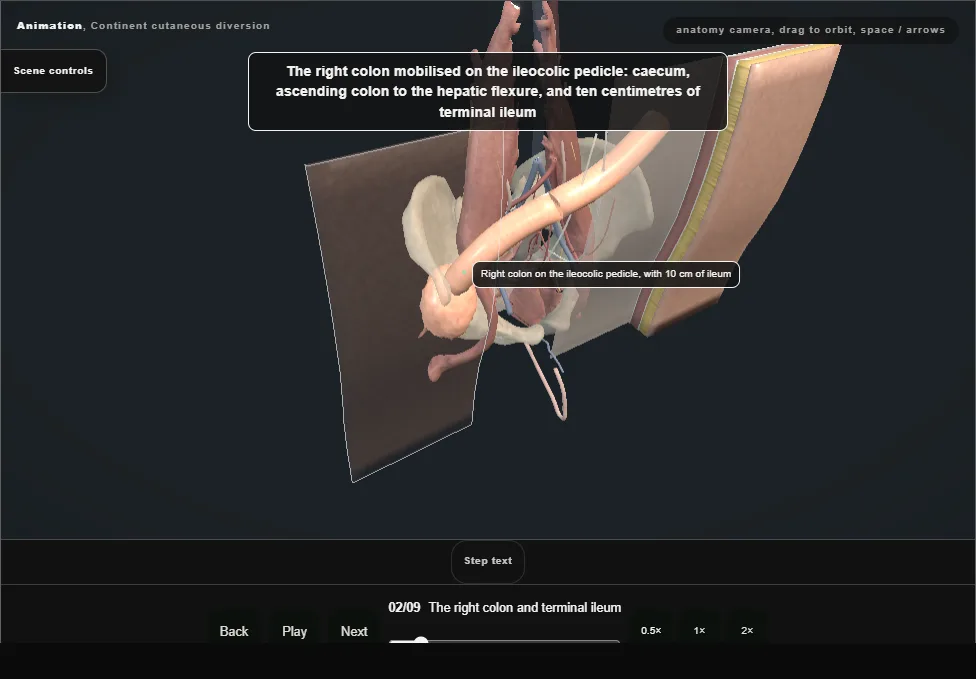
- Caecum and ascending colon to the hepatic flexure with ten centimetres of terminal ileum, mobilised on the ileocolic pedicle.
- The bowel rejoined, ileum to transverse colon, and the mesenteric window closed.
- 03
Opening the colon along its taenia
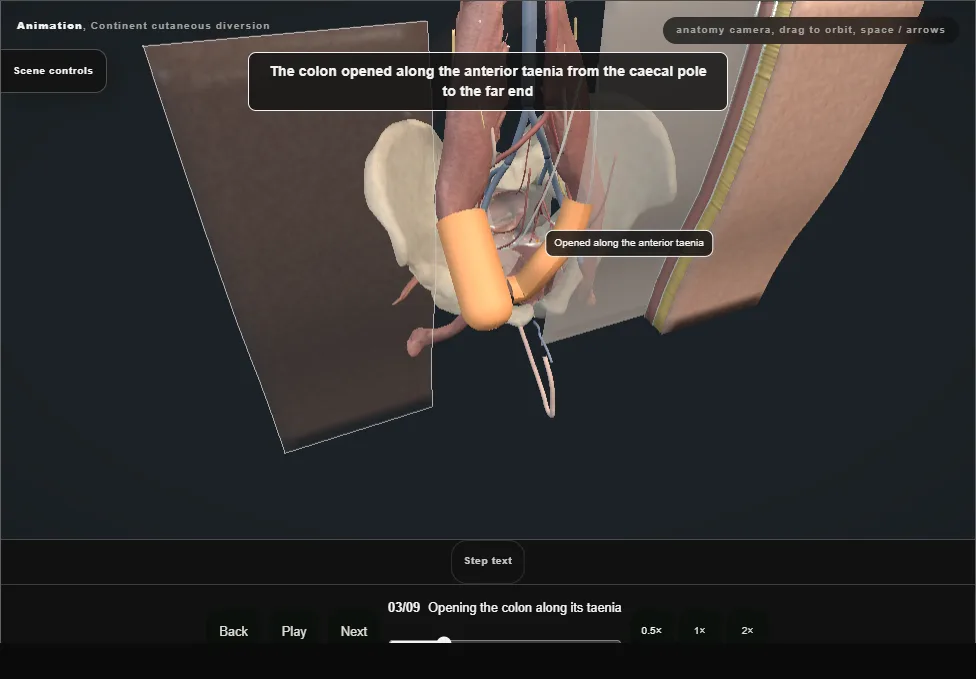
- Opened along the anterior taenia from the caecal pole to the far end.
- A tube that would contract as a ring becomes a sheet that cannot.
- 04
Folding and closing the reservoir
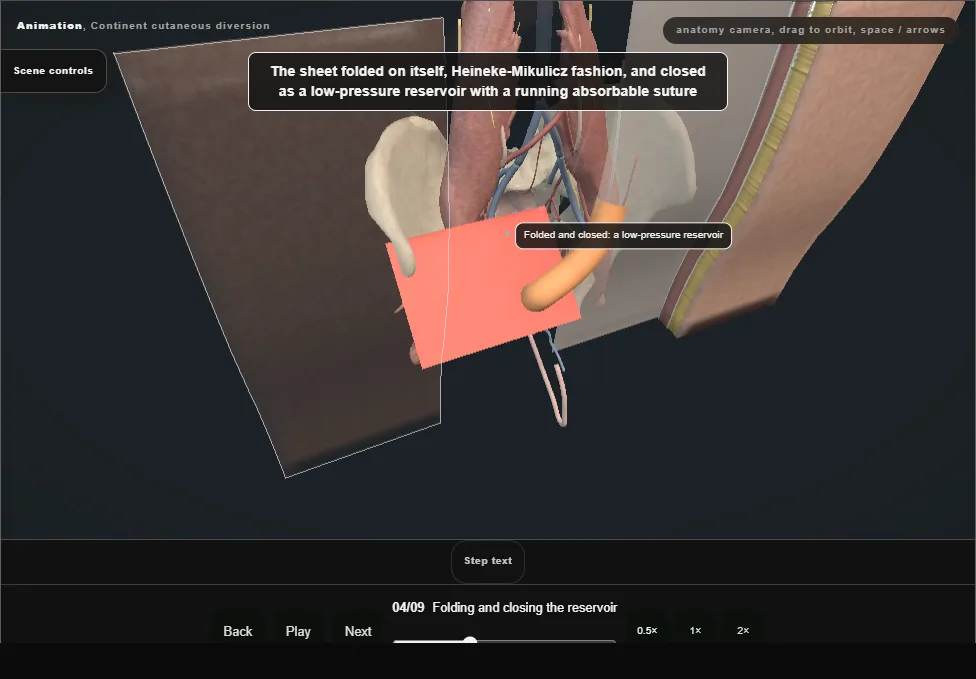
- The sheet folded on itself and closed as a low-pressure reservoir with a running absorbable suture.
- The ileocaecal valve is kept: it is the reservoir end of the continence mechanism.
- 05
The continence mechanism
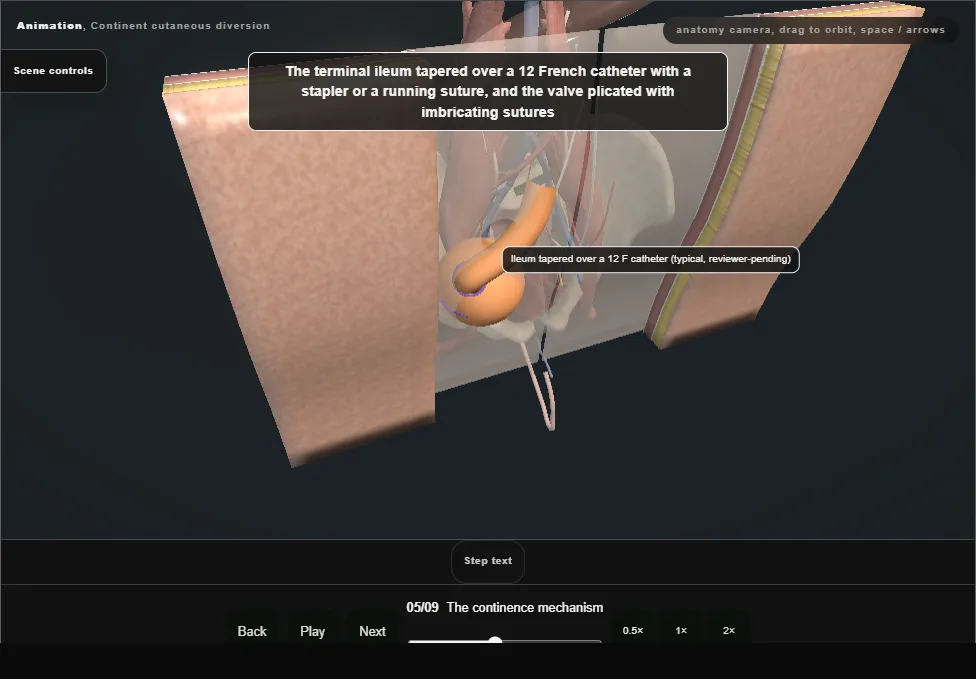
- The terminal ileum tapered over a 12 French catheter and the valve plicated with imbricating sutures: a narrow limb of even calibre that a catheter passes without a catch and that the full pouch presses shut.
- 06
The ureters into the reservoir
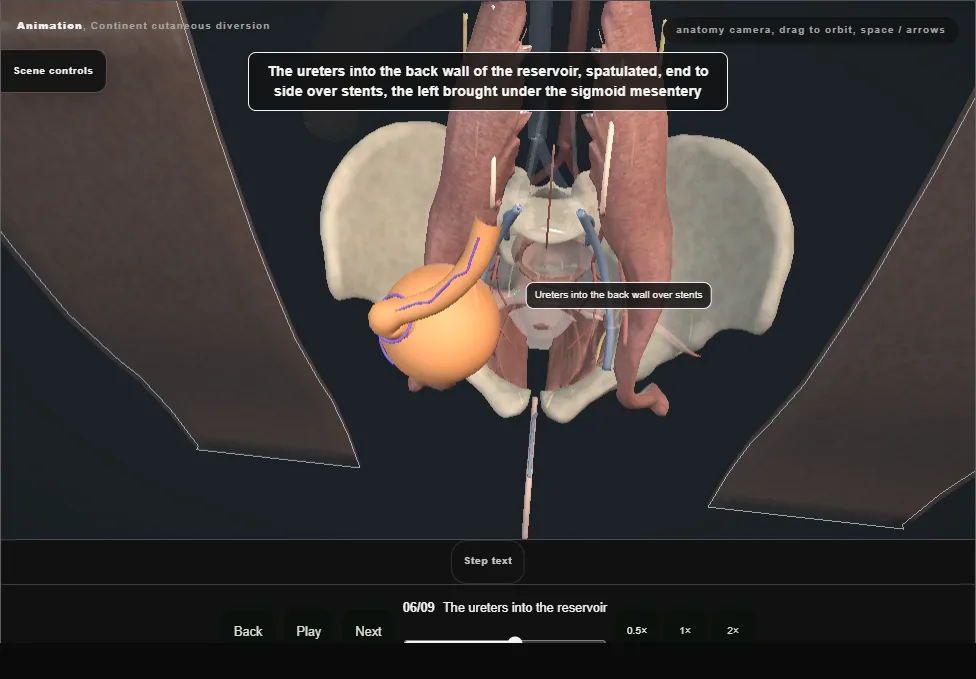
- Into the back wall, spatulated, end to side over stents, the left brought under the sigmoid mesentery.
- Joined directly here (some centres tunnel them under the taenia): reflux into a low-pressure pouch matters less than a stricture.
- 07
The stoma
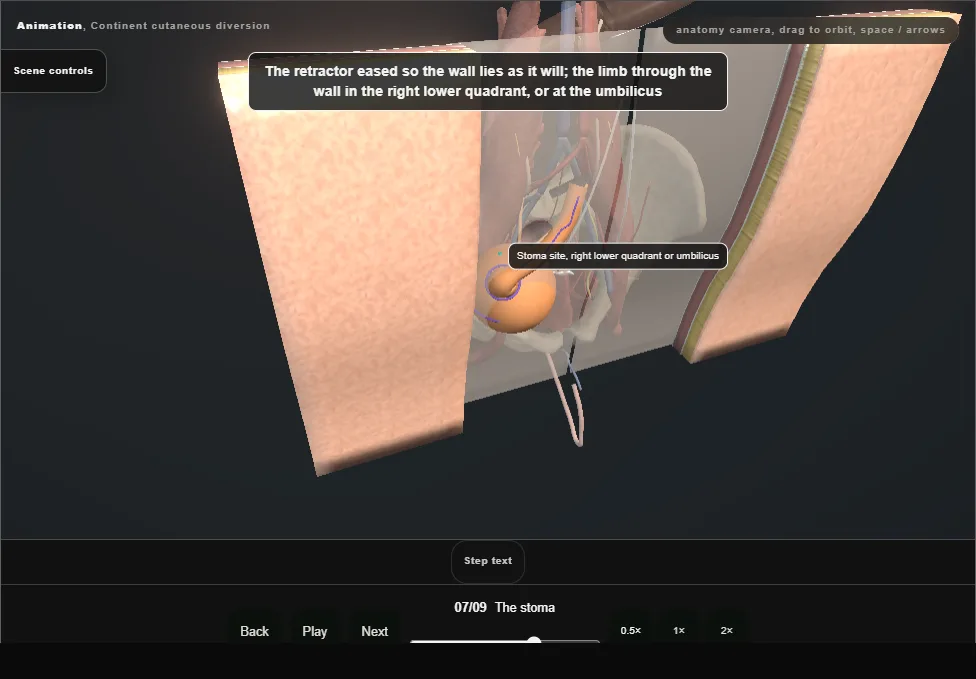
- The retractor eased so the wall lies as it will; the limb through the wall in the right lower quadrant or at the umbilicus and matured flush: no bud, nothing for a bag.
- The limb runs straight from pouch to skin without a bend a catheter would have to negotiate.
- 08
Catheters, stents, drains, irrigation
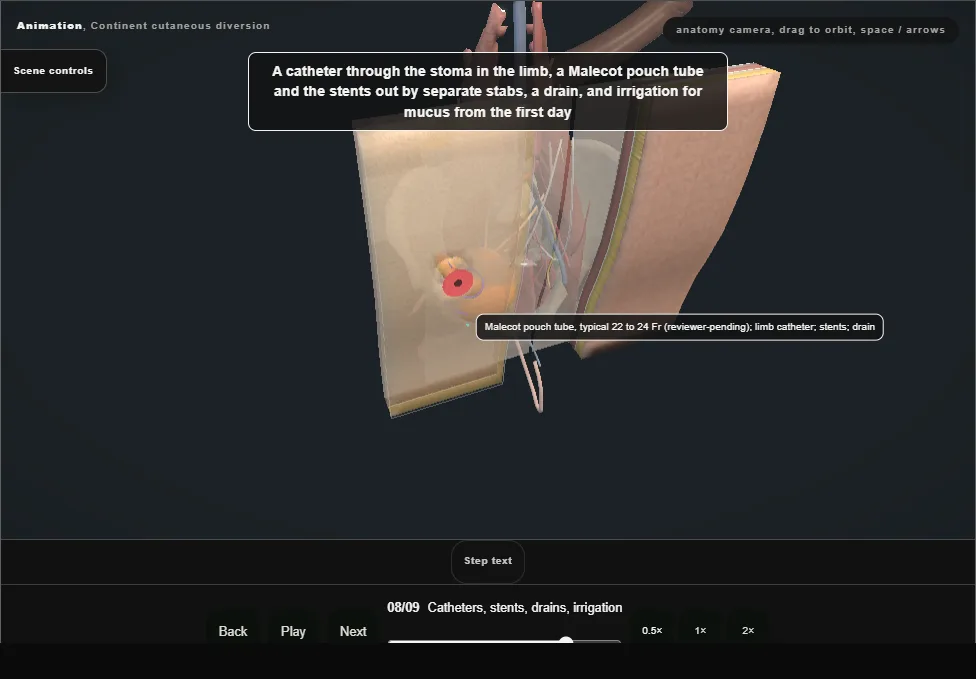
- A catheter through the stoma in the limb, a Malecot pouch tube and the stents out through the pouch wall by separate stabs, a drain, and irrigation for mucus from day one.
- A pouchogram at three weeks before the tubes come out.
- 09
After
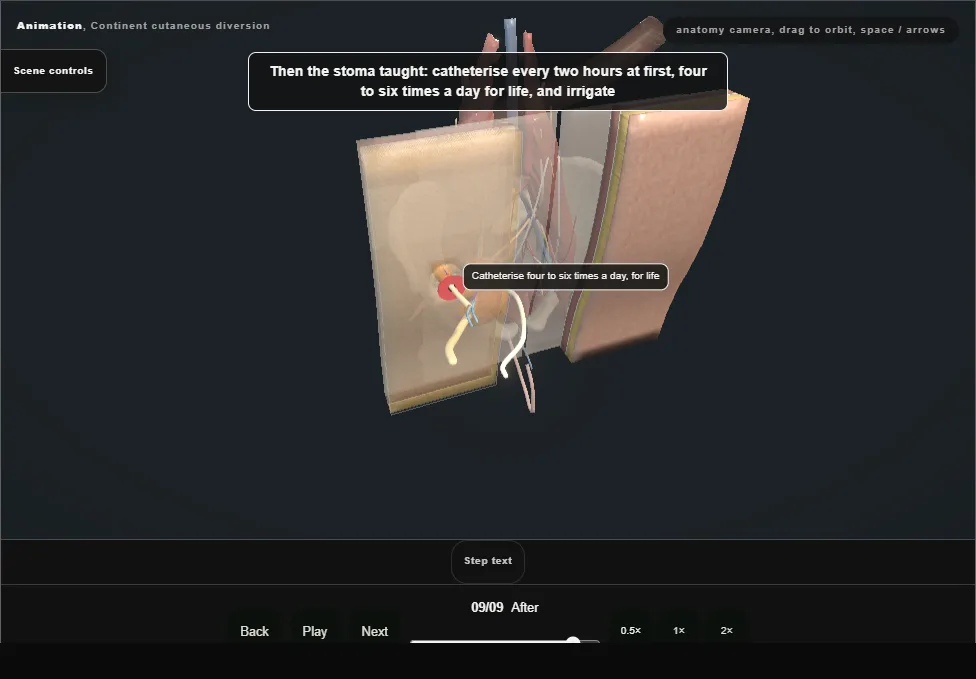
- The stoma taught: every two hours at first, four to six times a day for life, and irrigated.
- Lifelong bicarbonate, B12, kidneys, stones in the pouch, and the stoma that starts to catch.
Derived from pelvis/ContinentDiversionScene.tsx at build time: every step title and caption above is the authored
ProcedureDef text, reproduced verbatim, and this page shares its readable-points renderer with the animation
itself. 9 of 9 steps have a captured frame.
Text fingerprint 212d54764ff28694. A caption edit without a re-capture fails the production
check, so the sheet and the animation cannot drift apart silently.