
Continent cutaneous urinary diversion
Creation of a low-pressure internal bowel reservoir emptied by intermittent catheterisation through a continent abdominal stoma.
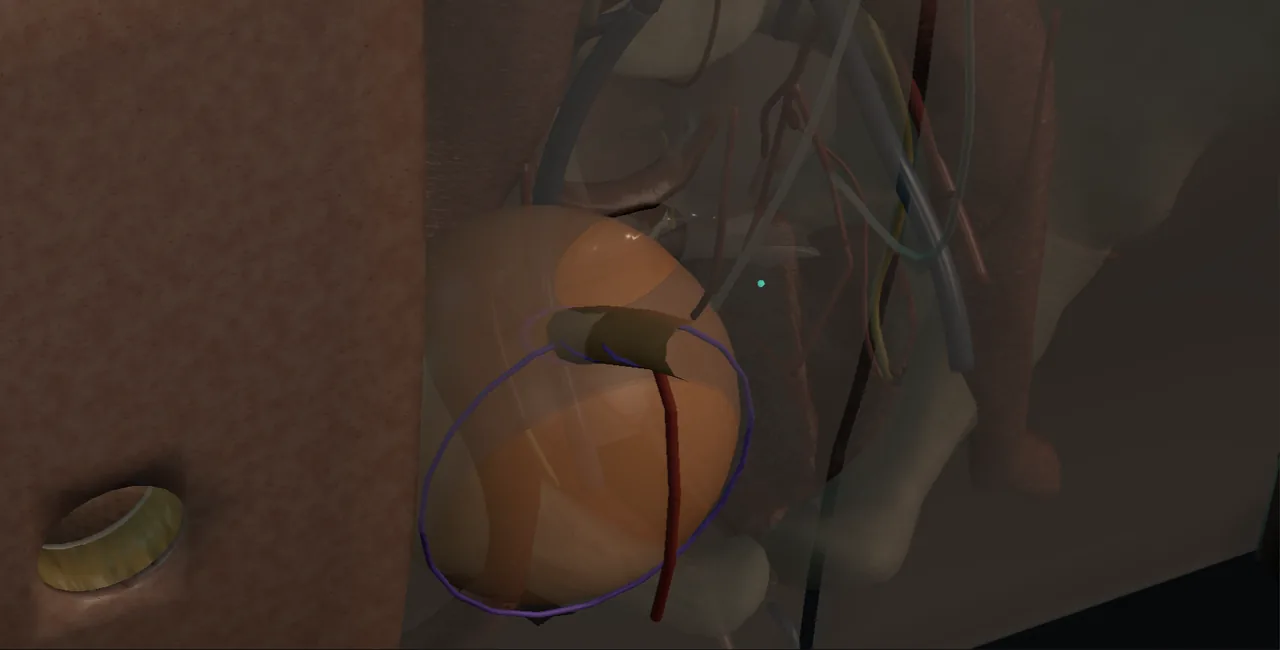 Interactive 3D Interactive Indiana pouch construction Open the 3D animation
Teaching catalogue only. This coverage record is not a patient pathway or operative instruction.
Typical place in practice
Selected patients requiring urinary diversion who can reliably catheterise and accept the metabolic, stone, mucus and revision burdens of a continent reservoir.
Alternatives and neighbouring procedures
Ileal conduit, orthotopic neobladder, ureterostomy, long-term catheter drainage or no extirpative surgery where appropriate.
Same procedure family, explicit technique branches
These are variations of this canonical operation. Complication modules below identify whether they apply to all branches or only to named approaches.
Ileo-colonic reservoir
Creates an Indiana- or Miami-type pouch using an ileocaecal continence mechanism.
Ileal continent reservoir
Uses ileum for both storage and continence.
Reservoir with appendix/Monti channel
Uses a tailored channel when native bowel valve anatomy is unsuitable.
Reservoir revision
Treats leakage, stenosis, stones, perforation, reflux or difficult catheterisation.
High-level sequence
Coverage outline only; not a step-by-step technical guide.
- Confirm catheterisation ability, renal function and bowel suitability
- Isolate and detubularise the selected bowel segment
- Create a compliant reservoir and reliable continence mechanism
- Implant ureters and mature an accessible catheterisable stoma
- Teach irrigation/catheterisation and establish lifelong renal, metabolic and structural follow-up
Every failure mode is its own module.
Timing and variation coverage are recorded for each module.
Bowel leak, obstruction or intra-abdominal sepsis
Bowel isolation and anastomosis carry immediate and adhesive late risks.
Applies to: All variantsUrinary leak or reservoir perforation
Anastomotic failure can occur early, while a mature reservoir can rupture years later.
Applies to: All variantsStomal or channel stenosis and catheterisation failure
Narrowing, angulation, false passage or valve failure can threaten dependable emptying.
Applies to: All variantsReservoir or stomal incontinence
High pressure or failure of the continence mechanism can cause leakage.
Applies to: All variantsUreteroenteric stricture and renal deterioration
Ischaemic anastomotic scarring can silently obstruct an upper tract.
Applies to: All variantsInfection, mucus obstruction or stones
Bowel mucus, bacteriuria, foreign material and incomplete emptying promote blockage and calculi.
Applies to: All variantsMetabolic, nutritional or drug-handling disturbance
Urine–bowel contact changes acid-base balance and solute handling.
Applies to: All variantsMalignancy in the reservoir or anastomosis
Bowel incorporated into the urinary tract carries a long-term tumour surveillance consideration.
Applies to: All variantsSources for this module
Radical cystectomy, lymph-node dissection and urinary diversion.
Accessed 2026-08-03 · opens source European Association of Urology EAU Guidelines on Neuro-urologyBotulinum toxin, sphincterotomy, neuromodulation, augmentation and diversion.
Accessed 2026-08-03 · opens source British Association of Urological Surgeons Patient information leaflets by procedureUK patient-facing procedure, alternatives, recovery and complication framing.
Accessed 2026-08-03 · opens source