
Complex ureteric replacement
Tertiary reconstruction for long or multifocal ureteric loss using graft augmentation, appendix, bowel substitution or renal autotransplantation.
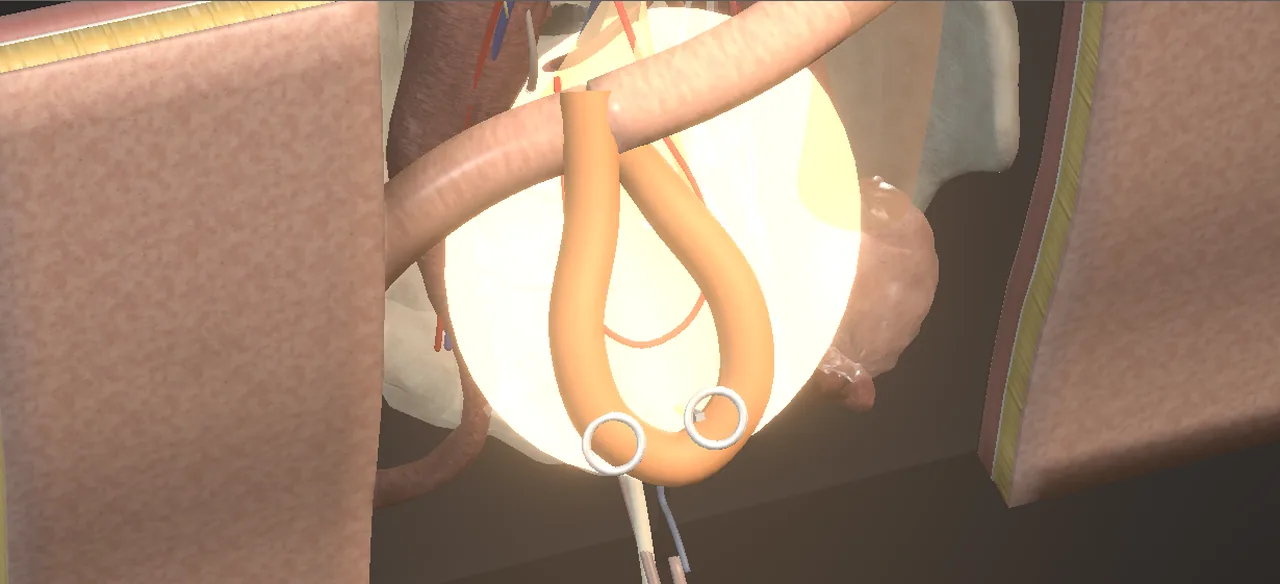 Interactive 3D Interactive ileal ureter Open the 3D animation 3D Interactive ureterolysis
Teaching catalogue only. This coverage record is not a patient pathway or operative instruction.
Typical place in practice
Extensive benign stricture or ureteric loss not bridgeable by reimplantation, psoas hitch, Boari flap or short ureteroureterostomy.
Alternatives and neighbouring procedures
Chronic stent or nephrostomy, nephrectomy in a poorly functioning unit, transureteroureterostomy, or urinary diversion.
Same procedure family, explicit technique branches
These are variations of this canonical operation. Complication modules below identify whether they apply to all branches or only to named approaches.
Buccal mucosal graft ureteroplasty
Widens a selected long stricture while preserving the native ureteric plate.
Appendiceal interposition or onlay
Uses appendix for selected right- or occasionally left-sided defects.
Ileal ureter substitution
Replaces a long ureteric segment with small bowel.
Renal autotransplantation
Shortens the required urinary reconstruction by relocating the kidney.
Combined or bilateral substitution
Addresses exceptional multifocal or bilateral disease.
High-level sequence
Coverage outline only; not a step-by-step technical guide.
- Define stricture length, renal function, bowel suitability and prior treatment
- Preserve drainage while planning the simplest durable replacement
- Expose viable proximal and distal urinary tract with blood supply preserved
- Create a tension-free watertight graft, conduit or transplanted reconstruction
- Monitor leak, obstruction, infection, renal function and metabolic consequences
Operative notes
Concise operative notes covering the key steps, landmarks and watch points, in the order you encounter them.
Ureteric rebuild - the ladder
What it does: 4 ways to bridge a missing ureter length.
1: reimplant, short low gaps
- Cut out the diseased end. Fill the bladder.
- Cut 3 cm through bladder muscle only.
- Open mucosa at the far end.
- Lay the spatulated ureter in.
- Close muscle over it. That tunnel stops reflux.
- Catheter 7-10 days.
2: psoas hitch, gains 5-8 cm
- Free the bladder: cut the OPPOSITE side umbilical artery, +/- superior vesical.
- Oblique cut across the bladder top.
- Finger inside pushes bladder up to psoas.
- 3-6 stitches, vertical, into psoas tendon. Vertical misses the nerve along psoas. Shallow misses the leg nerves.
- Hitch BEFORE joining, or the ureter kinks.
- Stent out 7-14 days.
3: Boari flap, gains 12-15 cm
- Bladder flap on a pedicle (superior vesical artery). Base 4 cm wide. Tip 3 cm. Length = gap + 3-4 cm.
- Fix tip to psoas.
- Ureter through the back of the flap. Spatulate.
- Join mucosa to mucosa, 4/0. No tension.
- Roll the flap closed over a catheter.
- Cystogram at 2 weeks. Then catheter out.
4: ileal ureter / kidney swap
- Know the concept only. Full-length gaps.
From the UroRef Operative Quick Guide. Open the note page →
Retroperitoneal fibrosis surgery
What it does: free ureters trapped in scar behind the bowel.
- Stent both ureters first. Marks and protects.
- Both sides, even if 1 is blocked.
- Midline cut. Peritoneum opened between duodenum and the inferior mesenteric vein.
- Find ureters high up. Dilated. Not yet in scar.
- Sharp, then blunt, freeing of the whole segment.
- Biopsy the scar. Exclude lymphoma, cancer.
- Then either: tuck the ureters inside the tummy, or move them sideways with fat between, or wrap each in omentum. (Omentum = the stomach's fatty apron. Free it off the colon, split in the midline.)
From the UroRef Operative Quick Guide. Open the note page →
Every failure mode is its own module.
Timing and variation coverage are recorded for each module.
Urinary leak or fistula
Long reconstruction and substitution-tissue joins create several potential leakage points.
Applies to: All variantsRecurrent stricture, kinking or obstruction
Anastomotic scarring, graft contraction or conduit geometry can impair drainage.
Applies to: All variantsInfection or sepsis
Devices, stasis, bowel colonisation and leakage can produce systemic infection.
Applies to: All variantsBowel leak, obstruction or nutritional impact
Bowel isolation adds anastomotic, adhesive and absorption consequences.
Applies to: Ileal ureter substitution · Combined or bilateral substitutionMucus, stone or metabolic disturbance
Urine contact with bowel causes mucus production and solute exchange.
Applies to: Ileal ureter substitution · Combined or bilateral substitutionGraft contraction or oral donor-site morbidity
Substitution mucosa can contract, while harvest causes pain, numbness or tightness.
Applies to: Buccal mucosal graft ureteroplastyVascular thrombosis and renal loss
Autotransplant introduces arterial and venous anastomoses whose failure can sacrifice the kidney.
Applies to: Renal autotransplantationReduced renal function or nephrectomy
Persistent obstruction, infection or vascular injury can defeat the nephron-preserving objective.
Applies to: All variantsSources for this module
Renal, ureteric, bladder, urethral and genital trauma and reconstruction.
Accessed 2026-08-03 · opens source European Association of Urology EAU Guidelines on Urethral StricturesDilatation, DVIU, anastomotic, graft, flap, staged and perineal procedures.
Accessed 2026-08-03 · opens source British Association of Urological Surgeons Patient information leaflets by procedureUK patient-facing procedure, alternatives, recovery and complication framing.
Accessed 2026-08-03 · opens source