
Adrenalectomy
Open and minimally invasive removal of an adrenal gland or selected lesion, with hormonal preparation, laterality and oncological exposure retained as distinct pathways.
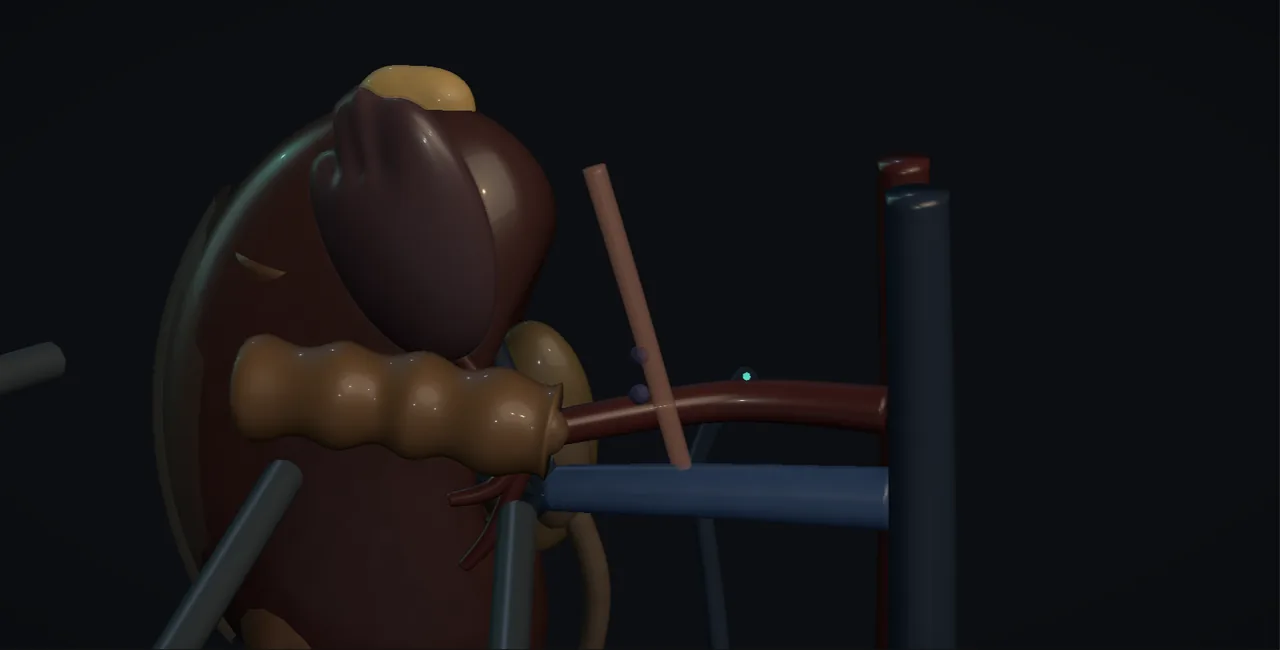 Interactive 3D Interactive laparoscopic adrenalectomy Open the 3D animation
Teaching catalogue only. This coverage record is not a patient pathway or operative instruction.
Typical place in practice
A functioning adrenal lesion, suspicious or malignant tumour, symptomatic mass, or selected metastasis after endocrine and oncological assessment.
Alternatives and neighbouring procedures
Observation or surveillance, medical endocrine control, image-guided treatment in selected disease, or systemic oncological management.
Same procedure family, explicit technique branches
These are variations of this canonical operation. Complication modules below identify whether they apply to all branches or only to named approaches.
Laparoscopic transperitoneal adrenalectomy
Uses broad abdominal landmarks and early adrenal-vein control.
Posterior retroperitoneoscopic adrenalectomy
Avoids the peritoneal cavity and may suit selected smaller lesions or bilateral procedures.
Robotic adrenalectomy
Facilitates fine dissection in selected anatomy.
Open oncological adrenalectomy
Provides en bloc access for large, invasive or suspected malignant disease.
Cortical-sparing partial adrenalectomy
Preserves adrenal cortex in selected hereditary, bilateral or solitary-gland scenarios.
High-level sequence
Coverage outline only; not a step-by-step technical guide.
- Confirm endocrine diagnosis and perioperative hormonal plan
- Select approach based on size, laterality, invasion and prior surgery
- Identify surrounding organs and control the adrenal vein safely
- Mobilise the gland or lesion without tumour disruption
- Monitor haemodynamics, endocrine function and pathology outcomes
Operative notes
Concise operative notes covering the key steps, landmarks and watch points, in the order you encounter them.
Laparoscopic setup rules
What it does: safe ports and position, any lap case.
- Hasson first port: open cut-down. Safe. (Veress needle: ~4% problems.)
- Side lying. Break the table under the 12th rib.
- Axillary roll. Pillow between legs. Gel pads.
- Boots and warmer on.
- Ports under vision, camera inside.
- 2026 update: Antibiotics: 1 dose, local policy, allergy aware. The old fixed gent + cefuroxime recipe is gone.
From the UroRef Operative Quick Guide. Open the note page →
Every failure mode is its own module.
Timing and variation coverage are recorded for each module.
Major vascular bleeding
Short adrenal veins and proximity to the vena cava, renal vessels and aorta can produce difficult haemorrhage.
Applies to: All variantsHaemodynamic or endocrine crisis
Hormone release or abrupt hormone deficiency can cause major physiological instability.
Applies to: All variantsPancreatic, splenic, hepatic, bowel or renal injury
The at-risk adjacent organ differs by side and approach.
Applies to: All variantsPleural injury or pneumothorax
High retroperitoneal or posterior dissection can breach the diaphragm or pleura.
Applies to: All variantsAdrenal insufficiency
Insufficient residual cortex or bilateral disease can leave a need for long-term endocrine replacement.
Applies to: Cortical-sparing partial adrenalectomyPositive margin, tumour spill or local recurrence
Oncological quality depends on intact en bloc removal when malignancy is suspected.
Applies to: Open oncological adrenalectomy · Laparoscopic transperitoneal adrenalectomy · Robotic adrenalectomyConversion or access-site complication
Bleeding, invasion or limited working space may require a larger incision and creates port-specific risks.
Applies to: Laparoscopic transperitoneal adrenalectomy · Posterior retroperitoneoscopic adrenalectomy · Robotic adrenalectomySources for this module
Partial and radical nephrectomy, approach selection and renal-tumour ablation.
Accessed 2026-08-03 · opens source British Association of Urological Surgeons Patient information leaflets by procedureUK patient-facing procedure, alternatives, recovery and complication framing.
Accessed 2026-08-03 · opens source