
Surgery for undescended and impalpable testis
Inguinal, scrotal and laparoscopic localisation and fixation pathways for palpable or impalpable undescended testis, including staged vascular strategies.
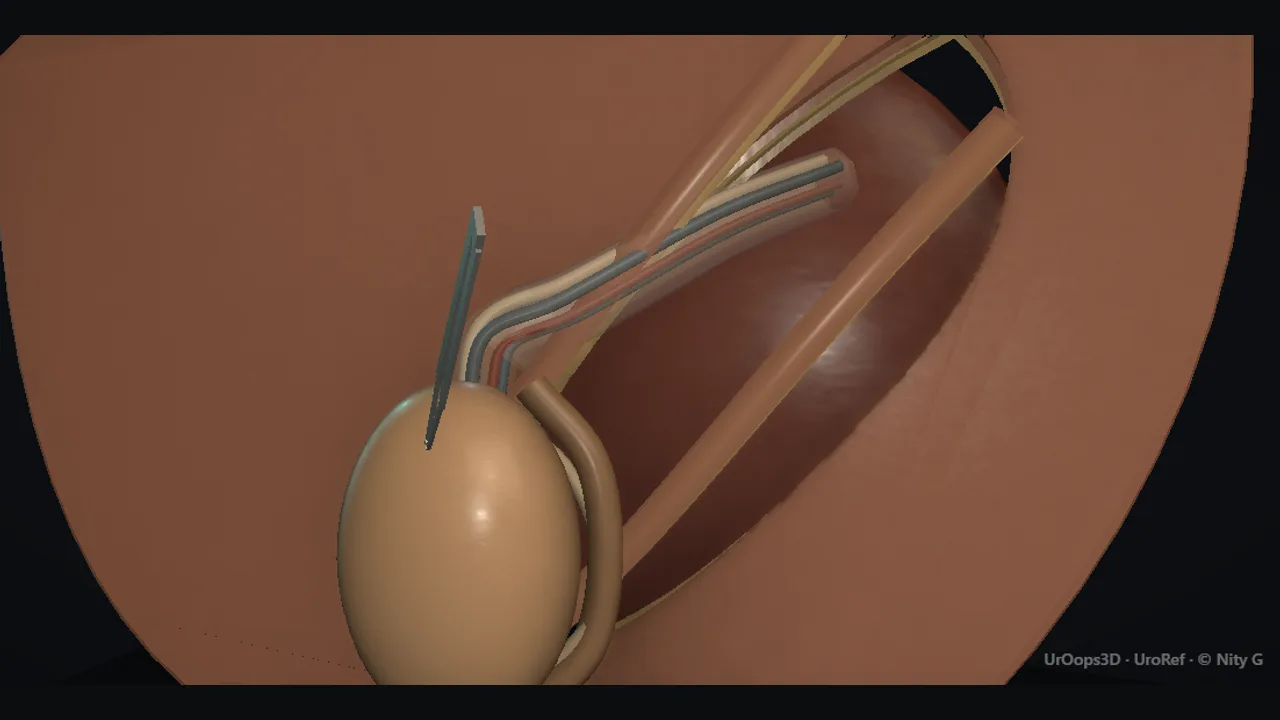 Interactive 3D Interactive operative model Open the 3D animation 3D Interactive inguinal herniotomy in an infant
Teaching catalogue only. This coverage record is not a patient pathway or operative instruction.
Typical place in practice
A testis that has not reached and remained in the scrotum at the recommended treatment stage, or an impalpable testis requiring anatomical definition.
Alternatives and neighbouring procedures
Observation applies to selected retractile testes; orchidectomy or surveillance may be considered for a non-viable remnant or selected post-pubertal anatomy.
Same procedure family, explicit technique branches
These are variations of this canonical operation. Complication modules below identify whether they apply to all branches or only to named approaches.
Inguinal orchidopexy
Mobilises a palpable canalicular testis and closes an associated patent processus vaginalis.
Single scrotal-incision orchidopexy
Treats selected low palpable testes without formal inguinal exposure.
Laparoscopic orchidopexy
Treats an intra-abdominal testis when vessel length permits a direct route.
One- or two-stage Fowler–Stephens pathway
Uses collateral blood supply for a high testis that cannot reach on its native vessels.
Excision of atrophic testis or remnant
Removes non-viable tissue after appropriate assessment and consent.
High-level sequence
Coverage outline only; not a step-by-step technical guide.
- Confirm laterality, palpability and associated anomalies
- Localise testis and define vessels and vas
- Mobilise on the least disruptive vascular strategy
- Create a tension-free dependent scrotal position
- Fix without torsion and monitor growth and position
Every failure mode is its own module.
Timing and variation coverage are recorded for each module.
Testicular atrophy or loss
Vascular compromise can follow dissection, tension, twisting or reliance on inadequate collaterals.
Applies to: All variantsVas deferens or epididymal injury
Congenital elongation or separation can make reproductive structures particularly vulnerable.
Applies to: All variantsHigh position, re-ascent or recurrent torsion
Inadequate length or fixation can compromise durable scrotal placement.
Applies to: All variantsBleeding, infection or hernia
Access wounds and an incompletely treated processus vaginalis can cause routine or approach-specific morbidity.
Applies to: All variantsIntra-abdominal organ or port injury
Abdominal access adds bowel, bladder and vascular risks.
Applies to: Laparoscopic orchidopexy · One- or two-stage Fowler–Stephens pathwayNeed for a second planned or unplanned operation
A staged technique requires completion, and failed position or viability can require revision.
Applies to: One- or two-stage Fowler–Stephens pathwaySources for this module
Common congenital, acute scrotal and paediatric reconstructive procedures.
Accessed 2026-08-03 · opens source British Association of Urological Surgeons Patient information leaflets by procedureUK patient-facing procedure, alternatives, recovery and complication framing.
Accessed 2026-08-03 · opens source