
Deceased-donor kidney and multiorgan retrieval
Coordinated recovery, perfusion and packaging of kidneys from deceased donors, with brain-death, circulatory-death and en bloc graft pathways separated.
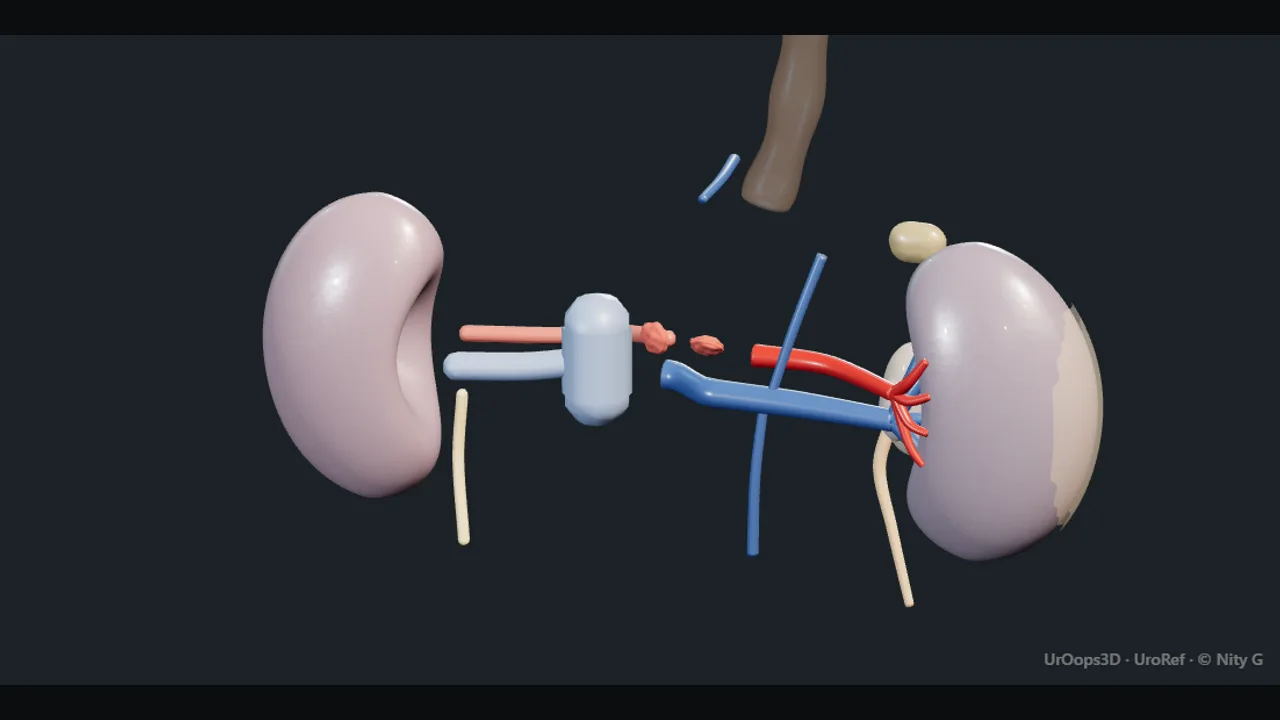 Interactive 3D Interactive deceased-donor kidney retrieval Open the 3D animation
Teaching catalogue only. This coverage record is not a patient pathway or operative instruction.
Typical place in practice
Authorised organ donation after death, undertaken within transplant, legal and allocation governance and coordinated with other organ-retrieval teams.
Alternatives and neighbouring procedures
No retrieval when consent, safety, donor suitability or logistical requirements are not met.
Same procedure family, explicit technique branches
These are variations of this canonical operation. Complication modules below identify whether they apply to all branches or only to named approaches.
Donation after brain death retrieval
Allows planned organ exposure before circulation is stopped.
Donation after circulatory death retrieval
Prioritises rapid preservation after the required death-determination process.
En bloc paediatric kidney retrieval
Preserves small vessels and permits en bloc implantation.
Kidney-only or complex vascular retrieval
Adapts dissection for prior surgery, vascular variation or organ-specific donation.
High-level sequence
Coverage outline only; not a step-by-step technical guide.
- Confirm authorisation, organ plan, anatomy and team roles
- Expose abdominal organs without compromising another graft
- Coordinate perfusion and warm/cold ischaemia milestones
- Recover kidneys with adequate vessels, ureters and peri-ureteric tissue
- Inspect, label, preserve, package and communicate graft findings
Every failure mode is its own module.
Timing and variation coverage are recorded for each module.
Renal artery or vein injury and unusable graft
Unrecognised vascular variation or hurried division can shorten or damage essential vessels.
Applies to: All variantsUreteric devascularisation
Stripping peri-ureteric tissue can cause later transplant ureter necrosis.
Applies to: All variantsInadequate perfusion or prolonged ischaemia
Delay, cannula malposition or flush failure can compromise graft function.
Applies to: All variantsInjury to another donated organ
Multiorgan dissection requires shared planes and explicit coordination.
Applies to: All variantsUnrecognised tumour, infection or anatomical abnormality
Missed donor pathology can affect recipient safety and organ allocation.
Applies to: All variantsIdentification, laterality or packaging error
Chain-of-custody and graft-specific communication are safety-critical procedural elements.
Applies to: All variantsTeam sharps, fluid or occupational exposure
Retrieval conditions can create occupational hazards requiring established protocols.
Applies to: All variants