
Focal ablation for localised prostate cancer
Image-planned focal or whole-gland energy treatment, with high-intensity focused ultrasound and cryotherapy retained as distinct modalities and surveillance treated as mandatory.
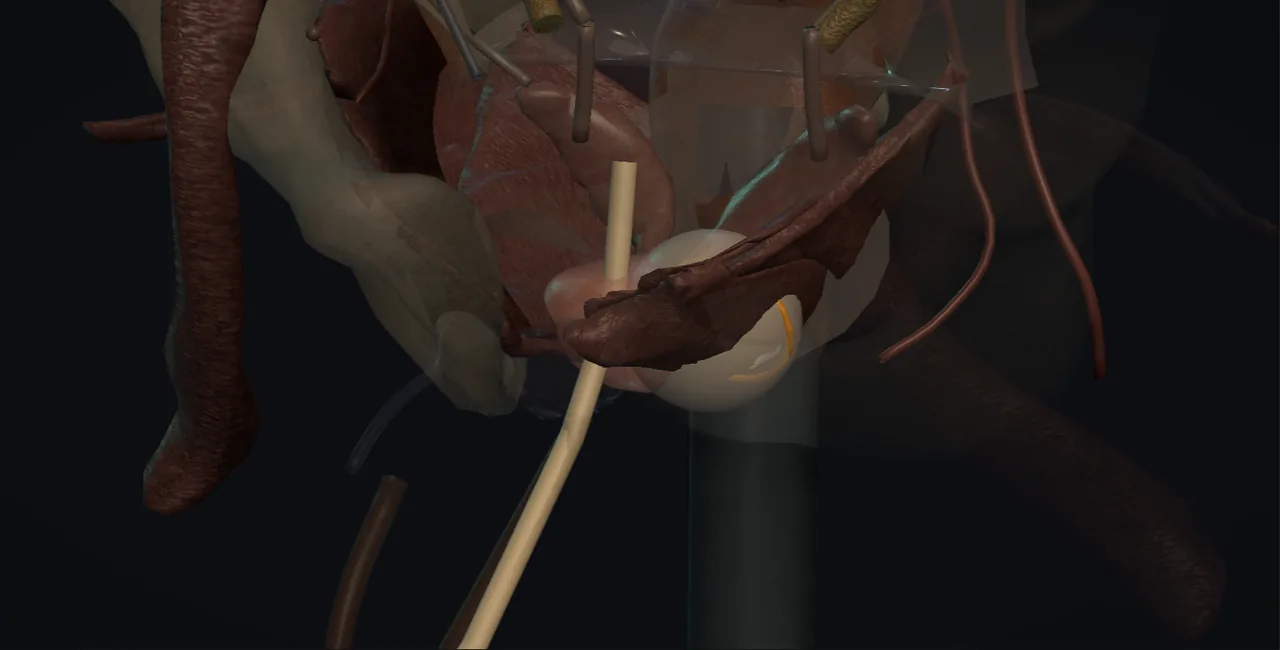 Interactive 3D Interactive focal ablation planning and delivery Open the 3D animation
Teaching catalogue only. This coverage record is not a patient pathway or operative instruction.
Typical place in practice
Selected localised prostate cancer after multiparametric imaging, targeted/systematic biopsy and discussion of the evidence and need for repeat testing.
Alternatives and neighbouring procedures
Active surveillance, radical prostatectomy, radiotherapy, whole-gland ablation in selected contexts, or systemic/palliative care for non-localised disease.
Same procedure family, explicit technique branches
These are variations of this canonical operation. Complication modules below identify whether they apply to all branches or only to named approaches.
Focal HIFU
Thermally ablates an image-defined target with a planned margin.
Whole-gland HIFU
Treats a broader field with a different functional-risk profile.
Focal cryotherapy
Freezes an image-defined region while monitoring the urethra and nearby structures.
Whole-gland cryotherapy
Creates a whole-gland freeze zone and carries broader tissue consequences.
Salvage focal ablation
Treats selected local recurrence in tissue with reduced healing reserve.
High-level sequence
Coverage outline only; not a step-by-step technical guide.
- Confirm disease map, risk category and baseline urinary/sexual function
- Plan the treatment zone and protection of urethra, sphincter, rectum and neurovascular bundles
- Deliver monitored energy to the intended volume
- Assess immediate urinary drainage and adjacent-organ safety
- Undertake scheduled PSA, imaging and repeat-biopsy surveillance
Every failure mode is its own module.
Timing and variation coverage are recorded for each module.
Urinary retention, slough or bladder-outlet obstruction
Tissue swelling and later necrotic debris can obstruct the urethra.
Applies to: All variantsUrinary infection or sepsis
Transrectal/transperineal access and necrotic tissue can become infected.
Applies to: All variantsRectourethral fistula or rectal injury
Energy spread into the rectal wall can cause a severe delayed fistula.
Applies to: All variantsUrethral stricture or bladder-neck stenosis
Thermal or cold injury can heal by fibrosis.
Applies to: All variantsUrinary incontinence
Sphincter or outlet injury can cause stress or urgency leakage.
Applies to: All variantsErectile or ejaculatory dysfunction
Neurovascular and gland treatment can alter erection, ejaculation and fertility.
Applies to: All variantsResidual, recurrent or out-of-field cancer
Focal treatment does not remove the gland and depends on rigorous whole-gland surveillance.
Applies to: All variantsSalvage-healing complication
Previously irradiated or ablated tissue has greater risks of necrosis, fistula and poor healing.
Applies to: Salvage focal ablationSources for this module
Radical prostatectomy, lymph-node dissection and selected focal-treatment context.
Accessed 2026-08-03 · opens source British Association of Urological Surgeons Patient information leaflets by procedureUK patient-facing procedure, alternatives, recovery and complication framing.
Accessed 2026-08-03 · opens source